Stock Analysis · Alpha Metallurgical Resources Inc (AMR)
Overview
Alpha Metallurgical Resources is a U.S. coal producer focused mainly on metallurgical coal, the type of coal used to make steel. That is an important distinction: this is not primarily a utility coal business tied to electricity demand. Its mines are concentrated in Central Appalachia, especially in Virginia and West Virginia, and the company sells coal to steelmakers and coke producers in the United States and overseas.
The business model is fairly straightforward. Alpha extracts coal, processes it, and sells it under contracts and spot arrangements. Results depend heavily on how much coal it ships, the quality mix of those shipments, and above all the market price of metallurgical coal. Because steel production is cyclical, Alpha’s earnings can swing sharply from one year to the next.
Based on recent annual filings, revenue is overwhelmingly tied to coal sales, with metallurgical coal representing the dominant share. A simple breakdown is:
- Metallurgical coal: about 90% to 95% of revenue. This includes higher-grade coals used in blast furnace steelmaking and related blends sold to domestic and export customers.
- Thermal and other coal sales: about 5% to 10% of revenue. This is the smaller legacy portion tied to coal used for power generation or lower-value industrial uses.
- Other revenue: very limited. This can include handling, transportation-related items, or minor ancillary activities, but it is not a major earnings driver.
Geographically, the company has meaningful export exposure, which matters because seaborne metallurgical coal prices often drive profitability more than U.S. conditions alone. In strong coal markets, this export mix can lift margins quickly. In weak markets, the same exposure can amplify downside.
Over the last few years, the income profile has changed dramatically. Revenue and profit surged during the 2022 coal price spike, then normalized sharply afterward. More recently, the business moved from very high profitability toward much thinner results and even losses as pricing weakened. That pattern captures the essence of Alpha: potentially very cash-generative at the top of the cycle, but highly exposed when the market turns.
The profit structure shows how cyclical the company is. Revenue stayed above $2 billion in recent years, but operating income fell from an exceptional peak in 2022 to a loss in 2025 as gross profit nearly disappeared. Operating overhead stayed relatively controlled, so the main driver of the swing was pricing and margin compression rather than runaway administrative costs.
Key Figures
| Metric | Value | Sector ⓘ |
|---|---|---|
| Date | Oct 03, 2026 | |
| Context | ||
| Sector | Basic Materials | |
| Industry | Coking Coal | |
| Market Cap ⓘ | $2.10B | |
| Beta ⓘ | 0.70 | |
Value (Cheapness) | ||
| P/E Ratio ⓘ | N/A | 17.61 |
| P/B Ratio ⓘ | 1.43 | 1.77 |
| FCF Yield ⓘ | -0.07% | 5.87% |
| Dividend Yield ⓘ | N/A | 2.06% |
| EBIT / EV ⓘ | -3.46% | 6.43% |
| PEG ⓘ | N/A | |
Growth (Business expansion) | ||
| Revenue Growth ⓘ | -10.40% | 11.30% |
| RPS Growth (5Y CAGR) ⓘ | 8.17% | 4.46% |
| EPS Growth (5Y CAGR) ⓘ | N/A | -13.11% |
| BVPS Growth (5Y CAGR) ⓘ | 42.33% | 5.51% |
| Margin Growth (5Y Trend) ⓘ | -19.99% | -1.57% |
| FCF Growth (5Y CAGR) ⓘ | -33.64% | 0.55% |
| DPS Growth (5Y CAGR) ⓘ | -53.91% | 6.02% |
Quality (Business durability) | ||
| ROIC (Latest) ⓘ | -3.41% | 9.31% |
| ROA (Latest) ⓘ | -2.00% | 4.94% |
| ROIC (5Y Median) ⓘ | 40.23% | 7.91% |
| ROA (5Y Median) ⓘ | 16.33% | 3.93% |
| Net Debt / EBIT (Latest) ⓘ | N/A | 1.40 |
| Net Debt / EBIT (5Y Median) ⓘ | -0.24 | 1.70 |
| Net Debt / EBITDA (Latest) ⓘ | -2.71 | 0.91 |
| Net Debt / Assets ⓘ | -13.13% | 13.69% |
| EBITDA / Interest ⓘ | 33.10 | 11.93 |
| Operating Margin (Latest) ⓘ | -3.28% | 13.07% |
| Operating Margin (5Y Median) ⓘ | 16.02% | 11.86% |
| Debt to Equity (Latest) ⓘ | 0.76% | 40.43% |
| Profit Margin (Latest) ⓘ | -2.23% | 6.57% |
| Free Cash Flow (Latest) ⓘ | -$1.45M | |
Momentum (Price trend) | ||
| 3Y Return ⓘ | -35.11% | +65.06% |
| 12M Return (excl. last month) ⓘ | +57.99% | +36.05% |
| 6M Return ⓘ | -18.05% | +1.89% |
| Price vs. 200-Day MA ⓘ | -11.34% | +1.03% |
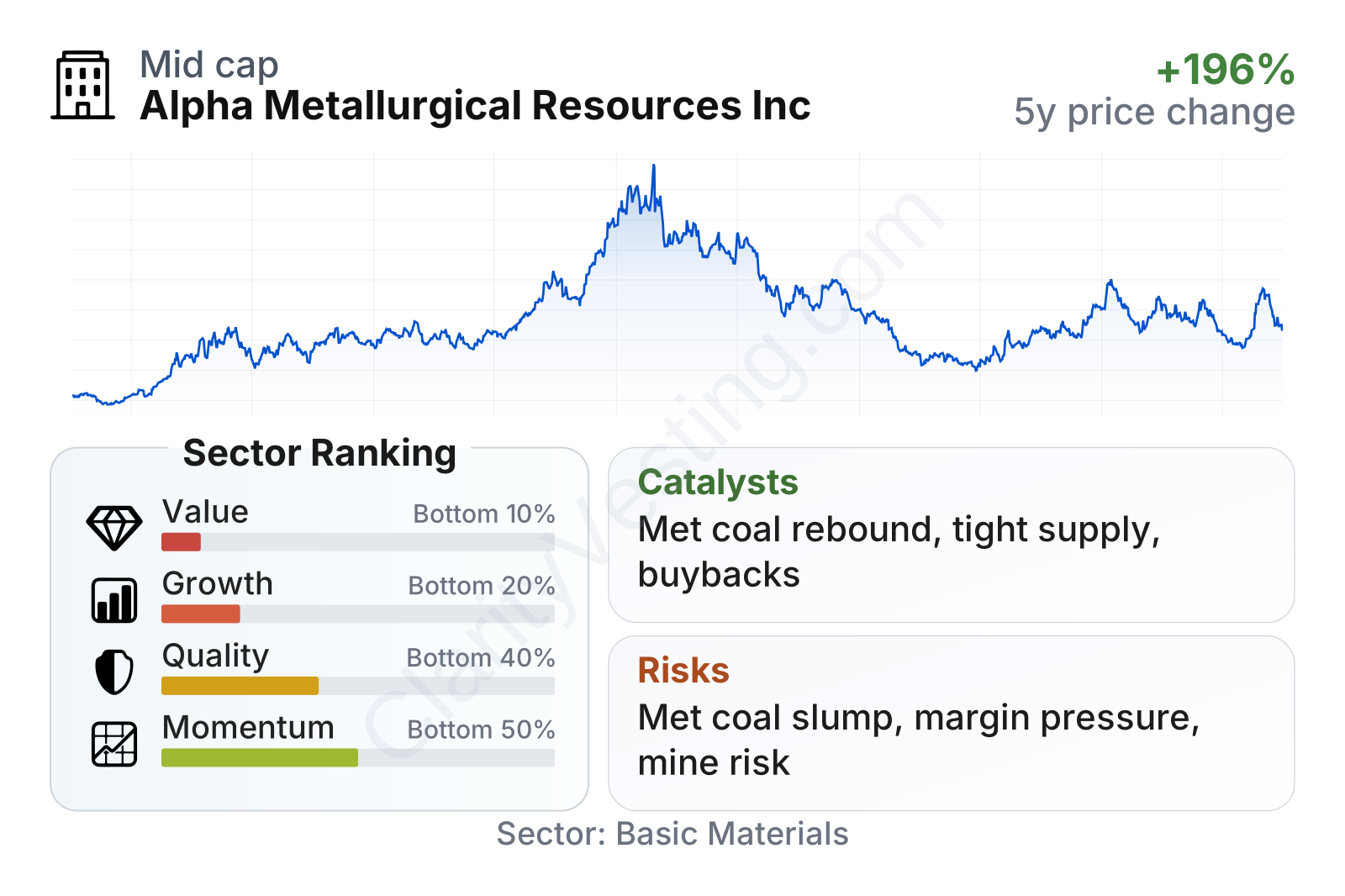
Alpha is now a mid-sized materials company with a stock that has been extremely volatile over the past several years. The market profile is unusual: leverage is very low and the balance sheet remains one of the cleaner ones in the sector, but recent value, growth, and quality metrics look weak because profits have dropped sharply from prior highs. In other words, the company still carries the financial imprint of a strong cycle, while current earnings reflect a much weaker part of that cycle.
The table also highlights a split picture versus the broader sector. Long-term book value growth has been strong, and the company’s historical returns on capital were excellent during the boom years. But trailing profitability, cash generation, and year-over-year growth have deteriorated enough to place Alpha near the lower end of the sector on several current measures.
Growth
Alpha operates in a sector that is mature rather than structurally fast-growing. Metallurgical coal does not have the same long-term demand concerns as thermal coal because it is tied to steelmaking, and primary steel production still depends heavily on blast furnaces in many regions. That gives the business a clearer industrial role than power coal producers. Still, it is not a classic secular growth industry. Long-term demand depends on global steel output, infrastructure activity, and the pace at which electric arc furnaces and alternative ironmaking methods gain share.
For Alpha specifically, the growth case is less about opening a brand-new market and more about capturing strong cash flows when steelmaking coal prices are favorable, maintaining a disciplined cost base, and preserving flexibility through the cycle. The company’s strategy has generally emphasized high-quality metallurgical coal, export positioning, and tight capital discipline rather than aggressive expansion. That approach makes sense in a commodity industry where overspending at the top of the cycle often destroys value later.
Recent revenue trends show clear pressure. After extraordinary growth during the commodity upswing, year-over-year sales turned negative and remained under strain into 2026. The pace of decline appears less extreme than at the worst point of the downturn, but the company is still dealing with a much softer pricing and earnings environment than it had two to three years ago.
Cash generation tells a similar story. Free cash flow was very strong during the peak period, then contracted sharply as coal prices normalized. The latest trailing figure is around break-even to slightly negative, which suggests the company is no longer benefiting from the pricing tailwind that made it so profitable earlier in the cycle. For a long-term view, the key question is whether current weakness is only cyclical or whether it reflects a lower structural earnings base.
The most relevant catalyst remains a recovery in seaborne metallurgical coal prices, especially if steel production improves in key import markets. Another possible support is supply discipline across the industry: metallurgical coal is harder to replace quickly than many commodities, and permitting new mines in the U.S. is difficult. If supply stays constrained while global steel demand steadies, producers like Alpha can see earnings rebound quickly without needing major new investment.
Recent company updates have also pointed to continued focus on shareholder returns and disciplined capital allocation when cash flow allows. That is meaningful because Alpha does not need heavy balance-sheet repair anymore; if the market improves, more of the upside can potentially flow to equity holders rather than creditors.
Risks
This article is for informational purposes only and does not constitute financial advice. Some content is AI-generated. See Disclaimer