Stock Analysis · Amprius Technologies Inc (AMPX)
Overview
Amprius Technologies is an advanced battery company focused on lithium-ion cells that use silicon anode technology. In simple terms, the company is trying to make batteries that store more energy for their weight and charge faster than conventional lithium-ion batteries. That matters most in applications where every pound counts, such as drones, defense systems, high-altitude platforms, aviation, and eventually electric mobility markets that need very high performance.
The business model is still centered on selling battery cells and battery packs rather than generating broad recurring service revenue. Based on the company’s recent filings, revenue is primarily tied to product sales, with a smaller contribution from development-related work and customer-funded programs when those occur. Amprius is still at an early commercialization stage, so customer concentration and timing of shipments can make revenue mix swing sharply from one period to another.
The main revenue sources appear to be:
- Battery product sales: approximately the large majority of revenue. This includes high-energy and high-power lithium-ion cells, battery packs, and related deliveries to customers in aviation, unmanned systems, and defense-oriented uses.
- Development and other commercial work: a smaller and variable share. This can include engineering support, qualification activity, and customer-specific programs tied to battery adoption.
What stands out is that Amprius is not a broad, diversified industrial company. It is a specialized battery developer and manufacturer trying to convert technical advantages into scaled commercial demand. Revenue has expanded quickly in recent years, but the company is still in the phase where production buildout and customer qualification matter as much as reported sales.
The long-term picture shows a business that has moved from very small revenue and deeply negative gross profit to meaningfully higher sales and a turn to positive gross profit in 2025. Even so, operating expenses remain heavy, especially as the company invests in scaling, commercialization, and technology development.
Key Figures
| Metric | Value | Sector ⓘ |
|---|---|---|
| Date | Oct 17, 2026 | |
| Context | ||
| Sector | Industrials | |
| Industry | Electrical Equipment & Parts | |
| Market Cap ⓘ | $1.25B | |
| Beta ⓘ | 2.35 | |
Value (Cheapness) | ||
| P/E Ratio ⓘ | N/A | 22.10 |
| P/B Ratio ⓘ | 9.14 | 1.97 |
| FCF Yield ⓘ | -4.67% | 6.38% |
| Dividend Yield ⓘ | N/A | 1.94% |
| EBIT / EV ⓘ | -2.87% | 4.79% |
| PEG ⓘ | N/A | |
Growth (Business expansion) | ||
| Revenue Growth ⓘ | 125.90% | 9.30% |
| RPS Growth (5Y CAGR) ⓘ | 114.94% | 7.81% |
| EPS Growth (5Y CAGR) ⓘ | -18.40% | -13.06% |
| BVPS Growth (5Y CAGR) ⓘ | 56.96% | 6.14% |
| Margin Growth (5Y Trend) ⓘ | N/A | 0.88% |
| FCF Growth (5Y CAGR) ⓘ | N/A | 11.01% |
| DPS Growth (5Y CAGR) ⓘ | N/A | 9.48% |
Quality (Business durability) | ||
| ROIC (Latest) ⓘ | -27.36% | 10.84% |
| ROA (Latest) ⓘ | -25.13% | 5.41% |
| ROIC (5Y Median) ⓘ | -41.41% | 9.38% |
| ROA (5Y Median) ⓘ | -38.53% | 4.95% |
| Net Debt / EBIT (Latest) ⓘ | N/A | 2.08 |
| Net Debt / EBIT (5Y Median) ⓘ | N/A | 2.27 |
| Net Debt / EBITDA (Latest) ⓘ | N/A | 1.39 |
| Net Debt / Assets ⓘ | -45.68% | 19.28% |
| EBITDA / Interest ⓘ | N/A | 9.58 |
| Operating Margin (Latest) ⓘ | -35.50% | 10.50% |
| Operating Margin (5Y Median) ⓘ | -357.00% | 10.29% |
| Debt to Equity (Latest) ⓘ | 5.08% | 65.48% |
| Profit Margin (Latest) ⓘ | -33.40% | 6.67% |
| Free Cash Flow (Latest) ⓘ | -$58.44M | |
Momentum (Price trend) | ||
| 3Y Return ⓘ | +129.23% | +61.68% |
| 12M Return (excl. last month) ⓘ | +12.79% | +12.58% |
| 6M Return ⓘ | -55.28% | 0.00% |
| Price vs. 200-Day MA ⓘ | -40.51% | +0.02% |
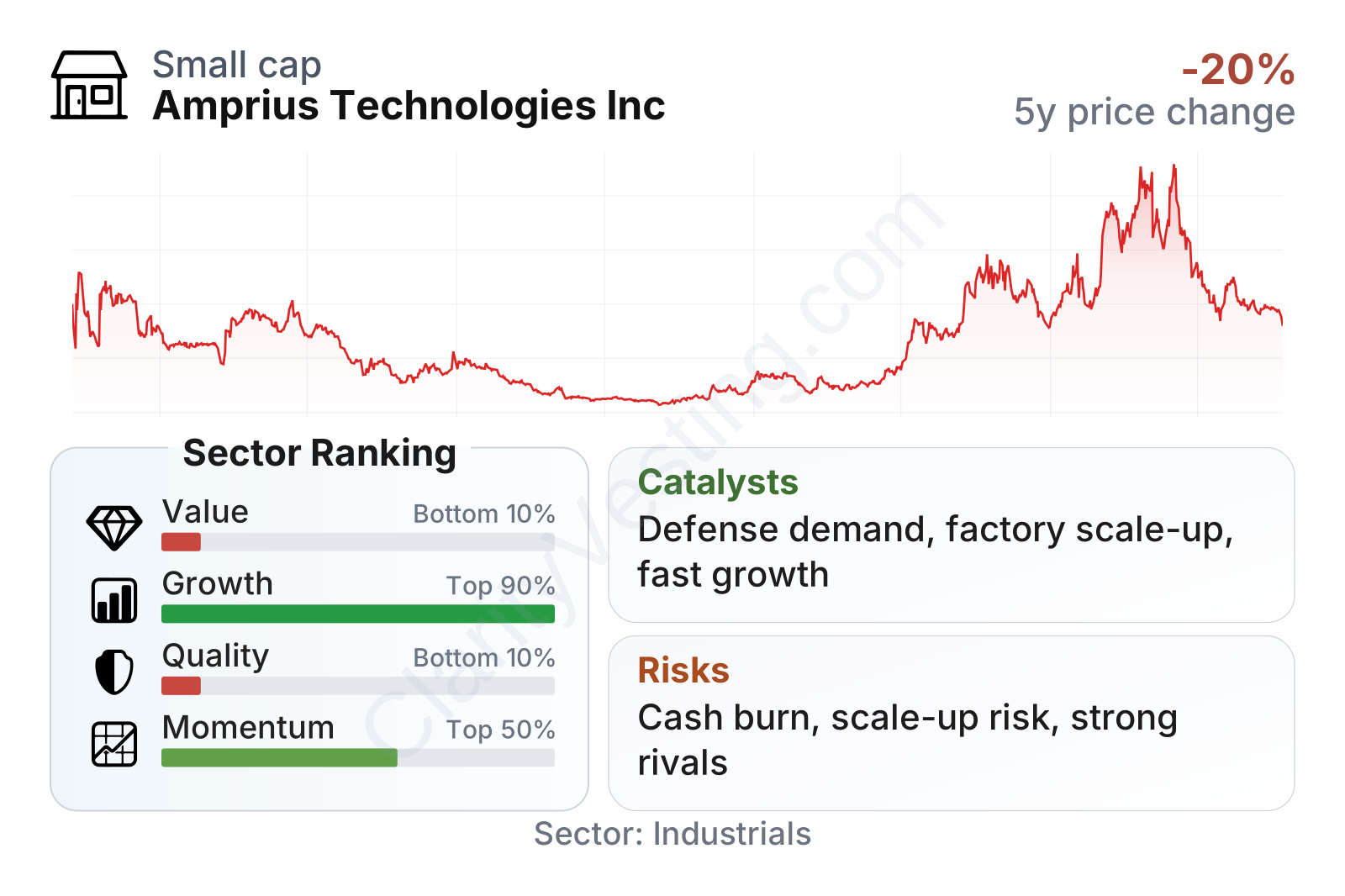
Amprius screens as a high-growth but low-profitability company. Growth measures rank near the top of its sector, helped by revenue expansion that is far above the industry median. On the other hand, value and quality measures rank near the bottom because the company is still loss-making, free cash flow remains negative, and the stock trades at a high multiple of book value. The market is clearly pricing in future potential rather than present earnings strength.
The stock’s trading history also shows unusually high volatility. After a steep decline through 2023 and 2024, shares rebounded sharply in 2025 and then pulled back again in 2026. That pattern fits the profile of an early-stage industrial technology company where sentiment can swing quickly with new contracts, production milestones, or financing developments.
Growth
Amprius operates in a sector with real structural tailwinds. Demand for lighter, faster-charging, higher-energy batteries is rising across drones, defense, aviation, and specialized mobility applications. These are not commodity markets where the lowest-cost battery always wins. In several of Amprius’s target niches, performance can matter more than price, which creates room for premium products if the company can deliver at scale and with consistent reliability.
The company’s strategy is logical for that market. It is focusing first on applications where its silicon anode cells can solve a difficult engineering problem, especially weight and endurance constraints. That is generally a more realistic path than immediately competing head-on in mass-market electric vehicles against giant battery manufacturers with much lower production costs.
Recent revenue growth has been exceptionally strong, including multiple periods of triple-digit year-over-year expansion. Even after that surge, growth remains well above the sector norm. This supports the idea that Amprius is moving from pilot-stage commercialization toward a more visible revenue base, although the business is still small enough that individual orders can heavily influence the trend.
A major growth catalyst is manufacturing scale. The company has emphasized expanding production capacity through contract manufacturing and its planned large-scale domestic facility strategy. If management can convert technical performance into repeatable high-volume output, the addressable opportunity becomes much larger. Public company communications have also highlighted customer engagement in defense and aviation-adjacent markets, which is important because these segments can reward high energy density and fast charging more readily than mainstream battery categories.
Another encouraging sign is the improvement in gross profit profile. The company moved from negative gross profit in earlier years to positive gross profit in 2025, suggesting that commercialization is progressing beyond pure development work. That does not mean the business is close to full profitability, but it does indicate that the core product economics may be improving as shipments rise.
The main limitation is that growth still consumes cash. Free cash flow remains clearly negative and has worsened again over the last year, reflecting investment in working capital, operations, and expansion. For a company at this stage, strong revenue growth is useful only if it eventually leads to operating leverage and a more durable cash profile.
Recent corporate announcements have reinforced the opportunity set around next-generation batteries, including progress on production readiness, customer deliveries, and partnerships intended to support larger-scale manufacturing. Those developments matter because for Amprius, future growth depends not only on having promising cell chemistry but on proving that it can manufacture enough of it at commercial quality.
Risks
This article is for informational purposes only and does not constitute financial advice. Some content is AI-generated. See Disclaimer


