Stock Analysis · Amphastar P (AMPH)
Overview
Amphastar Pharmaceuticals is a specialty pharmaceutical company focused on complex generic and proprietary injectable, inhalation, and intranasal products. In simple terms, it makes medicines that are often harder to manufacture than standard pills, including hospital products, emergency treatments, and certain branded therapies. The company also develops active pharmaceutical ingredients and runs manufacturing operations that support both its own products and selected partners.
Its revenue base is fairly concentrated in a limited number of products, which is common in specialty pharma. Based on recent annual filings, the main sources of revenue are approximately:
- BAQSIMI and other glucagon-related products: about 25% to 30% of revenue. This includes the acquired nasal glucagon franchise used for severe hypoglycemia.
- Enoxaparin: about 20% to 25%. This is an injectable anticoagulant used in hospitals and other care settings.
- Primatene MIST: about 10% to 15%. This is an over-the-counter inhalation product for mild asthma symptoms.
- Naloxone products: about 10% to 15%. These products are used to reverse opioid overdose and include both prescription and public-health related demand.
- Corticotropin and other branded or specialty products: around 5% to 10%, depending on period and launch progress.
- Other injectable and inhalation medicines, APIs, and manufacturing services: roughly 20% to 30% combined.
The business mix matters because Amphastar is not a broad-based pharmaceutical giant. It is a smaller healthcare company whose results can move meaningfully when one product gains share, faces price pressure, or meets a supply disruption. At the same time, its focus on technically demanding products can create better margins than many commodity generic drug makers.
Over the last several years, revenue expanded strongly through 2024, while profitability also improved. In 2025, sales leveled off and earnings came under pressure, suggesting the company is now in a transition phase after a period of unusually strong momentum. That makes product depth and execution more important than before.
The overall financial picture shows a business that scaled up well from 2021 to 2024, with operating income and net income rising faster than revenue for much of that stretch. In 2025, revenue was broadly stable to slightly lower while expenses increased, which reduced earnings. That pattern suggests Amphastar still has a profitable core, but recent margin pressure needs to be watched closely.
Key Figures
| Metric | Value | Sector ⓘ |
|---|---|---|
| Date | Oct 17, 2026 | |
| Context | ||
| Sector | Healthcare | |
| Industry | Drug Manufacturers - Specialty & Generic | |
| Market Cap ⓘ | $1.11B | |
| Beta ⓘ | 0.90 | |
Value (Cheapness) | ||
| P/E Ratio ⓘ | 15.43 | 24.79 |
| P/B Ratio ⓘ | 1.52 | 3.08 |
| FCF Yield ⓘ | 13.78% | 3.15% |
| Dividend Yield ⓘ | N/A | 1.94% |
| EBIT / EV ⓘ | 8.77% | 0.57% |
| PEG ⓘ | 2.77 | |
Growth (Business expansion) | ||
| Revenue Growth ⓘ | 5.40% | 7.45% |
| RPS Growth (5Y CAGR) ⓘ | 14.15% | 8.61% |
| EPS Growth (5Y CAGR) ⓘ | -12.00% | -17.81% |
| BVPS Growth (5Y CAGR) ⓘ | 16.28% | 3.72% |
| Margin Growth (5Y Trend) ⓘ | 1.29% | -0.62% |
| FCF Growth (5Y CAGR) ⓘ | 14.50% | 1.04% |
| DPS Growth (5Y CAGR) ⓘ | 81.28% | 6.77% |
Quality (Business durability) | ||
| ROIC (Latest) ⓘ | 7.07% | 3.24% |
| ROA (Latest) ⓘ | 4.61% | 3.01% |
| ROIC (5Y Median) ⓘ | 14.48% | 4.60% |
| ROA (5Y Median) ⓘ | 10.32% | 1.89% |
| Net Debt / EBIT (Latest) ⓘ | 3.63 | 1.34 |
| Net Debt / EBIT (5Y Median) ⓘ | 2.27 | 1.84 |
| Net Debt / EBITDA (Latest) ⓘ | 2.43 | 1.00 |
| Net Debt / Assets ⓘ | 26.65% | 5.45% |
| EBITDA / Interest ⓘ | 7.32 | 9.64 |
| Operating Margin (Latest) ⓘ | 17.55% | 9.27% |
| Operating Margin (5Y Median) ⓘ | 23.63% | 7.38% |
| Debt to Equity (Latest) ⓘ | 89.61% | 28.58% |
| Profit Margin (Latest) ⓘ | 10.76% | 3.59% |
| Free Cash Flow (Latest) ⓘ | $152.89M | |
Momentum (Price trend) | ||
| 3Y Return ⓘ | -43.15% | +42.80% |
| 12M Return (excl. last month) ⓘ | -13.31% | +18.50% |
| 6M Return ⓘ | +21.86% | +7.57% |
| Price vs. 200-Day MA ⓘ | +18.33% | +5.12% |
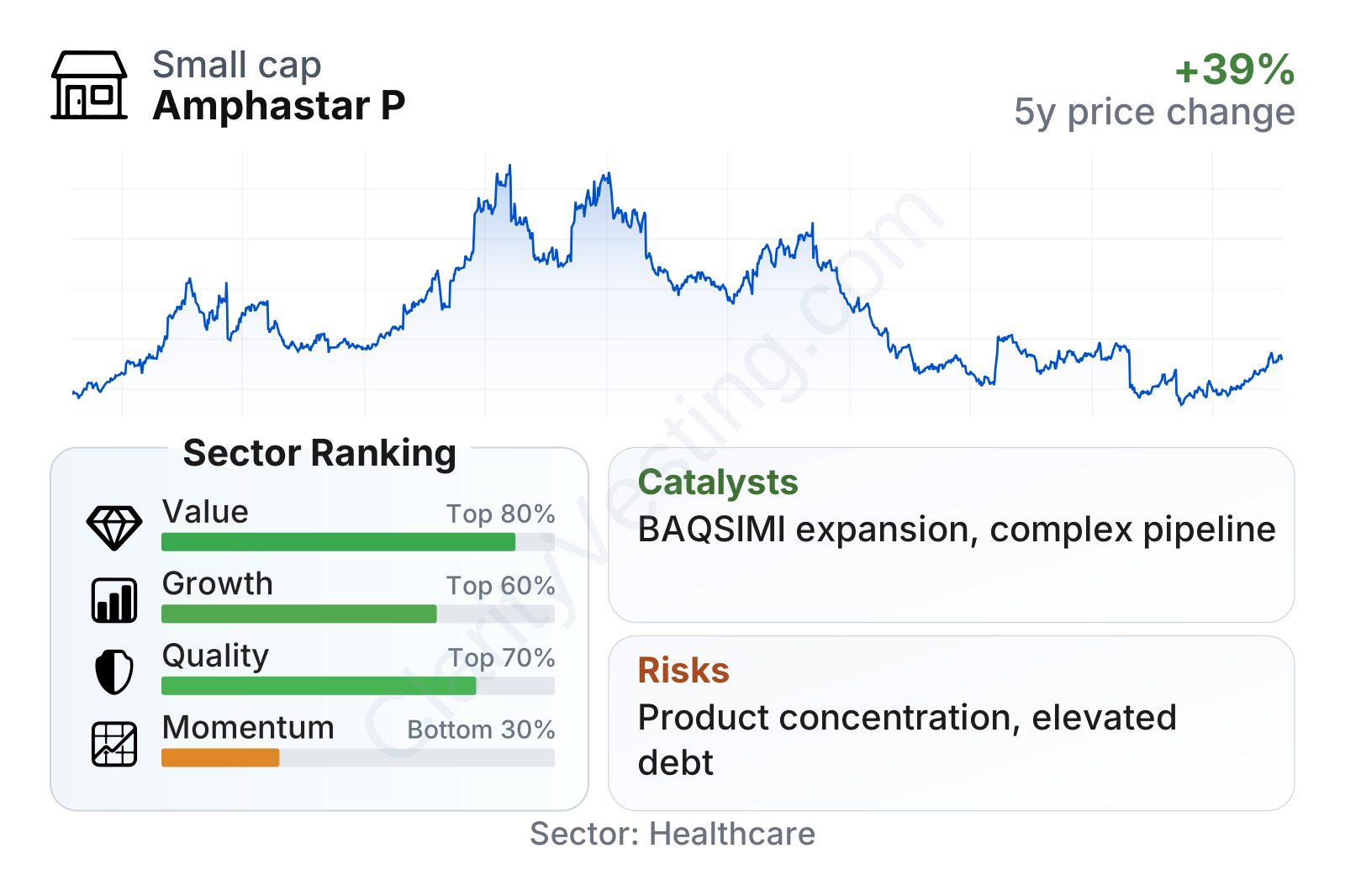
Amphastar sits in the small-cap range, which usually means more upside from successful products but also more volatility when growth slows. On valuation, the company looks cheaper than the typical healthcare peer on earnings and book value, while its free cash flow yield stands out as particularly strong. Quality is also solid overall: returns on capital and operating margins are above sector norms. Growth is more mixed, with a healthy five-year expansion record but slower recent revenue progress. Market performance has been weak over the past three years, although shorter-term price action has improved.
Growth
Amphastar operates in a healthcare niche that still has room for long-term expansion. Demand for complex injectables, respiratory products, emergency-use medicines, and drug-device combinations is supported by aging populations, chronic disease, hospital use, and public-health needs. These are not fad-driven markets. They tend to reward manufacturing know-how, regulatory experience, and the ability to reliably supply difficult products.
The company’s strategy also makes sense on paper. Rather than competing only in highly commoditized generic tablets, Amphastar focuses on harder-to-make formulations and delivery systems where fewer rivals can operate efficiently. Its acquisition of BAQSIMI broadened the business toward branded diabetes rescue therapy, while its internal pipeline includes complex generic and specialty candidates that could diversify revenue over time.
Revenue growth was very strong through 2023 and remained positive in 2024, but the pace slowed sharply in 2025 before turning modestly positive again in the most recent period. That trend suggests the earlier growth surge has matured, and the next phase likely depends more on launches, market share gains, and product mix rather than simple carryover momentum.
Cash generation remains one of the more constructive parts of the case. Free cash flow stayed strong even after the operating slowdown, which gives Amphastar flexibility to support product development, manufacturing investment, and debt management. Over a five-year view, its cash flow growth has been well ahead of the sector median, a useful sign for a company in a capital-intensive part of healthcare.
Recent company updates have pointed to continuing commercial emphasis on BAQSIMI, progress in specialty and complex generic products, and ongoing work to expand the development pipeline. One of the more important potential growth drivers is whether newer or acquired products can reduce dependence on a few legacy medicines. If that happens, Amphastar could become less cyclical within its niche and more resilient from year to year.
Risks
This article is for informational purposes only and does not constitute financial advice. Some content is AI-generated. See Disclaimer


