Stock Analysis · AMN Healthcare Services Inc (AMN)
Overview
AMN Healthcare Services Inc is a healthcare workforce solutions company. In simple terms, it helps hospitals, clinics, and other care providers find medical professionals when they need them, whether for short-term staffing gaps, permanent hiring, executive recruiting, or technology-based workforce management. The business is closely tied to labor shortages in healthcare, which makes AMN an important intermediary between healthcare providers and clinicians.
Its revenue mainly comes from staffing and related services sold to healthcare organizations. Based on the company’s recent reporting structure, the business is largely organized around three main sources:
- Nurse and allied solutions: typically the largest revenue contributor, generally around 50% to 60% of total revenue in recent periods. This includes travel nurses, allied health professionals such as imaging and laboratory staff, and labor disruption staffing.
- Physician and leadership solutions: generally around 20% to 30% of revenue. This segment includes locum tenens physicians, advanced practice professionals, permanent physician placement, and leadership search.
- Technology and workforce solutions: generally around 15% to 25% of revenue. This includes vendor management systems, scheduling, language services, analytics, and other software-enabled services that help clients manage staffing more efficiently.
The mix matters because AMN is not just a traditional staffing agency. The more it expands in technology and managed services, the more it can deepen client relationships and potentially reduce dependence on the most volatile parts of temporary staffing demand.
Over the last few years, the business has gone through a major normalization. Revenue and profit surged during the pandemic-era staffing shortage, then declined as emergency demand faded and bill rates came down. The long-term question is whether AMN can stabilize at a healthier base and use its scale, client network, and technology tools to rebuild growth from there.
The business flow shows a sharp step-down from the 2022 peak, with revenue, gross profit, and operating income all compressing afterward. At the same time, selling and administrative costs did not fall as fast, which helps explain why profitability turned negative in 2024 and 2025 before showing signs of improvement more recently.
Key Figures
| Metric | Value | Sector ⓘ |
|---|---|---|
| Date | Oct 17, 2026 | |
| Context | ||
| Sector | Healthcare | |
| Industry | Medical Care Facilities | |
| Market Cap ⓘ | $1.46B | |
| Beta ⓘ | 0.40 | |
Value (Cheapness) | ||
| P/E Ratio ⓘ | 13.64 | 24.79 |
| P/B Ratio ⓘ | 2.14 | 3.08 |
| FCF Yield ⓘ | 30.11% | 3.15% |
| Dividend Yield ⓘ | N/A | 1.94% |
| EBIT / EV ⓘ | 11.57% | 0.57% |
| PEG ⓘ | 1.71 | |
Growth (Business expansion) | ||
| Revenue Growth ⓘ | 2.30% | 7.45% |
| RPS Growth (5Y CAGR) ⓘ | -3.85% | 8.61% |
| EPS Growth (5Y CAGR) ⓘ | -31.50% | -17.81% |
| BVPS Growth (5Y CAGR) ⓘ | -8.89% | 3.72% |
| Margin Growth (5Y Trend) ⓘ | -14.03% | -0.62% |
| FCF Growth (5Y CAGR) ⓘ | -1.82% | 1.04% |
| DPS Growth (5Y CAGR) ⓘ | N/A | 6.77% |
Quality (Business durability) | ||
| ROIC (Latest) ⓘ | 9.42% | 3.24% |
| ROA (Latest) ⓘ | 4.66% | 3.01% |
| ROIC (5Y Median) ⓘ | 16.84% | 4.60% |
| ROA (5Y Median) ⓘ | 7.25% | 1.89% |
| Net Debt / EBIT (Latest) ⓘ | 2.07 | 1.34 |
| Net Debt / EBIT (5Y Median) ⓘ | 1.44 | 1.84 |
| Net Debt / EBITDA (Latest) ⓘ | 1.19 | 1.00 |
| Net Debt / Assets ⓘ | 17.51% | 5.45% |
| EBITDA / Interest ⓘ | 9.72 | 9.64 |
| Operating Margin (Latest) ⓘ | 5.82% | 9.27% |
| Operating Margin (5Y Median) ⓘ | 8.93% | 7.38% |
| Debt to Equity (Latest) ⓘ | 104.66% | 28.58% |
| Profit Margin (Latest) ⓘ | 3.06% | 3.59% |
| Free Cash Flow (Latest) ⓘ | $439.13M | |
Momentum (Price trend) | ||
| 3Y Return ⓘ | -45.87% | +42.80% |
| 12M Return (excl. last month) ⓘ | +87.33% | +18.50% |
| 6M Return ⓘ | +106.50% | +7.57% |
| Price vs. 200-Day MA ⓘ | +48.95% | +5.12% |
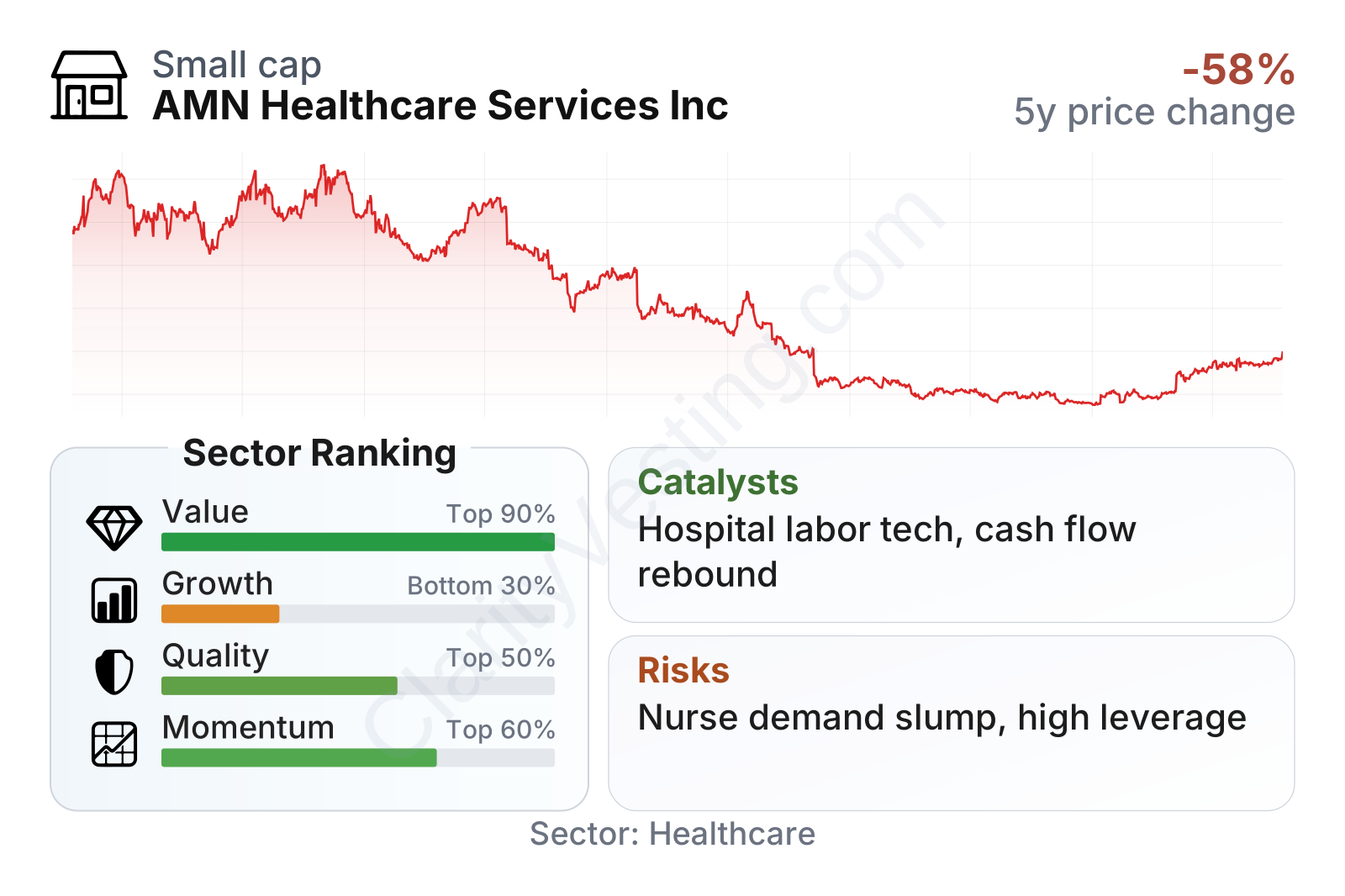
AMN is now a much smaller company than it appeared at the pandemic peak, and the stock chart reflects that reset. Even after a strong rebound over the last several months, the shares remain far below prior highs. In the latest metrics, the most notable contrast is between valuation and growth: the company screens cheaply versus much of the healthcare sector, while its recent growth profile remains weak. Quality is more mixed. Returns on capital are still above many sector peers, but margins are below their historical level and leverage is meaningfully higher than the industry median.
The table also highlights a key feature of the current setup: AMN is generating strong free cash flow relative to its market value, which can support debt reduction and operational flexibility. That said, weak multi-year growth metrics show that the market is still treating the company as a business in recovery rather than one already back to a steady expansion phase.
Growth
AMN operates in a sector with durable long-term demand drivers. The U.S. healthcare system continues to face clinician shortages, an aging population, and uneven staffing needs across specialties and geographies. Those trends support ongoing demand for recruitment, temporary staffing, and workforce management tools. So the broader sector still offers room for growth, even if short-term conditions can be highly cyclical.
AMN’s strategy also makes practical sense for the next phase of the market. During a weaker travel-nurse environment, the company has been leaning more on physician staffing, permanent placement, language services, and technology-enabled workforce solutions. That diversification is important because hospitals are under pressure to control labor costs, and AMN’s software, vendor management, and scheduling tools can become more attractive when clients want efficiency rather than simply more temporary labor.
Revenue growth has been highly volatile. After extraordinary expansion during the staffing boom, AMN moved through a long period of year-over-year contraction. More recently, the trend has started to improve, including a return to modest positive growth and one unusually strong quarter that likely reflects easier comparisons and portfolio shifts rather than a clean return to boom conditions. The main takeaway is that the decline phase appears to be easing, but growth is not yet consistently strong.
Free cash flow is a more encouraging part of the picture. Cash generation remained solid through the downturn and has improved sharply in the latest trailing period. For a staffing company coming off a deep correction, that matters because it gives management room to reduce debt, maintain operations, and potentially invest in technology and cross-selling opportunities without depending heavily on external financing.
A meaningful catalyst is the continued need for healthcare labor coordination rather than just emergency staffing. If hospitals keep shifting toward centralized workforce management, outsourced recruitment, and flexible clinician sourcing, AMN could benefit because it already combines staffing scale with software and managed-services capabilities. Recent operating improvement and stronger cash generation also suggest the company may be moving out of the most difficult part of the post-pandemic reset.
Risks
This article is for informational purposes only and does not constitute financial advice. Some content is AI-generated. See Disclaimer


