Stock Analysis · Amylyx Pharmaceuticals Inc (AMLX)
Overview
Amylyx Pharmaceuticals is a biotechnology company focused on developing and commercializing treatments for serious diseases with high unmet medical need, especially in neurodegenerative and endocrine conditions. Its business model is typical of smaller drug companies: value creation depends on moving a limited number of drug candidates through clinical trials, winning regulatory approvals, and then turning those approvals into sustainable sales.
The company’s recent history has been unusually volatile. Amylyx previously generated meaningful revenue from RELYVRIO/ALBRIOZA for amyotrophic lateral sclerosis (ALS), but that product was withdrawn from the U.S. and Canadian markets in 2024 after a confirmatory study did not support the earlier benefit. That has left the company in a transition period, with its investment case now centered much more on its pipeline than on an established commercial franchise.
Based on recent annual reporting, Amylyx’s revenue sources have become extremely narrow.
- Product revenue: approximately 0% in 2025 — after the withdrawal of RELYVRIO/ALBRIOZA, recurring commercial sales effectively disappeared.
- Collaboration, license, and other revenue: limited and irregular — this can include milestone-related or partner-related items when they exist, but it is not currently a stable large-scale source of revenue.
- Interest and cash-management income: not a core operating revenue source — with a sizable cash balance, interest income can matter to reported results, but it does not reflect demand for medicines.
This revenue mix is important for long-term readers because it means Amylyx is currently better understood as a pipeline-driven biotech than as a mature pharmaceutical business with diversified sales. Over the last several years, operating expenses have been driven mainly by research and development and corporate infrastructure, while revenue has moved sharply up and down depending on product events.
The operating profile shows how dramatic that shift has been: revenue surged in 2023 with the ALS launch, then fell sharply in 2024 and reached essentially zero in 2025, while research spending remained significant. In other words, the company still has the cost base of an active drug developer, but no longer has a meaningful marketed product offsetting those expenses.
Key Figures
| Metric | Value | Sector ⓘ |
|---|---|---|
| Date | Oct 24, 2026 | |
| Context | ||
| Sector | Healthcare | |
| Industry | Drug Manufacturers - Specialty & Generic | |
| Market Cap ⓘ | $3.62B | |
| Beta ⓘ | -0.09 | |
Value (Cheapness) | ||
| P/E Ratio ⓘ | N/A | 25.42 |
| P/B Ratio ⓘ | 13.28 | 3.08 |
| FCF Yield ⓘ | -3.50% | 3.12% |
| Dividend Yield ⓘ | N/A | 1.85% |
| EBIT / EV ⓘ | -3.85% | 0.56% |
| PEG ⓘ | N/A | |
Growth (Business expansion) | ||
| Revenue Growth ⓘ | -99.60% | 7.50% |
| RPS Growth (5Y CAGR) ⓘ | N/A | 8.60% |
| EPS Growth (5Y CAGR) ⓘ | -33.11% | -17.73% |
| BVPS Growth (5Y CAGR) ⓘ | N/A | 3.72% |
| Margin Growth (5Y Trend) ⓘ | N/A | -0.57% |
| FCF Growth (5Y CAGR) ⓘ | N/A | 0.96% |
| DPS Growth (5Y CAGR) ⓘ | N/A | 6.69% |
Quality (Business durability) | ||
| ROIC (Latest) ⓘ | -40.75% | 3.17% |
| ROA (Latest) ⓘ | -48.49% | 2.98% |
| ROIC (5Y Median) ⓘ | -62.07% | 4.56% |
| ROA (5Y Median) ⓘ | -79.82% | 1.87% |
| Net Debt / EBIT (Latest) ⓘ | N/A | 1.34 |
| Net Debt / EBIT (5Y Median) ⓘ | N/A | 1.86 |
| Net Debt / EBITDA (Latest) ⓘ | N/A | 1.00 |
| Net Debt / Assets ⓘ | -16.66% | 5.06% |
| EBITDA / Interest ⓘ | N/A | 9.55 |
| Operating Margin (Latest) ⓘ | N/A | 9.25% |
| Operating Margin (5Y Median) ⓘ | -619.89% | 7.33% |
| Debt to Equity (Latest) ⓘ | 2.20% | 26.68% |
| Profit Margin (Latest) ⓘ | N/A | 3.34% |
| Free Cash Flow (Latest) ⓘ | -$126.72M | |
Momentum (Price trend) | ||
| 3Y Return ⓘ | +73.68% | +51.61% |
| 12M Return (excl. last month) ⓘ | +147.93% | +19.90% |
| 6M Return ⓘ | +63.07% | +10.10% |
| Price vs. 200-Day MA ⓘ | +45.67% | +6.44% |
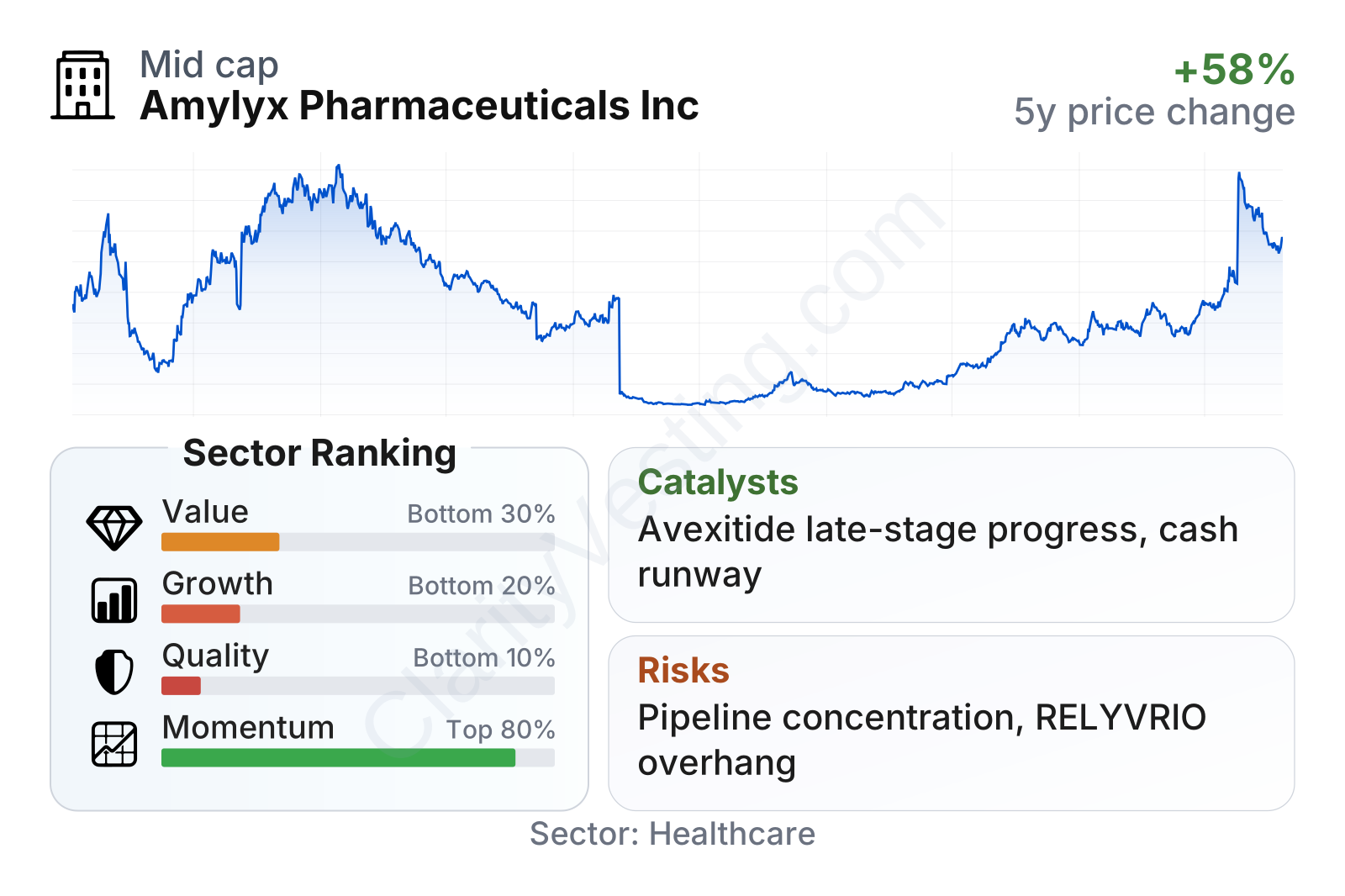
Amylyx is currently a mid-sized biotech by market value, but its financial quality, growth, and value metrics rank poorly versus much of the healthcare sector. The strongest relative area is recent share-price momentum, reflecting renewed market optimism around pipeline developments rather than current business fundamentals. The balance sheet is a notable exception: leverage is very low, which gives the company more flexibility than many early-commercial or clinical-stage peers.
The stock-price history also highlights how event-driven this company is. Shares climbed sharply during the commercialization phase of its ALS treatment, collapsed after the product setback in 2024, and then rebounded strongly as attention shifted to the next wave of clinical assets. That pattern matters because it shows the market is reacting less to steady earnings power and more to binary development milestones.
Growth
The sector Amylyx operates in remains attractive over the long run. Neurology and rare-disease drug development continue to draw industry attention because successful treatments can address major unmet needs, qualify for premium pricing, and sometimes benefit from orphan-drug incentives or faster regulatory pathways. In that sense, Amylyx is active in a part of healthcare where a single successful program can reshape the company.
The challenge is that Amylyx does not currently have operating growth in the ordinary sense. Recent year-over-year revenue comparisons are distorted by the rise and fall of RELYVRIO, and the latest trend is a collapse rather than an expansion.
That picture confirms the reset: after an exceptional jump tied to commercialization, revenue turned deeply negative on a year-over-year basis once the ALS product was removed. For a long-term assessment, this means future growth is not about recovering a mature business line; it depends on whether new medicines can reach the market and gain traction.
The strategic logic from here is straightforward. Amylyx has reoriented around a smaller set of pipeline assets and a tighter operating structure. The most important growth catalyst is avexitide, which the company is developing for post-bariatric hypoglycemia, a rare and underserved condition. The company has also advanced broader metabolic and neurodegenerative programs, but avexitide stands out because it is the clearest near-to-medium-term opportunity to rebuild commercial relevance.
Another supportive element is cash preservation. Amylyx remains free-cash-flow negative, but the burn rate has improved from the worst periods following the commercial reversal.
Cash usage is still substantial, yet the trend is less severe than at the peak of the post-withdrawal reset. For a development-stage biotech, that matters because preserving capital extends the time available to reach major clinical and regulatory milestones without relying too heavily on new financing.
Recent company updates have pointed to progress around the avexitide program, including regulatory alignment and late-stage development planning. If execution stays on track, that creates a meaningful opening: Amylyx could move from a company known mainly for a failed follow-up ALS study to one with a potentially differentiated asset in a niche market that currently lacks approved treatment options in the U.S.
Risks
This article is for informational purposes only and does not constitute financial advice. Some content is AI-generated. See Disclaimer


