Stock Analysis · AP Moeller-Maersk AS (AMKBY)
Overview
AP Moller-Maersk is one of the world’s best-known shipping and logistics groups. The company started as a container shipping operator, but over time it has built a broader business that also includes port terminals, inland transport, warehousing, air freight, fulfillment, and logistics services for businesses that want a more integrated supply chain. In simple terms, Maersk helps move goods from factories to end customers across oceans, ports, trucks, rail networks, warehouses, and distribution systems.
Its revenue base is still led by ocean shipping, but the company is no longer only a vessel operator. Based on recent annual reporting, revenue is mainly generated from the following areas:
- Ocean: approximately 65% to 70% of revenue. This is the core container shipping business, including long-distance transport of goods by sea.
- Logistics & Services: approximately 20% to 25% of revenue. This includes warehousing, distribution, customs services, inland transportation, supply chain management, e-commerce logistics, and air freight solutions.
- Terminals: approximately 10% to 12% of revenue. This business, largely tied to APM Terminals, operates port terminals and related infrastructure.
- Towage & Maritime Services and other activities: a small low-single-share portion of revenue after portfolio simplification and divestments, depending on reporting scope and period.
That mix matters for long-term analysis. Ocean shipping produces the largest earnings swings because freight rates can rise and fall sharply. Logistics and terminals are generally steadier and fit management’s long-running objective of reducing reliance on pure shipping cycles.
The multi-year financial picture shows exactly that tension: extraordinary profits during the freight boom in 2021 and 2022, followed by normalization in 2023 and more moderate profitability afterward. Revenue has remained large on an absolute basis, but earnings and cash generation have been much more volatile than sales alone would suggest.
The flow of revenue and costs highlights how unusual 2021 and especially 2022 were for Maersk. Profitability surged during the shipping rate spike, then fell back sharply as market conditions normalized. More recent results suggest the business has stabilized above the 2023 trough, but still far below the exceptional peak years.
Key Figures
| Metric | Value | Sector ⓘ |
|---|---|---|
| Date | Oct 24, 2026 | |
| Context | ||
| Sector | Industrials | |
| Industry | Marine Shipping | |
| Market Cap ⓘ | $51.98B | |
| Beta ⓘ | 0.51 | |
Value (Cheapness) | ||
| P/E Ratio ⓘ | 23.15 | 22.29 |
| P/B Ratio ⓘ | 0.96 | 1.98 |
| FCF Yield ⓘ | 8.40% | 6.26% |
| Dividend Yield ⓘ | 2.04% | 1.92% |
| EBIT / EV ⓘ | 5.26% | 4.83% |
| PEG ⓘ | 0.38 | |
Growth (Business expansion) | ||
| Revenue Growth ⓘ | 20.00% | 9.30% |
| RPS Growth (5Y CAGR) ⓘ | 2.28% | 7.76% |
| EPS Growth (5Y CAGR) ⓘ | -58.73% | -13.17% |
| BVPS Growth (5Y CAGR) ⓘ | 11.27% | 6.13% |
| Margin Growth (5Y Trend) ⓘ | -25.14% | 0.74% |
| FCF Growth (5Y CAGR) ⓘ | -28.56% | 10.79% |
| DPS Growth (5Y CAGR) ⓘ | 33.08% | 9.41% |
Quality (Business durability) | ||
| ROIC (Latest) ⓘ | 3.99% | 10.75% |
| ROA (Latest) ⓘ | 2.60% | 5.41% |
| ROIC (5Y Median) ⓘ | 9.87% | 9.37% |
| ROA (5Y Median) ⓘ | 7.18% | 4.95% |
| Net Debt / EBIT (Latest) ⓘ | 3.52 | 2.04 |
| Net Debt / EBIT (5Y Median) ⓘ | 1.52 | 2.27 |
| Net Debt / EBITDA (Latest) ⓘ | 1.15 | 1.39 |
| Net Debt / Assets ⓘ | 12.71% | 19.27% |
| EBITDA / Interest ⓘ | 4.84 | 9.58 |
| Operating Margin (Latest) ⓘ | 5.64% | 10.49% |
| Operating Margin (5Y Median) ⓘ | 11.71% | 10.30% |
| Debt to Equity (Latest) ⓘ | 31.63% | 64.82% |
| Profit Margin (Latest) ⓘ | 4.07% | 6.67% |
| Free Cash Flow (Latest) ⓘ | $4.37B | |
Momentum (Price trend) | ||
| 3Y Return ⓘ | +171.00% | +67.77% |
| 12M Return (excl. last month) ⓘ | +82.81% | +12.05% |
| 6M Return ⓘ | +52.31% | 0.00% |
| Price vs. 200-Day MA ⓘ | +31.62% | +0.67% |
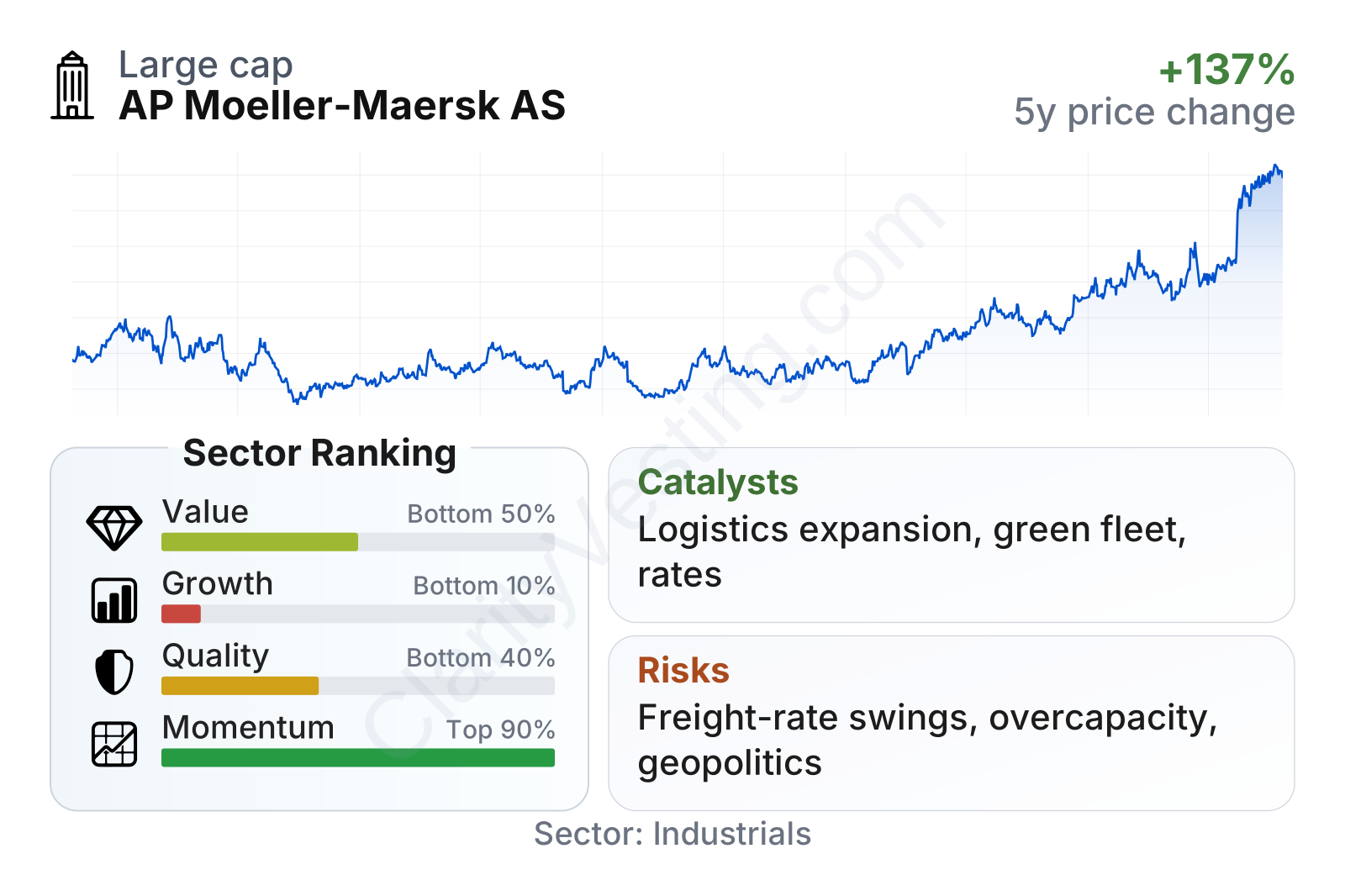
Maersk currently stands out as a very large global transport company with relatively low share-price volatility, a value profile close to the sector on earnings, and a lower price-to-book ratio than many industrial peers. Free cash flow yield is also above the sector median, which suggests the market is not placing an aggressive premium on current cash generation. The weaker area is growth quality: recent revenue has improved, but the longer five-year record still reflects the post-boom reset in shipping profits and margins.
The stock’s recent market performance has been strong. Over the last several months and over a three-year view, returns have clearly outpaced the sector median. That strength indicates the market has responded positively to improving freight conditions and Maersk’s resilience, although shipping shares can move quickly when the cycle changes.
Growth
Maersk operates in a sector that is essential rather than structurally fast-growing. Global trade tends to expand over long periods, and containerized shipping remains a backbone of world commerce, but the industry is cyclical and heavily influenced by freight rates, capacity additions, fuel costs, and geopolitical disruptions. That means the sector can grow over time while still producing very uneven annual results.
Management’s broader strategy makes practical sense for future growth because it aims to increase exposure to logistics and integrated supply chain services instead of depending only on ocean freight. For customers, using one provider across shipping, terminals, customs, warehousing, and inland delivery can reduce complexity. For Maersk, that can create stickier relationships and potentially smoother earnings than stand-alone shipping.
Revenue growth over the past few years has been highly uneven. The company moved from an extraordinary boom to a steep decline, then back to recovery. Most recently, year-over-year growth has turned positive again, which is encouraging, but the longer pattern still shows how exposed Maersk remains to industry cycles rather than steady compounding.
Cash generation tells a similar story. Free cash flow remains positive and meaningful in absolute terms, but it is far below the exceptional levels seen during the pandemic-era freight surge. For long-term analysis, the important point is not whether Maersk can repeat those peak years, but whether it can keep producing solid cash through a more normal shipping environment while continuing to invest in logistics capabilities.
Several catalysts could support future expansion. First, any sustained tightening in container shipping capacity or renewed disruption in global trade lanes can improve freight rates and vessel utilization. Second, growth in contract logistics, warehousing, and inland transport gives Maersk a path to increase revenue outside pure ocean shipping. Third, terminal assets are strategically valuable because ports are difficult and expensive to replicate, which can support long-term network advantages.
Recent company updates have also pointed to continued investment in decarbonization and fleet transition, including methanol-capable vessels. While these projects involve significant cost, they can strengthen Maersk’s position with large customers seeking lower-emission transport options. Over time, environmental regulation may favor operators that have already started upgrading fleets and fuel capabilities.
Risks
This article is for informational purposes only and does not constitute financial advice. Some content is AI-generated. See Disclaimer