Stock Analysis · American Homes 4 Rent (AMH)
Overview
American Homes 4 Rent is a residential real estate investment trust focused on single-family rental homes in the United States. Instead of owning apartment towers, it owns detached houses, townhomes, and build-to-rent communities, then earns recurring rental income from residents. The company operates at large scale across multiple states, with a portfolio concentrated in markets that have benefited from population growth, job creation, and relatively affordable housing compared with coastal gateway cities.
The business model is straightforward: acquire or develop homes, lease them to residents, manage maintenance and turnover, and finance the portfolio efficiently enough to produce steady cash flow. In recent years, the company has increasingly emphasized internally developed communities and purpose-built rental neighborhoods, which can offer better design consistency, operating efficiency, and supply pipelines than relying only on buying existing homes one by one.
Its revenue base is dominated by rental operations. Based on the company’s reporting structure in recent filings, the main sources are approximately:
- Single-family property rentals and related income: about 95% to 97% — base rent from leased homes, plus resident reimbursements and other property-level income tied to occupancy.
- Other property and ancillary income: about 2% to 4% — items such as fees and other leasing-related charges.
- Non-core and other sources: typically below 2% — gains or incidental items can appear in results, but they are not the core earnings engine.
What stands out is the consistency of the model. Revenue has moved higher over the last several years, while gross profit and operating income have also expanded. Interest expense has risen as financing costs increased, but the underlying rental business has remained solid enough to keep net income growing overall.
The operating picture shows a business that has grown steadily from a little above $1.3 billion in annual revenue in 2021 to roughly $1.7 billion by 2024, with profitability improving along the way. One 2025 visualization appears distorted, so the more reliable takeaway is the multi-year trend through 2024: expanding rental income, disciplined overhead, and a larger earnings base.
Key Figures
| Metric | Value | Sector ⓘ |
|---|---|---|
| Date | Oct 17, 2026 | |
| Context | ||
| Sector | Real Estate | |
| Industry | REIT - Residential | |
| Market Cap ⓘ | $12.56B | |
| Beta ⓘ | 0.79 | |
Value (Cheapness) | ||
| P/E Ratio ⓘ | 24.32 | 17.38 |
| P/B Ratio ⓘ | 1.83 | 0.85 |
| FCF Yield ⓘ | 7.38% | 7.38% |
| Dividend Yield ⓘ | 4.11% | 4.85% |
| EBIT / EV ⓘ | 4.25% | 3.78% |
| PEG ⓘ | 29.82 | |
Growth (Business expansion) | ||
| Revenue Growth ⓘ | 2.80% | 5.30% |
| RPS Growth (5Y CAGR) ⓘ | 5.87% | 6.02% |
| EPS Growth (5Y CAGR) ⓘ | 4.92% | -11.37% |
| BVPS Growth (5Y CAGR) ⓘ | 0.91% | 0.45% |
| Margin Growth (5Y Trend) ⓘ | 16.59% | -0.22% |
| FCF Growth (5Y CAGR) ⓘ | 12.09% | 5.40% |
| DPS Growth (5Y CAGR) ⓘ | 21.69% | 5.02% |
Quality (Business durability) | ||
| ROIC (Latest) ⓘ | 4.67% | 5.69% |
| ROE (Latest) ⓘ | 7.47% | 7.56% |
| ROA (Latest) ⓘ | 3.63% | 2.85% |
| ROIC (5Y Median) ⓘ | 2.76% | 4.22% |
| ROE (5Y Median) ⓘ | 5.83% | 6.03% |
| ROA (5Y Median) ⓘ | 3.18% | 2.44% |
| Net Debt / EBIT (Latest) ⓘ | 7.35 | 7.59 |
| Net Debt / EBIT (5Y Median) ⓘ | 12.05 | 8.40 |
| Net Debt / EBITDA (Latest) ⓘ | 4.23 | 5.27 |
| Net Debt / Assets ⓘ | 38.66% | 37.76% |
| EBITDA / Interest ⓘ | 5.86 | 4.10 |
| Operating Margin (Latest) ⓘ | 36.65% | 35.29% |
| Operating Margin (5Y Median) ⓘ | 21.72% | 37.31% |
| Debt to Equity (Latest) ⓘ | 75.64% | 88.87% |
| Profit Margin (Latest) ⓘ | 25.53% | 19.61% |
| Free Cash Flow (Latest) ⓘ | $926.44M | |
Momentum (Price trend) | ||
| 3Y Return ⓘ | -1.86% | +30.75% |
| 12M Return (excl. last month) ⓘ | -1.41% | +4.36% |
| 6M Return ⓘ | +4.81% | -2.52% |
| Price vs. 200-Day MA ⓘ | -0.30% | -2.34% |
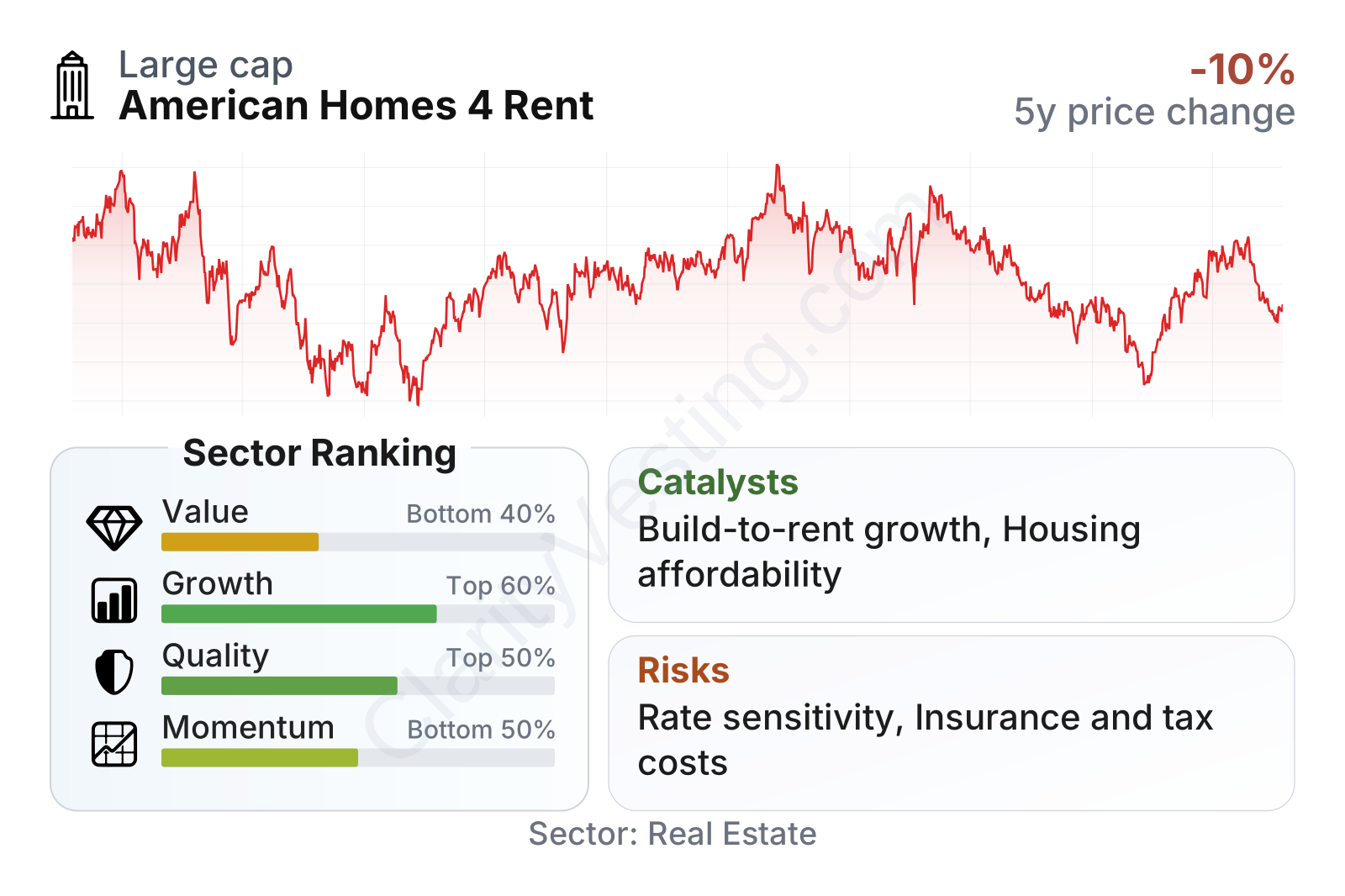
American Homes 4 Rent sits in the large-cap end of residential REITs and has shown lower share-price volatility than the broader stock market, as reflected by a beta below 1. On valuation, the shares trade above the sector median on both earnings and book value multiples, which suggests the market is assigning a premium to the company’s portfolio quality and operating model. On growth and quality, the picture is more balanced: recent revenue growth has been modest, but five-year trends in revenue per share, earnings, free cash flow, and margins remain constructive. Momentum has been weaker than much of the sector over longer periods, even though the shorter-term performance has improved.
Growth
American Homes 4 Rent operates in a part of housing with favorable long-term demand drivers. High home prices, elevated mortgage rates, and limited for-sale affordability have made renting a single-family home more attractive for many households. That matters because the company serves residents who want more space, yards, or suburban locations without the financial burden of homeownership. This is not a short-lived niche: it sits at the intersection of housing undersupply and affordability pressure, two themes that have persisted across the U.S. market.
The company’s strategy also makes sense for future expansion. It has combined acquisitions with in-house development and land banking, especially through build-to-rent communities. That approach can support growth in newer homes with standardized layouts, potentially lower maintenance needs, and better neighborhood clustering, all of which may improve operations over time. In simple terms, purpose-built rental housing can be easier and cheaper to manage than a scattered set of older homes bought from many different sellers.
Revenue per share has climbed steadily over the last five years, moving from roughly $4.00 to just above $5.00. That is important because it shows the company has not just grown by getting bigger; it has also increased the amount of revenue tied to each share over time. The five-year pace is close to 6% annually, which is respectable for a mature REIT.
Dividend per share has also risen strongly, more than doubling since 2021. The current yield is around 4%, which is not the highest in the REIT sector, but the growth rate has been notably stronger than the sector median. That combination points to a company that has been building distributable cash flow rather than simply offering a high yield from a stagnant base.
A meaningful catalyst is the continued normalization of the housing market in favor of rentals. If mortgage rates stay elevated or if homeownership remains out of reach for many households, single-family rental demand could remain firm. Another support comes from new community deliveries and stabilized occupancy in recently developed neighborhoods. In 2026, the company has continued to present itself as a disciplined owner-operator with development capacity, which remains a differentiator in a fragmented market.
Risks
This article is for informational purposes only and does not constitute financial advice. Some content is AI-generated. See Disclaimer


