Stock Analysis · Amgen Inc (AMGN)
Overview
Amgen is one of the largest biotechnology companies in the world. It develops, manufactures, and sells medicines, mainly for cancer, inflammation, bone health, rare diseases, and cardiovascular conditions. Its business is built around biologic drugs, which are complex medicines made from living cells, and it also has a growing portfolio of newer therapies added through internal research and acquisitions.
Revenue is diversified across several established products and newer growth drivers. Based on Amgen’s latest annual reporting, the main sources of product revenue can be summarized approximately as follows:
- Rare disease medicines: about 20%. This category was lifted by the Horizon Therapeutics acquisition and includes products such as Tepezza, Krystexxa, and Uplizna.
- Inflammation: about 18%. The main contributor is Enbrel, with additional support from Otezla.
- General medicine: about 16%. This includes products such as Repatha for cholesterol management and other broad-use therapies.
- Bone health: about 15%. Prolia and EVENITY are the key medicines here.
- Oncology: about 14%. This includes products such as BLINCYTO, XGEVA, and KYPROLIS.
- Inflammation and nephrology support products/other established brands: about 10%.
- Biosimilars: about 7%. These are lower-cost alternatives to biologic drugs originally developed by other companies.
Geographically, Amgen still depends heavily on the United States, but international sales are meaningful and important for future expansion. The overall picture is that Amgen is not a single-product company: it combines mature cash-generating drugs with newer assets intended to offset older products that are losing exclusivity or facing pricing pressure.
The business mix also shows a useful financial pattern: revenue has expanded strongly in the last two years, while research spending has increased and interest expense remains elevated after the Horizon deal. That combination suggests Amgen is using its cash flow from established products to fund both innovation and integration of acquired assets.
Key Figures
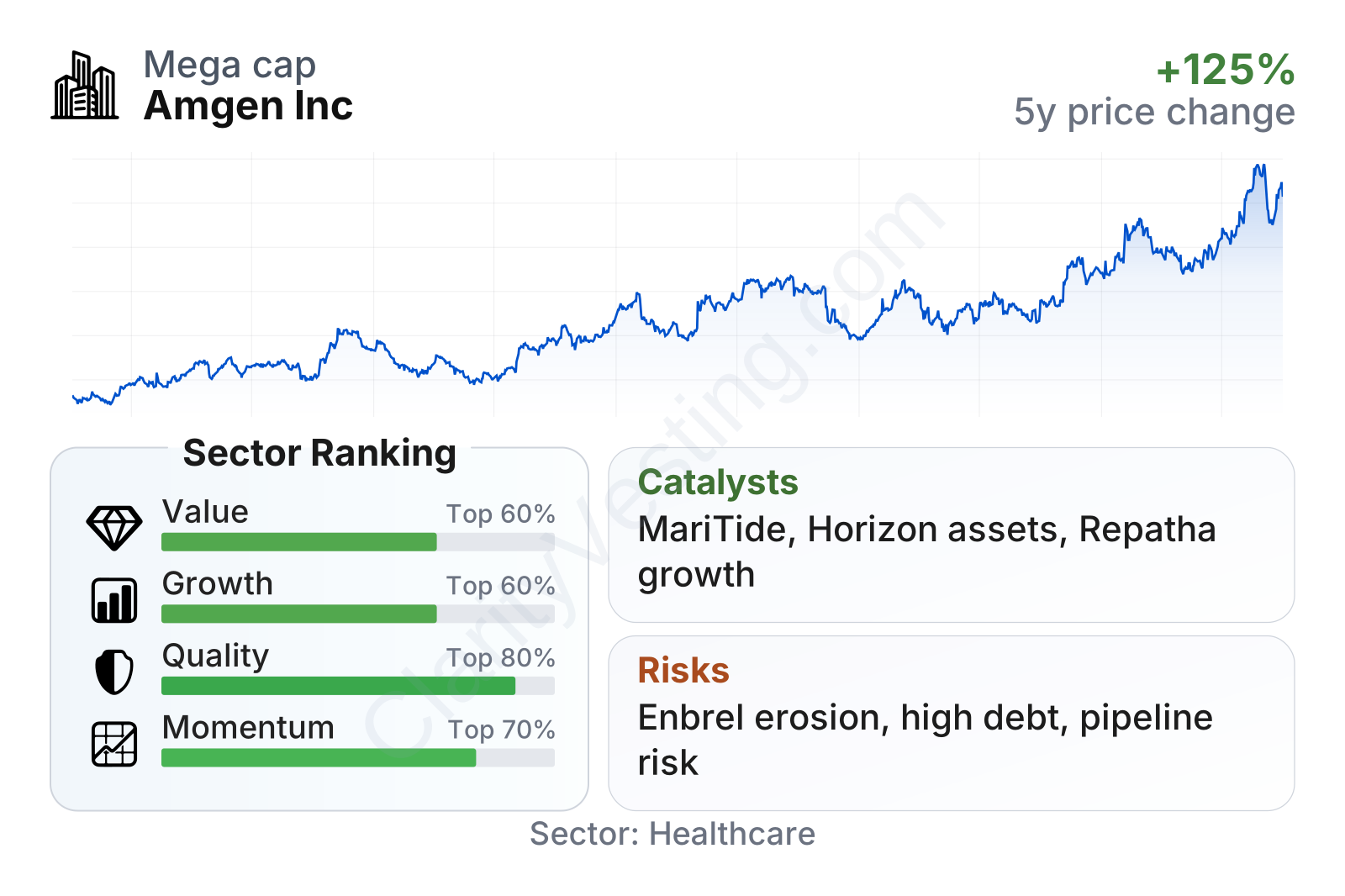
The share price trend over the last five years has been generally upward, with some volatility around acquisition-related concerns and earnings normalization. Compared with many healthcare names, the stock has behaved relatively defensively, which fits Amgen’s low beta and mature product base.
| Metric | Value | Sector ⓘ |
|---|---|---|
| Date | Oct 03, 2026 | |
| Context | ||
| Sector | Healthcare | |
| Industry | Drug Manufacturers - General | |
| Market Cap ⓘ | $227.88B | |
| Beta ⓘ | 0.43 | |
Value (Cheapness) | ||
| P/E Ratio ⓘ | 26.31 | 24.06 |
| P/B Ratio ⓘ | 18.96 | 3.08 |
| FCF Yield ⓘ | 4.47% | 3.07% |
| Dividend Yield ⓘ | 2.31% | 2.05% |
| EBIT / EV ⓘ | 4.93% | 0.63% |
| PEG ⓘ | 2.45 | |
Growth (Business expansion) | ||
| Revenue Growth ⓘ | 9.50% | 7.50% |
| RPS Growth (5Y CAGR) ⓘ | 10.58% | 8.70% |
| EPS Growth (5Y CAGR) ⓘ | -10.98% | -18.20% |
| BVPS Growth (5Y CAGR) ⓘ | 8.11% | 3.95% |
| Margin Growth (5Y Trend) ⓘ | 1.53% | -0.58% |
| FCF Growth (5Y CAGR) ⓘ | -0.85% | 0.88% |
| DPS Growth (5Y CAGR) ⓘ | 7.79% | 6.80% |
Quality (Business durability) | ||
| ROIC (Latest) ⓘ | 16.78% | 3.29% |
| ROA (Latest) ⓘ | 9.41% | 3.02% |
| ROIC (5Y Median) ⓘ | 15.60% | 4.75% |
| ROA (5Y Median) ⓘ | 8.45% | 1.93% |
| Net Debt / EBIT (Latest) ⓘ | 3.34 | 1.33 |
| Net Debt / EBIT (5Y Median) ⓘ | 3.88 | 1.83 |
| Net Debt / EBITDA (Latest) ⓘ | 2.62 | 0.99 |
| Net Debt / Assets ⓘ | 45.29% | 5.33% |
| EBITDA / Interest ⓘ | 6.19 | 9.63 |
| Operating Margin (Latest) ⓘ | 33.98% | 9.25% |
| Operating Margin (5Y Median) ⓘ | 30.40% | 7.80% |
| Debt to Equity (Latest) ⓘ | 490.28% | 28.99% |
| Profit Margin (Latest) ⓘ | 22.95% | 3.60% |
| Free Cash Flow (Latest) ⓘ | $10.18B | |
Momentum (Price trend) | ||
| 3Y Return ⓘ | +67.31% | +37.48% |
| 12M Return (excl. last month) ⓘ | +56.50% | +20.85% |
| 6M Return ⓘ | +16.83% | +9.73% |
| Price vs. 200-Day MA ⓘ | +12.95% | +4.69% |
Amgen stands out most on quality, where profitability and returns on assets are well above much of the sector. Growth looks respectable rather than exceptional, supported by revenue expansion and improving operating trends. Value appears mixed: the earnings multiple is close to the sector range, while free cash flow yield and dividend yield are somewhat stronger, but the very high price-to-book ratio is distorted by acquisition accounting and a balance sheet carrying large intangible assets. Momentum has also been favorable, with stock performance ahead of many peers.
Growth
Amgen operates in a sector with durable long-term demand. Aging populations, broader diagnosis rates, rising use of specialty medicines, and continued innovation in oncology, immunology, and rare disease all support the pharmaceutical and biotech market over time. This is not a high-speed industry in every segment, but it is one where strong science, commercial scale, and regulatory expertise can create long periods of earnings power.
Amgen’s strategy for future growth is relatively clear. First, it is trying to extend the life of its business beyond older blockbuster medicines by pushing newer products such as Repatha, EVENITY, BLINCYTO, and the rare disease portfolio acquired with Horizon. Second, it is investing heavily in internal research, including obesity and inflammation programs, where the commercial opportunity could be very large if clinical results remain competitive. Third, it is using its manufacturing scale and global distribution network to extract more value from existing products across more markets.
Recent revenue growth has been solid, especially after the Horizon acquisition, and the pace has remained positive even as the comparison became harder. That matters because it suggests growth is not coming from only one temporary step-up. The business appears to be transitioning from a flat period in 2022 and early 2023 into a broader expansion phase.
Free cash flow remains one of Amgen’s core strengths. It has moved around from year to year, but the overall level is still high enough to support research, debt reduction, acquisitions, and dividends at the same time. For a large drug company, that financial flexibility is a major strategic asset.
A significant catalyst is the company’s obesity program, especially MariTide. Obesity is one of the biggest opportunities in global pharmaceuticals, and even partial success could materially change Amgen’s growth profile. Another catalyst is continued expansion of the rare disease portfolio, where treatments often face less direct competition and can sustain strong pricing. New indications for existing products also matter because they can add revenue without the same commercial buildout required for a completely new launch.
Recent company updates have also pointed to continued execution on pipeline development, product launches, and post-acquisition integration. For a business of this size, that combination of internal R&D and bolt-on growth is one of the more credible ways to keep revenue moving higher over a long period.
Risks
This article is for informational purposes only and does not constitute financial advice. Some content is AI-generated. See Disclaimer