Stock Analysis · Affiliated Managers Group Inc (AMG)
Overview
Affiliated Managers Group Inc. is an asset management company. Instead of running one single investment brand, it owns stakes in a collection of independent investment firms, called affiliates. These affiliates manage money for institutions, wealth clients, and funds across areas such as global equities, private markets, alternatives, liquid alternatives, and fixed income. AMG earns a share of the economics generated by those affiliates, so its results depend heavily on assets under management, investment performance, client flows, and market levels.
This model is different from a traditional asset manager with one centralized brand. AMG acts more like a platform owner and capital partner. It provides capital, distribution support, and strategic resources, while leaving portfolio teams with a high degree of autonomy. That structure can help attract specialized investment boutiques, especially in higher-fee areas like alternative strategies and private markets.
The company’s revenue is mainly built from the economics of its affiliated managers. Based on recent company disclosures, the mix is best understood through the strategies and client channels that drive fee generation rather than a simple product list.
- Alternative and private markets strategies: approximately 45% to 55% of earnings power. This includes private markets, hedge fund-style strategies, and other less traditional investment areas that usually carry higher fees and can be more resilient than plain-vanilla equity products.
- Global and U.S. equities: approximately 25% to 35%. These strategies are more exposed to stock market levels and client sentiment, but they remain an important part of affiliate revenue.
- Fixed income and multi-asset strategies: approximately 10% to 20%. These areas tend to have lower fees than alternatives but can support steadier client relationships.
- Other affiliate-related income and investment income: generally a small share of total revenue, including mark-to-market and other corporate-level items that can create year-to-year noise.
Over the last few years, the business has shown that earnings can move sharply depending on markets and transaction activity, but it has also kept unusually strong operating profitability for the sector. The revenue path has not been perfectly smooth, yet the company remains a meaningful player in publicly listed asset management with a business model centered on owning and expanding a portfolio of specialist firms.
The income flow shows a business with very high margins for a financial company, but also one where reported revenue and expense lines can shift materially from year to year. The broader pattern is that profitability recovered after a softer 2023-2024 period, with 2025 showing a clear rebound in revenue and operating income.
Key Figures
| Metric | Value | Sector ⓘ |
|---|---|---|
| Date | Oct 17, 2026 | |
| Context | ||
| Sector | Financial Services | |
| Industry | Asset Management | |
| Market Cap ⓘ | $9.62B | |
| Beta ⓘ | 1.07 | |
Value (Cheapness) | ||
| P/E Ratio ⓘ | 13.28 | 12.26 |
| P/B Ratio ⓘ | 5.50 | 1.23 |
| FCF Yield ⓘ | 11.35% | 10.40% |
| Dividend Yield ⓘ | 0.01% | 3.02% |
| EBIT / EV ⓘ | 12.73% | 8.14% |
| PEG ⓘ | 0.61 | |
Growth (Business expansion) | ||
| Revenue Growth ⓘ | 29.90% | 9.35% |
| RPS Growth (5Y CAGR) ⓘ | 8.31% | 12.19% |
| EPS Growth (5Y CAGR) ⓘ | -5.19% | -9.53% |
| BVPS Growth (5Y CAGR) ⓘ | -5.25% | 4.99% |
| Margin Growth (5Y Trend) ⓘ | 2.17% | -3.86% |
| FCF Growth (5Y CAGR) ⓘ | -5.18% | 4.81% |
| DPS Growth (5Y CAGR) ⓘ | 7.94% | 8.79% |
Quality (Business durability) | ||
| ROIC (Latest) ⓘ | 19.66% | 9.49% |
| ROE (Latest) ⓘ | 42.61% | 13.90% |
| ROA (Latest) ⓘ | 9.34% | 1.55% |
| ROIC (5Y Median) ⓘ | 16.97% | 7.86% |
| ROE (5Y Median) ⓘ | 24.05% | 12.17% |
| ROA (5Y Median) ⓘ | 7.50% | 1.30% |
| Net Debt / EBIT (Latest) ⓘ | 1.69 | 0.96 |
| Net Debt / EBIT (5Y Median) ⓘ | 1.42 | 0.73 |
| Net Debt / EBITDA (Latest) ⓘ | 1.55 | 0.92 |
| Operating Margin (Latest) ⓘ | 60.72% | 22.30% |
| Operating Margin (5Y Median) ⓘ | 54.09% | 24.63% |
| Debt to Equity (Latest) ⓘ | 98.88% | 58.56% |
| Profit Margin (Latest) ⓘ | 37.72% | 26.57% |
| Free Cash Flow (Latest) ⓘ | $1.09B | |
Momentum (Price trend) | ||
| 3Y Return ⓘ | +200.18% | +88.33% |
| 12M Return (excl. last month) ⓘ | +48.15% | +19.38% |
| 6M Return ⓘ | +27.20% | +4.75% |
| Price vs. 200-Day MA ⓘ | +16.85% | +3.50% |
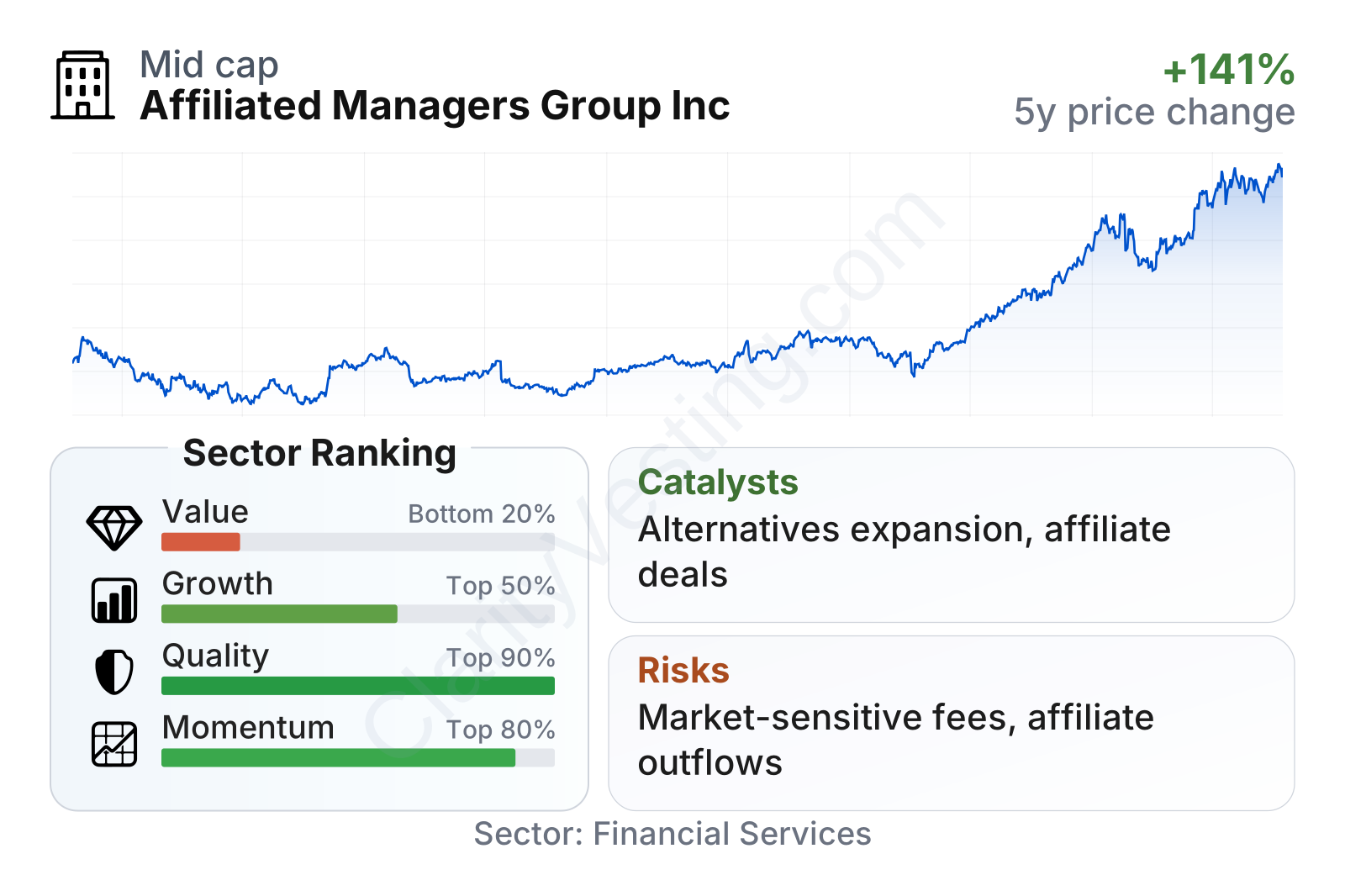
AMG stands out for profitability and capital efficiency. Its quality measures rank near the top of the sector, with returns on equity, assets, and invested capital well above typical financial firms. Growth is more mixed: recent revenue growth has been strong, but the longer-term trend in book value and free cash flow has been less impressive. Valuation is not obviously cheap on every measure. The earnings multiple is close to the sector range, while the price-to-book multiple is far above the median, reflecting both stronger profitability and a market view that AMG’s balance sheet understates the earning power of its affiliate model.
The stock has also had a powerful run. Over three years and across shorter periods, price performance has been much stronger than the sector median. That signals improving confidence in the business, but it also means the market is already recognizing part of the operational recovery.
Growth
AMG operates in a sector that is mature overall, but still has pockets of attractive expansion. Traditional long-only asset management faces fee pressure, the rise of passive products, and intense competition. The more promising areas are alternatives, private markets, and specialized active strategies where clients are still willing to pay for differentiated expertise. AMG’s structure is well aligned with those areas because it can partner with entrepreneurial firms rather than build everything internally.
The strategy for future growth is logical. The company can expand in three ways at once: market appreciation lifts assets under management, strong affiliate performance can attract net client inflows, and new investments in additional firms can add fresh revenue streams. This combination gives AMG more than one route to growth, which matters in an industry where organic flows can be volatile.
A notable catalyst is the company’s continued emphasis on alternatives and private markets. These strategies usually offer better fee rates and can deepen client relationships. If AMG keeps adding affiliates in these segments, it could continue shifting its business mix toward areas with stronger structural demand than traditional mutual-fund style products.
Another important point is earnings momentum. Earnings per share have generally trended upward over the last several years, with a particularly strong step-up in 2025. That supports the view that affiliate earnings and capital allocation have recently become more productive.
Book value per share has been less consistent, partly because the company uses capital for acquisitions and share repurchases and because the economics of minority stakes in affiliates do not always translate neatly into reported book value. In a business like AMG, book value matters, but it is less informative than earnings power and cash generation.
Recent company communications have also pointed to ongoing affiliate activity and capital deployment as part of the growth plan. For AMG, each successful investment in a new boutique can be meaningful because it adds another source of fees without requiring the company to absorb and fully centralize that business. That makes deal execution a significant opportunity when market conditions allow attractive transactions.
Risks
This article is for informational purposes only and does not constitute financial advice. Some content is AI-generated. See Disclaimer


