Stock Analysis · Ametek Inc (AME)
Overview
Ametek is an industrial technology company that makes highly engineered electronic instruments and electromechanical devices. In simple terms, it sells specialized equipment, sensors, monitoring tools, motors, motion-control products, and precision components used in factories, laboratories, aerospace systems, power applications, medical equipment, and other demanding environments. Its products are usually not consumer-facing. They are built into professional workflows where reliability, accuracy, and long service life matter more than low price.
The company organizes its business into two main segments. Based on recent annual disclosures, revenue is split approximately as follows:
- Electronic Instruments Group (about 70% of revenue) — advanced analytical and measurement instruments, process and factory monitoring systems, aerospace and power-related instruments, medical and research tools, and precision sensing equipment.
- Electromechanical Group (about 30% of revenue) — engineered motors, motion-control systems, automation components, thermal management products, specialty metals, and interconnect solutions used in industrial and aerospace applications.
Ametek’s model is built around niche markets where technical performance, regulatory qualification, recurring aftermarket demand, and customer switching costs can support durable margins. The company also uses acquisitions as a regular part of its expansion strategy, adding specialized businesses and then integrating them into its operating system.
Over the last several years, the business has shown a clear pattern: revenue has moved steadily higher, and profits have also expanded, suggesting that growth has not come only from scale but also from disciplined cost control and favorable product mix.
The long-term pattern points to improving earnings power. Revenue has climbed from roughly $5.5 billion in 2021 to about $7.4 billion in 2025, while net income has also advanced meaningfully. That combination is notable because it suggests Ametek has been able to grow without giving up profitability.
Key Figures
| Metric | Value | Sector ⓘ |
|---|---|---|
| Date | Oct 03, 2026 | |
| Context | ||
| Sector | Industrials | |
| Industry | Specialty Industrial Machinery | |
| Market Cap ⓘ | $57.49B | |
| Beta ⓘ | 0.99 | |
Value (Cheapness) | ||
| P/E Ratio ⓘ | 36.61 | 22.45 |
| P/B Ratio ⓘ | 5.06 | 1.98 |
| FCF Yield ⓘ | 3.17% | 6.31% |
| Dividend Yield ⓘ | 0.52% | 1.96% |
| EBIT / EV ⓘ | 3.45% | 4.81% |
| PEG ⓘ | 2.80 | |
Growth (Business expansion) | ||
| Revenue Growth ⓘ | 15.00% | 9.10% |
| RPS Growth (5Y CAGR) ⓘ | 7.66% | 7.75% |
| EPS Growth (5Y CAGR) ⓘ | -8.57% | -13.59% |
| BVPS Growth (5Y CAGR) ⓘ | 11.71% | 6.22% |
| Margin Growth (5Y Trend) ⓘ | 1.89% | 0.72% |
| FCF Growth (5Y CAGR) ⓘ | 12.33% | 10.98% |
| DPS Growth (5Y CAGR) ⓘ | 11.69% | 9.48% |
Quality (Business durability) | ||
| ROIC (Latest) ⓘ | 12.67% | 10.92% |
| ROA (Latest) ⓘ | 9.62% | 5.41% |
| ROIC (5Y Median) ⓘ | 19.35% | 9.21% |
| ROA (5Y Median) ⓘ | 9.53% | 4.94% |
| Net Debt / EBIT (Latest) ⓘ | 0.91 | 2.07 |
| Net Debt / EBIT (5Y Median) ⓘ | 1.47 | 2.28 |
| Net Debt / EBITDA (Latest) ⓘ | 0.75 | 1.43 |
| Net Debt / Assets ⓘ | 10.94% | 19.27% |
| EBITDA / Interest ⓘ | 25.14 | 9.53 |
| Operating Margin (Latest) ⓘ | 25.48% | 10.50% |
| Operating Margin (5Y Median) ⓘ | 25.40% | 10.27% |
| Debt to Equity (Latest) ⓘ | 20.52% | 65.48% |
| Profit Margin (Latest) ⓘ | 20.04% | 6.62% |
| Free Cash Flow (Latest) ⓘ | $1.82B | |
Momentum (Price trend) | ||
| 3Y Return ⓘ | +70.90% | +58.56% |
| 12M Return (excl. last month) ⓘ | +28.06% | +15.63% |
| 6M Return ⓘ | +15.91% | +4.19% |
| Price vs. 200-Day MA ⓘ | +8.11% | +0.93% |
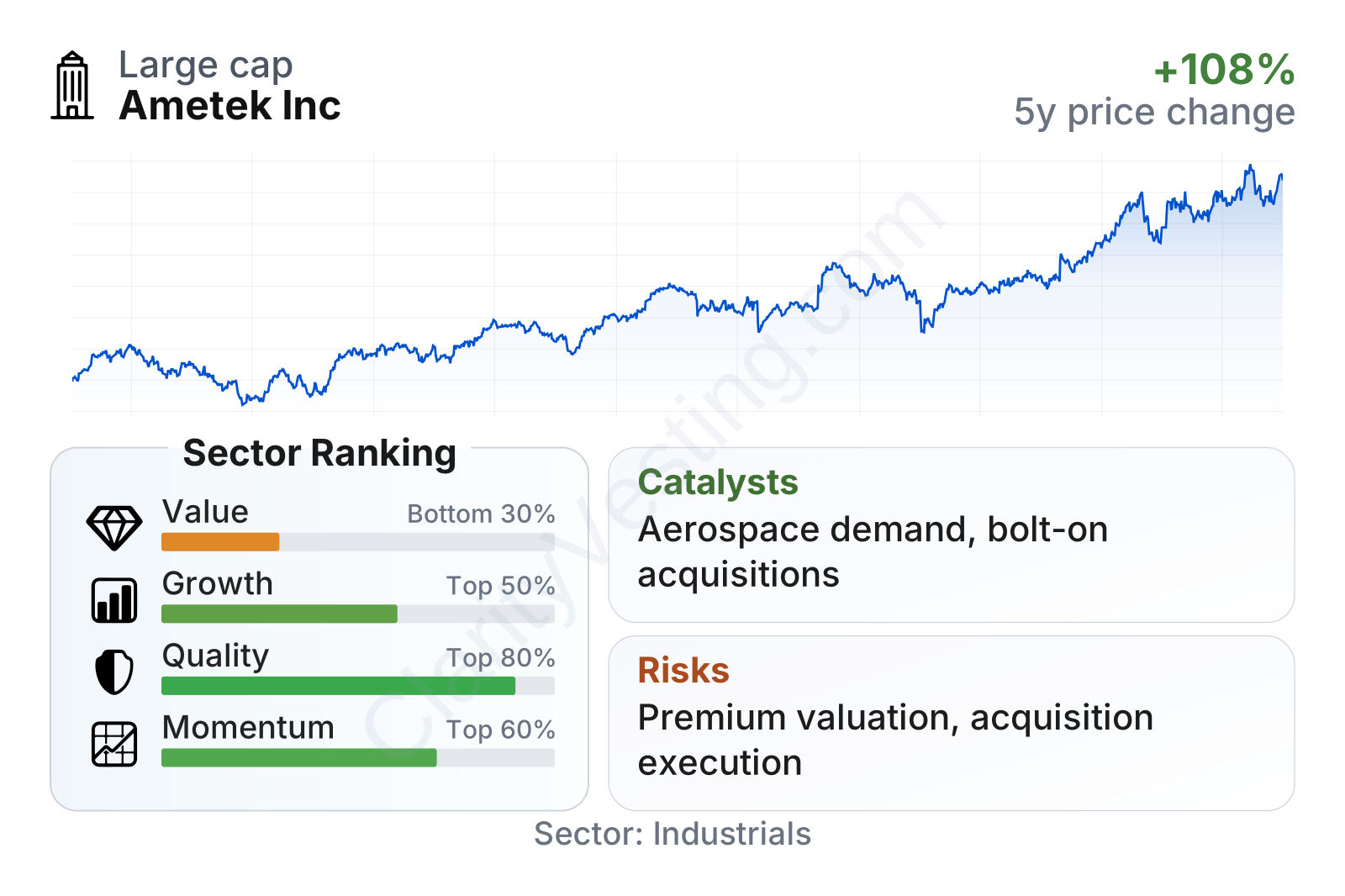
Ametek stands out most on business quality. Profitability is well above the typical industrial peer, returns on capital are strong, and leverage is lower than sector norms. Growth is solid rather than explosive, but the company’s cash generation has been consistently strong. The weaker area is valuation: the shares trade at a clear premium to the sector on earnings, book value, and cash flow measures, which means the market is already recognizing much of that quality.
Growth
Ametek operates in parts of the industrial economy that still have favorable long-term demand drivers: factory automation, aerospace systems, precision measurement, electrification, medical instrumentation, and advanced process control. These are not fast-changing consumer markets. They are specialized areas where customers often prioritize uptime, compliance, and product performance, which can create steadier demand over time.
The company’s strategy also makes sense for long-term expansion. Ametek combines organic growth with acquisitions, focusing on niche businesses that can benefit from its scale, manufacturing discipline, and global sales network. That approach has been a recurring feature of its development for many years and helps explain why its business mix has shifted toward higher-margin activities.
Recent revenue growth shows a reacceleration after a softer period in late 2024 and early 2025. The latest year-over-year pace is running around the mid-teens, ahead of the sector median. That does not necessarily mean straight-line growth from here, but it does indicate that demand and portfolio additions have recently been supportive.
Cash generation is another important part of the growth case. Free cash flow has risen strongly over the last several years and is now around $1.8 billion on a trailing basis. For a company of Ametek’s size, that level of cash creation matters because it gives management flexibility to fund acquisitions, invest in product development, reduce debt, and continue its dividend growth without heavily stretching the balance sheet.
A recent opportunity worth watching is the continued demand for mission-critical aerospace, automation, and analytical instrumentation markets, along with Ametek’s ongoing acquisition activity. In businesses like Ametek’s, new product launches and bolt-on deals often matter more than headline-breaking news because they can deepen exposure to attractive niches and expand recurring service revenue over time.
Risks
This article is for informational purposes only and does not constitute financial advice. Some content is AI-generated. See Disclaimer