Stock Analysis · Amundi SA (AMDUF)
Overview
Amundi SA is one of the largest asset managers in Europe. In simple terms, it manages money on behalf of other people and institutions. Its clients include individual savers, pension funds, insurers, companies, banks, and governments. The firm offers investment products such as mutual funds, exchange-traded funds, fixed-income strategies, equity portfolios, multi-asset solutions, and savings products distributed through banking networks. It also provides technology and services to other financial institutions through its investment platform activities.
Its business model is mostly based on collecting fees for managing assets. When the amount of money it manages rises, either because markets go up or because clients add new money, revenue usually improves as well. That means Amundi is tied both to long-term savings trends and to financial market conditions.
Based on recent annual reporting, Amundi’s revenue mix is centered on management fees, with smaller contributions from performance fees, net financial income, and service or technology activities. The exact split can move from year to year, but the broad structure is relatively stable.
- Management fees: approximately 70% to 80% of revenue. This is the core activity and includes fees earned on actively managed funds, passive products such as ETFs and index solutions, institutional mandates, retirement savings, and treasury or liquidity products.
- Net financial income and treasury-related income: approximately 10% to 20%. This can include income linked to seed capital, treasury management, and other balance-sheet-related financial items.
- Performance fees: approximately 5% to 10% in stronger market years, but this source is volatile. These fees depend on investment results beating specific targets.
- Technology and services: a smaller but growing share, generally below 10%. This includes the ALTO platform and related servicing activities sold to external clients.
Geographically and by client channel, Amundi is also diversified. It has strong distribution through Crédit Agricole and Société Génale networks, a broad institutional franchise, and a meaningful international footprint across Europe and Asia. That mix gives it scale, but it also means the group is exposed to fee pressure in mainstream asset management where low-cost products continue to gain share.
Over the last several years, revenue and operating profit have generally trended upward, although not in a straight line. Profitability remains solid for a company of this type, helped by scale and disciplined costs.
The business has shown a clear ability to convert revenue into operating profit and net income. Revenue expanded from the low-$6 billion range a few years ago into the low-$7 billion range more recently, while net income also recovered and moved higher after the market weakness seen in 2022. That points to a business with meaningful operating leverage when markets and client flows are supportive.
Key Figures
| Metric | Value | Sector ⓘ |
|---|---|---|
| Date | Nov 21, 2026 | |
| Context | ||
| Sector | Financial Services | |
| Industry | Asset Management | |
| Market Cap ⓘ | $21.42B | |
| Beta ⓘ | 1.09 | |
Value (Cheapness) | ||
| P/E Ratio ⓘ | 13.79 | 12.01 |
| P/B Ratio ⓘ | N/A | 1.48 |
| FCF Yield ⓘ | 24.47% | 8.77% |
| Dividend Yield ⓘ | N/A | 3.01% |
| EBIT / EV ⓘ | 21.93% | 8.31% |
| PEG ⓘ | 7.28 | |
Growth (Business expansion) | ||
| Revenue Growth ⓘ | 11.40% | 6.70% |
| RPS Growth (5Y CAGR) ⓘ | 4.08% | 12.35% |
| EPS Growth (5Y CAGR) ⓘ | 7.09% | -0.27% |
| BVPS Growth (5Y CAGR) ⓘ | 5.83% | 4.83% |
| Margin Growth (5Y Trend) ⓘ | 5.99% | -4.16% |
| FCF Growth (5Y CAGR) ⓘ | -2.45% | 4.69% |
| DPS Growth (5Y CAGR) ⓘ | 8.94% | 8.82% |
Quality (Business durability) | ||
| ROIC (Latest) ⓘ | N/A | 9.49% |
| ROE (Latest) ⓘ | 21.64% | 14.02% |
| ROA (Latest) ⓘ | N/A | 1.53% |
| ROIC (5Y Median) ⓘ | 6.62% | 7.80% |
| ROE (5Y Median) ⓘ | 11.22% | 12.09% |
| ROA (5Y Median) ⓘ | 3.75% | 1.28% |
| Net Debt / EBIT (Latest) ⓘ | -0.13 | 0.88 |
| Net Debt / EBIT (5Y Median) ⓘ | 3.92 | 0.73 |
| Net Debt / EBITDA (Latest) ⓘ | -0.13 | 0.71 |
| Operating Margin (Latest) ⓘ | 33.67% | 23.37% |
| Operating Margin (5Y Median) ⓘ | 26.94% | 24.29% |
| Debt to Equity (Latest) ⓘ | 18.00% | 59.34% |
| Profit Margin (Latest) ⓘ | 24.94% | 26.65% |
| Free Cash Flow (Latest) ⓘ | $5.24B | |
Momentum (Price trend) | ||
| 3Y Return ⓘ | +151.97% | +73.29% |
| 12M Return (excl. last month) ⓘ | +47.51% | +18.35% |
| 6M Return ⓘ | +42.48% | +3.24% |
| Price vs. 200-Day MA ⓘ | +19.66% | +2.17% |
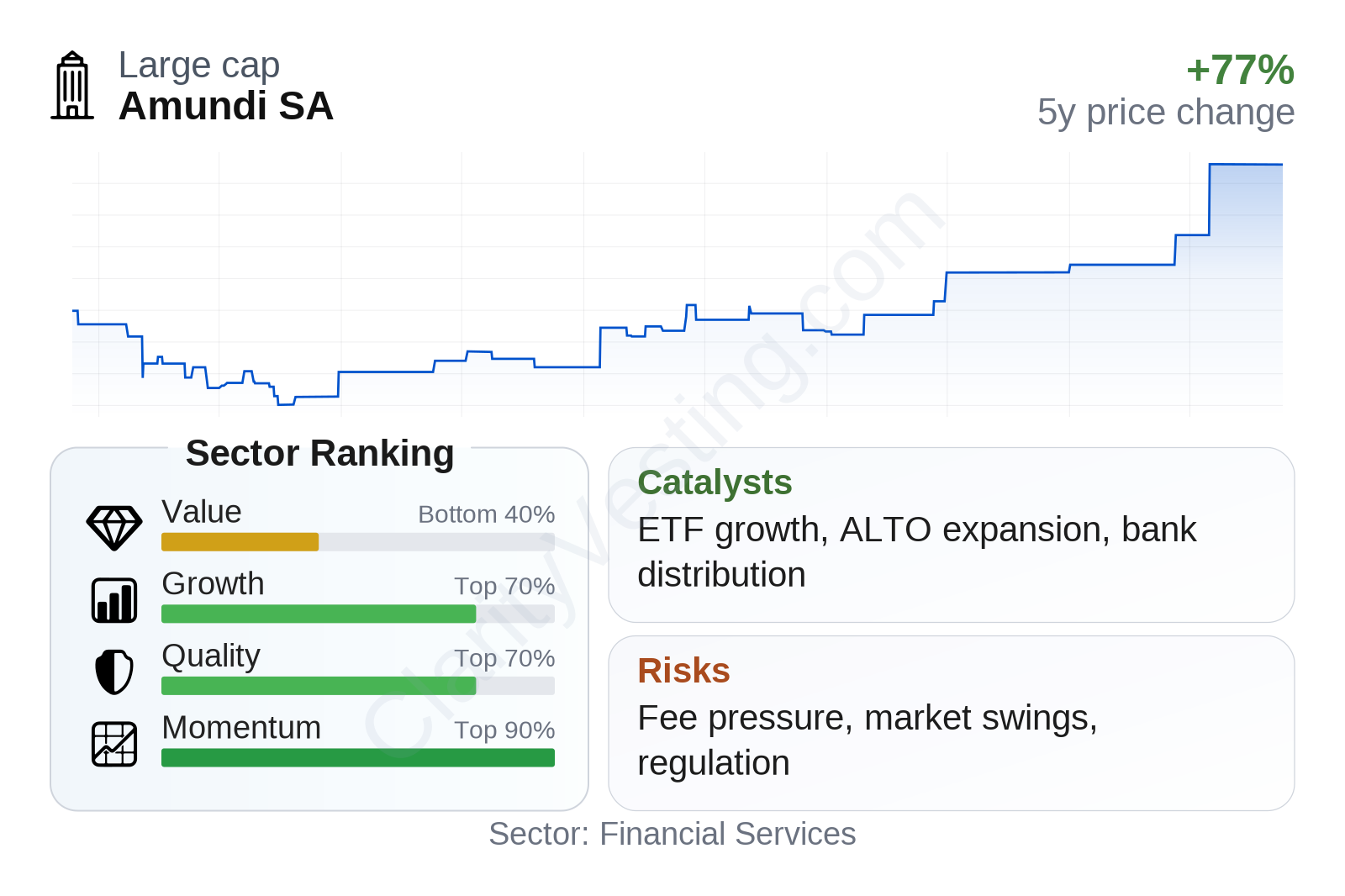
Amundi stands out more on profitability, cash generation, balance-sheet strength, and market performance than on classic low-multiple valuation. The stock trades at an earnings multiple slightly above the sector median, so it does not screen as obviously cheap on P/E alone. However, operating profitability is strong, free cash flow generation is very high, and leverage is modest, with net cash on a trailing basis and debt-to-equity around 18%, well below the sector median.
Growth indicators are mixed but still constructive. Recent year-over-year revenue growth has been stronger than the sector median, and five-year earnings and book value growth have been positive. The weaker point is longer-term revenue-per-share growth, which has lagged many peers, showing that expansion has been steady rather than exceptional. Price momentum has been very strong, with returns over the past 6 months, 12 months, and 3 years all comfortably ahead of the sector median, indicating that the market has recently rewarded the company’s operating progress.
Growth
Amundi operates in a sector that has favorable long-term foundations. Aging populations in Europe and many developed markets need retirement savings solutions. At the same time, the shift from bank deposits toward market-based savings products continues over time. Passive investing, ETFs, outsourced portfolio management, and digital investment services are also expanding. These trends do not guarantee smooth annual growth, but they do support a larger pool of assets for firms with broad product ranges and strong distribution.
Amundi’s strategy makes sense for this environment. It combines scale in traditional active management with a meaningful presence in lower-cost passive products and a growing technology/services arm. That matters because asset management has become a scale business: larger firms can spread compliance, data, distribution, and technology costs across more assets. Amundi’s size in Europe gives it room to defend margins while still participating in market segments where fees are lower.
A notable growth angle is the company’s technology platform business. Selling portfolio and investment-management software and services to financial institutions creates a revenue stream that is less directly tied to market levels than pure management fees. This is strategically important because it can deepen client relationships and diversify the business mix over time.
Another catalyst is product mix. ETFs, fixed income, and savings solutions have been areas of structural demand across the asset-management industry. If Amundi keeps winning flows in these categories, growth can continue even if fee rates remain under pressure. Its strong banking partnerships also provide a built-in distribution advantage in Europe, especially for retail savings products.
Recent operating trends also support the growth case. Revenue growth has been running above the sector median, margins have improved over a five-year period, and book value per share has risen steadily. That combination suggests that the company has not been growing by sacrificing profitability.
Earnings have not followed a perfectly straight path, reflecting the market sensitivity of the business, but the broader multi-year pattern remains positive. Five-year EPS growth has been better than the sector median, which is notable in an industry that has faced fee compression and volatile market conditions.
Book value per share has moved higher year after year, which is usually a useful sign for financial companies. It suggests that the business has continued to accumulate economic value over time rather than simply relying on short-term market swings.
As for recent opportunities, the company has continued to emphasize expansion in ETFs, responsible investing, Asian partnerships, and technology services. None of these alone changes the company overnight, but together they fit a practical long-term roadmap: more assets, broader distribution, and more recurring fee streams beyond traditional active funds.
Risks
This article is for informational purposes only and does not constitute financial advice. Some content is AI-generated. See Disclaimer