Stock Analysis · Ambiq Micro Inc (AMBQ)
Overview
Ambiq Micro is a semiconductor company focused on ultra-low-power chips used in battery-powered devices. Its products are designed to help electronics run longer on small batteries while still supporting processing, sensing, wireless connectivity, and increasingly on-device artificial intelligence. In simple terms, the company tries to solve a practical problem: how to add more computing features to small devices without draining power too quickly.
The company’s technology is mainly aimed at wearables, medical and health devices, industrial sensors, smart home equipment, and other edge devices that need long battery life. Ambiq is known for its Subthreshold Power Optimized Technology platform, which is central to how it positions itself in low-power microcontrollers and system-on-chip products.
Based on public company materials, revenue primarily comes from selling semiconductor products rather than from a diversified mix of software or services. A simple breakdown is:
- Chip product sales: the large majority of revenue, likely well above 90%. This includes microcontrollers, system-on-chip devices, and related semiconductor components used by device makers.
- Development tools, support, and other revenue: a small share, likely below 10% when present. This can include evaluation tools, software-related enablement, and other ancillary items tied to customer adoption.
Ambiq’s financial profile also shows a business still investing heavily to build scale. Over the past several years, research and development has remained very large relative to revenue, which is typical for a smaller chip company trying to expand its product line and customer reach. Gross profit recovered after the 2023 downturn, but operating losses remained substantial because spending on engineering and commercial infrastructure stayed high.
The long-term pattern is mixed but understandable for a growth-stage semiconductor firm: revenue has not moved in a straight line, yet gross profit improved from 2023 to 2025 while research spending stayed elevated. That suggests the company is still prioritizing product development and market expansion over near-term profitability.
Key Figures
| Metric | Value | Sector ⓘ |
|---|---|---|
| Date | Oct 03, 2026 | |
| Context | ||
| Sector | Technology | |
| Industry | Semiconductors | |
| Market Cap ⓘ | $1.65B | |
| Beta ⓘ | N/A | |
Value (Cheapness) | ||
| P/E Ratio ⓘ | N/A | 29.95 |
| FCF Yield ⓘ | -2.32% | 4.22% |
| Dividend Yield ⓘ | N/A | 1.30% |
| EBIT / EV ⓘ | -2.94% | 2.83% |
| PEG ⓘ | N/A | |
Growth (Business expansion) | ||
| Revenue Growth ⓘ | 89.70% | 15.80% |
| RPS Growth (5Y CAGR) ⓘ | 19.41% | 8.55% |
| EPS Growth (5Y CAGR) ⓘ | N/A | -11.72% |
| Margin Growth (5Y Trend) ⓘ | N/A | 0.39% |
| FCF Growth (5Y CAGR) ⓘ | -7.11% | 9.72% |
| DPS Growth (5Y CAGR) ⓘ | N/A | 7.73% |
Quality (Business durability) | ||
| ROIC (Latest) ⓘ | -12.37% | 9.36% |
| ROIC (5Y Median) ⓘ | N/A | 8.32% |
| Net Debt / EBIT (Latest) ⓘ | N/A | 0.50 |
| Net Debt / EBIT (5Y Median) ⓘ | N/A | 0.46 |
| Net Debt / EBITDA (Latest) ⓘ | N/A | 0.28 |
| Net Debt / Assets ⓘ | -83.14% | 3.44% |
| EBITDA / Interest ⓘ | N/A | 12.67 |
| Operating Margin (Latest) ⓘ | -39.39% | 9.81% |
| Operating Margin (5Y Median) ⓘ | -50.23% | 8.50% |
| Debt to Equity (Latest) ⓘ | 1.13% | 33.33% |
| Profit Margin (Latest) ⓘ | -37.77% | 7.15% |
| Free Cash Flow (Latest) ⓘ | -$38.34M | |
Momentum (Price trend) | ||
| 3Y Return ⓘ | N/A | +49.46% |
| 12M Return (excl. last month) ⓘ | +44.40% | +16.51% |
| 6M Return ⓘ | +173.69% | +24.29% |
| Price vs. 200-Day MA ⓘ | +27.75% | +4.74% |
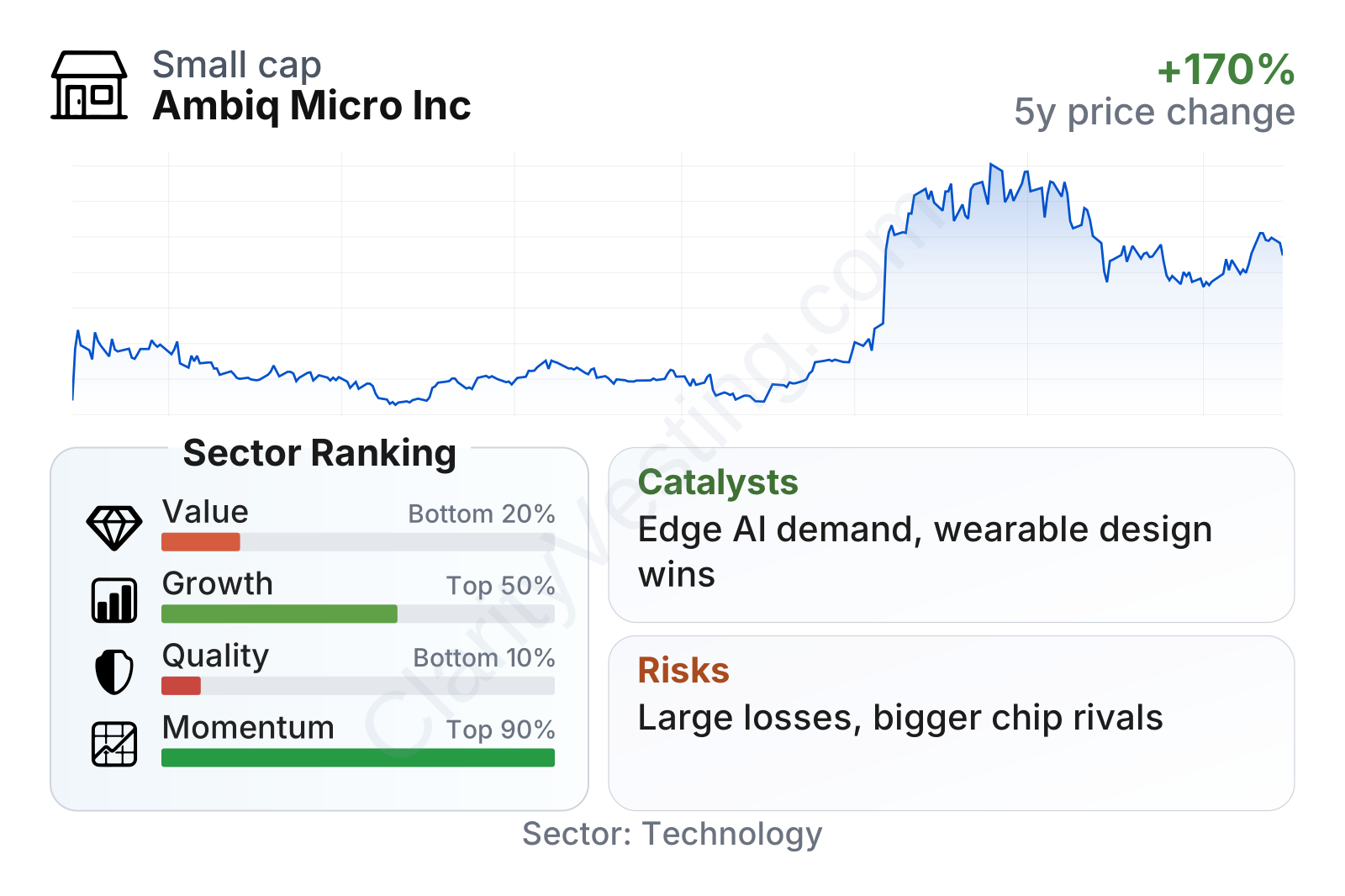
The market currently gives Ambiq strong credit for growth and recent share-price momentum, but much less credit for profitability and traditional value measures. Revenue growth has been far above the sector median, and the stock’s recent performance has also outpaced most semiconductor peers. By contrast, returns on capital, operating margin, and free cash flow remain deeply weaker than the industry midpoint, which shows that the business is still in a build-out phase rather than a mature earnings phase.
This combination creates an unusual profile: financially conservative on debt, commercially promising on growth, but still unproven on durable earnings power. For long-term analysis, that makes the company more dependent on future execution than on current fundamentals.
Growth
Ambiq operates in a part of the semiconductor market with real structural tailwinds. Demand for low-power computing is supported by the spread of wearables, connected sensors, industrial monitoring, healthcare electronics, and edge AI. These categories all benefit from chips that can process data locally while using very little energy. That is exactly where Ambiq is trying to differentiate itself.
The strategy is coherent. Instead of competing across the entire chip market, the company is focused on a narrower but important need: extending battery life while enabling more intelligence at the device level. If edge AI keeps expanding, ultra-low-power processing becomes more valuable because many end devices cannot rely on large batteries or constant cloud connectivity. This gives Ambiq a logical path to growth if its products continue winning sockets in new device generations.
Recent operating trends also support the idea that the addressable market is active. Revenue growth over the last year has been very strong relative to the broader sector, and the company’s multiyear revenue-per-share growth has also been better than the industry median. That does not prove permanence, but it does show that customer adoption is moving in the right direction after a volatile period.
Another positive point is that the balance sheet appears lightly leveraged, which gives Ambiq more flexibility to keep funding design work and commercial expansion. For a fabless chip company, continued investment in engineering matters because product cycles are long and customer wins can take time to convert into volume shipments.
A meaningful catalyst is the broader move toward AI at the edge. If more wearable, industrial, or medical devices need always-on sensing and local inference, Ambiq’s low-power positioning could become more valuable. Public company materials have also emphasized partnerships, developer tools, and new product introductions intended to make adoption easier for device makers. Those pieces matter because chip performance alone is often not enough; customers also need software support and a workable development environment.
Risks
This article is for informational purposes only and does not constitute financial advice. Some content is AI-generated. See Disclaimer