Stock Analysis · Amalgamated Bank (AMAL)
Overview
Amalgamated Bank is a U.S. regional bank with a distinctive niche. It provides traditional banking services such as commercial lending, consumer banking, and deposit accounts, but it is especially known for serving mission-driven organizations, labor unions, nonprofits, political groups, and socially responsible institutions. Alongside its banking operation, it also runs an investment advisory and trust business, which gives it a broader fee base than many small and mid-sized regional banks.
The business model is relatively simple: gather deposits, invest part of those funds in loans and securities, earn interest income, and add fee income from asset management, trust, card, and service activities. This mix matters because banks that rely only on lending can be more exposed to interest-rate swings, while fee businesses can add some stability.
Based on the company’s recent reporting structure, revenue is mainly generated from the following sources:
- Net interest income: approximately 80% to 90% of total revenue. This is the spread between what the bank earns on loans, securities, and other interest-earning assets and what it pays on deposits and borrowings.
- Non-interest income: approximately 10% to 20% of total revenue. This includes trust and investment management fees, service charges, card-related income, and other banking fees.
That revenue mix makes Amalgamated look primarily like a spread-based bank, but with a meaningful fee component tied to its specialized customer base. Over the last several years, total revenue has moved up materially, while expenses have risen more slowly overall, supporting a stronger earnings base than the bank had earlier in the decade.
The long-term pattern shows a clear expansion in revenue and net income since 2021. Interest expense climbed sharply as rates increased across the banking system, but Amalgamated still preserved healthy profitability, which suggests its deposit base and asset mix have been reasonably resilient.
Key Figures
| Metric | Value | Sector ⓘ |
|---|---|---|
| Date | Oct 24, 2026 | |
| Context | ||
| Sector | Financial Services | |
| Industry | Banks - Regional | |
| Market Cap ⓘ | $1.43B | |
| Beta ⓘ | 0.81 | |
Value (Cheapness) | ||
| P/E Ratio ⓘ | 12.75 | 12.46 |
| P/B Ratio ⓘ | 1.82 | 1.25 |
| FCF Yield ⓘ | 10.00% | 9.82% |
| Dividend Yield ⓘ | 1.36% | 2.94% |
| EBIT / EV ⓘ | 11.76% | 8.11% |
| PEG ⓘ | N/A | |
Growth (Business expansion) | ||
| Revenue Growth ⓘ | 23.50% | 9.10% |
| RPS Growth (5Y CAGR) ⓘ | 22.73% | 12.31% |
| EPS Growth (5Y CAGR) ⓘ | 3.11% | -6.97% |
| BVPS Growth (5Y CAGR) ⓘ | 10.06% | 5.02% |
| Margin Growth (5Y Trend) ⓘ | -3.08% | -4.00% |
| FCF Growth (5Y CAGR) ⓘ | 18.51% | 4.71% |
| DPS Growth (5Y CAGR) ⓘ | 15.74% | 8.92% |
Quality (Business durability) | ||
| ROIC (Latest) ⓘ | 12.97% | 9.18% |
| ROE (Latest) ⓘ | 14.08% | 13.93% |
| ROA (Latest) ⓘ | 1.25% | 1.57% |
| ROIC (5Y Median) ⓘ | 10.03% | 7.80% |
| ROE (5Y Median) ⓘ | 15.20% | 12.15% |
| ROA (5Y Median) ⓘ | 1.11% | 1.28% |
| Net Debt / EBIT (Latest) ⓘ | 0.50 | 1.02 |
| Net Debt / EBIT (5Y Median) ⓘ | 1.88 | 0.72 |
| Net Debt / EBITDA (Latest) ⓘ | 0.47 | 0.88 |
| Operating Margin (Latest) ⓘ | 31.03% | 22.30% |
| Operating Margin (5Y Median) ⓘ | 33.44% | 24.50% |
| Debt to Equity (Latest) ⓘ | 9.44% | 59.34% |
| Profit Margin (Latest) ⓘ | 33.97% | 26.42% |
| Free Cash Flow (Latest) ⓘ | $142.96M | |
Momentum (Price trend) | ||
| 3Y Return ⓘ | +235.52% | +95.73% |
| 12M Return (excl. last month) ⓘ | +71.79% | +17.30% |
| 6M Return ⓘ | +19.82% | +6.07% |
| Price vs. 200-Day MA ⓘ | +16.48% | +5.36% |
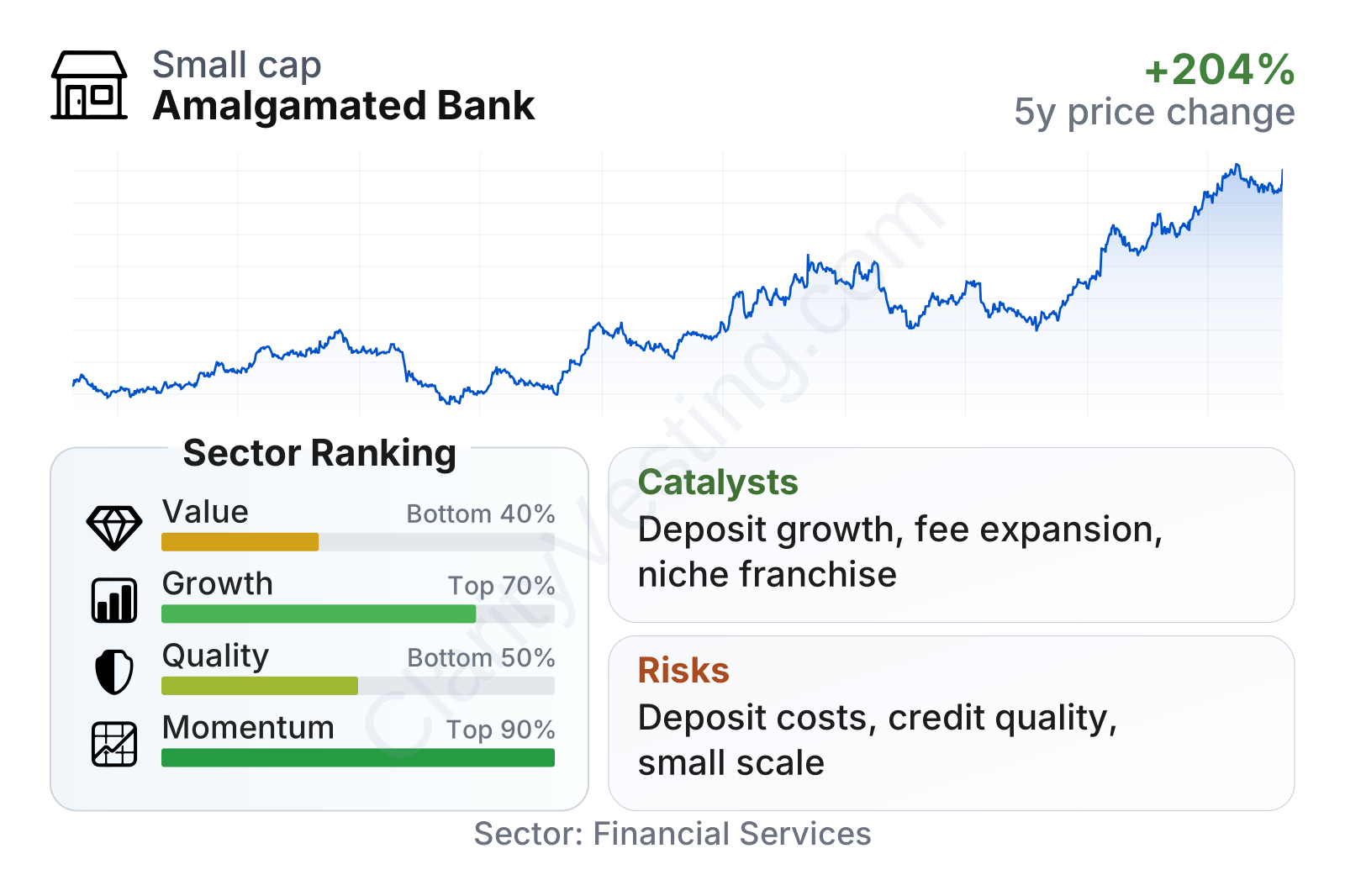
Amalgamated stands out as a smaller public bank with better-than-median growth and generally solid quality indicators for its sector. Revenue growth has been notably stronger than the typical regional bank, profitability remains healthy, and recent stock performance has been much stronger than the sector median. Valuation is more mixed: earnings multiples are close to the sector, but the price-to-book ratio now sits above the median, which suggests the market is assigning a premium to its business model and execution.
The share price record shows sharp volatility during the 2023 regional banking stress, followed by a strong rebound and a substantial rerating through 2024 to 2026. That pattern is common in banks, but the strength of the recovery indicates that the market increasingly views Amalgamated as more differentiated than a standard regional lender.
Growth
Amalgamated operates in a mature industry, not a high-growth one. Traditional banking in the United States is highly competitive and heavily regulated. However, some parts of the market are still attractive for specialized institutions, particularly where customer relationships are sticky and values-based branding helps win deposits and advisory mandates. That is where Amalgamated’s strategy makes the most sense.
The bank’s focus on labor unions, nonprofits, socially responsible organizations, and related institutional clients gives it a clearer identity than many regional peers. This matters because long-term growth in banking often comes less from dramatic industry expansion and more from taking share in selected niches, deepening relationships, and cross-selling additional services. A bank that can combine deposits, treasury services, lending, and investment management for the same client can grow more efficiently than one competing broadly on rate alone.
Recent operating trends support that view. Revenue growth has been well ahead of the sector median, and book value per share has compounded faster than many peers over the last five years. Dividend growth has also been stronger than average, which usually reflects confidence in earnings durability, even if the current dividend yield remains relatively modest because the stock price has appreciated strongly.
Earnings per share have risen significantly from 2021 through 2025, showing a business that has scaled profitably despite a more difficult funding environment for banks. The pace is not perfectly smooth, but the broader direction has been upward.
Book value per share has also advanced meaningfully after a dip in 2022. For a bank, this is an important sign because it reflects the growth of underlying shareholder equity over time. A rising book value often supports long-term compounding if credit quality and capital discipline remain intact.
As for catalysts, the most important ones are not flashy. Continued deposit growth from institutional and mission-driven clients, expansion of trust and investment management fees, and a stable or improving interest-rate backdrop could all support further earnings capacity. If the bank continues to attract low-cost or relationship-based deposits while maintaining loan discipline, it could keep converting its niche positioning into above-average growth.
Recent company updates have also pointed to ongoing business momentum rather than retrenchment. In the current environment, that matters because many regional banks are still being judged on deposit stability, capital strength, and commercial real estate exposure. Any evidence that Amalgamated is strengthening these areas can create a meaningful opportunity for the franchise to be valued differently from weaker peers.
Risks
This article is for informational purposes only and does not constitute financial advice. Some content is AI-generated. See Disclaimer


