Stock Analysis · Alexanders Inc (ALX)
Overview
Alexander’s, Inc. is a real estate investment trust focused on owning, operating, and developing a small number of large properties in the New York City area. Its portfolio is highly concentrated and includes office, retail, and mixed-use assets, with the company’s most important property being Bloomberg L.P.’s headquarters at 731 Lexington Avenue in Manhattan. Alexander’s is externally managed by Vornado Realty Trust, which is an important part of how the business is run.
For long-term analysis, the key point is that this is not a diversified national REIT. It is a concentrated New York property owner whose results depend heavily on a handful of major assets, long leases, occupancy, and property-level financing. That can create strong cash generation when assets are performing well, but it also makes results less predictable than those of larger, more diversified real estate groups.
Based on the company’s recent annual disclosures, revenue mainly comes from rental income tied to its operating properties, plus a smaller contribution from parking and tenant-related reimbursements. A practical breakdown is:
- Rental revenue: approximately 85% to 90% — base rent and other lease-related income from office, retail, and mixed-use properties.
- Tenant reimbursements and escalation income: approximately 8% to 12% — amounts tenants pay back for property operating costs, taxes, and similar items depending on lease terms.
- Parking and other property income: approximately 1% to 5% — parking operations and smaller miscellaneous property-related sources.
The business model is simple to understand: Alexander’s owns valuable real estate, rents it out, collects recurring income, pays property and financing costs, and distributes a large share of cash flow through dividends as a REIT.
Over the last several years, revenue has stayed in a fairly narrow range, but profit conversion has been much more uneven. That pattern fits a property company with a small asset base: one-off costs, financing changes, valuation-related items, or tenant shifts can have an outsized effect on net income from one year to the next.
Key Figures
| Metric | Value | Sector ⓘ |
|---|---|---|
| Date | Oct 17, 2026 | |
| Context | ||
| Sector | Real Estate | |
| Industry | REIT - Retail | |
| Market Cap ⓘ | $1.20B | |
| Beta ⓘ | 0.77 | |
Value (Cheapness) | ||
| P/E Ratio ⓘ | 7.16 | 17.38 |
| P/B Ratio ⓘ | 5.39 | 0.85 |
| FCF Yield ⓘ | 1.72% | 7.38% |
| Dividend Yield ⓘ | 7.60% | 4.85% |
| EBIT / EV ⓘ | 11.60% | 3.78% |
| PEG ⓘ | 2.51 | |
Growth (Business expansion) | ||
| Revenue Growth ⓘ | 6.10% | 5.30% |
| RPS Growth (5Y CAGR) ⓘ | 0.79% | 6.02% |
| EPS Growth (5Y CAGR) ⓘ | -32.37% | -11.37% |
| BVPS Growth (5Y CAGR) ⓘ | -18.97% | 0.45% |
| Margin Growth (5Y Trend) ⓘ | -35.44% | -0.22% |
| FCF Growth (5Y CAGR) ⓘ | -11.27% | 5.40% |
| DPS Growth (5Y CAGR) ⓘ | -0.00% | 5.02% |
Quality (Business durability) | ||
| ROIC (Latest) ⓘ | N/A | 5.69% |
| ROE (Latest) ⓘ | 96.50% | 7.56% |
| ROA (Latest) ⓘ | 13.59% | 2.85% |
| ROIC (5Y Median) ⓘ | 3.25% | 4.22% |
| ROE (5Y Median) ⓘ | 23.57% | 6.03% |
| ROA (5Y Median) ⓘ | 4.13% | 2.44% |
| Net Debt / EBIT (Latest) ⓘ | 2.27 | 7.59 |
| Net Debt / EBIT (5Y Median) ⓘ | 7.20 | 8.40 |
| Net Debt / EBITDA (Latest) ⓘ | 1.96 | 5.27 |
| Net Debt / Assets ⓘ | 41.42% | 37.76% |
| EBITDA / Interest ⓘ | 5.14 | 4.10 |
| Operating Margin (Latest) ⓘ | 102.13% | 35.29% |
| Operating Margin (5Y Median) ⓘ | 41.90% | 37.31% |
| Debt to Equity (Latest) ⓘ | 383.05% | 88.87% |
| Profit Margin (Latest) ⓘ | 79.06% | 19.61% |
| Free Cash Flow (Latest) ⓘ | $20.68M | |
Momentum (Price trend) | ||
| 3Y Return ⓘ | +67.21% | +30.75% |
| 12M Return (excl. last month) ⓘ | +9.01% | +4.36% |
| 6M Return ⓘ | -0.49% | -2.52% |
| Price vs. 200-Day MA ⓘ | -4.15% | -2.34% |
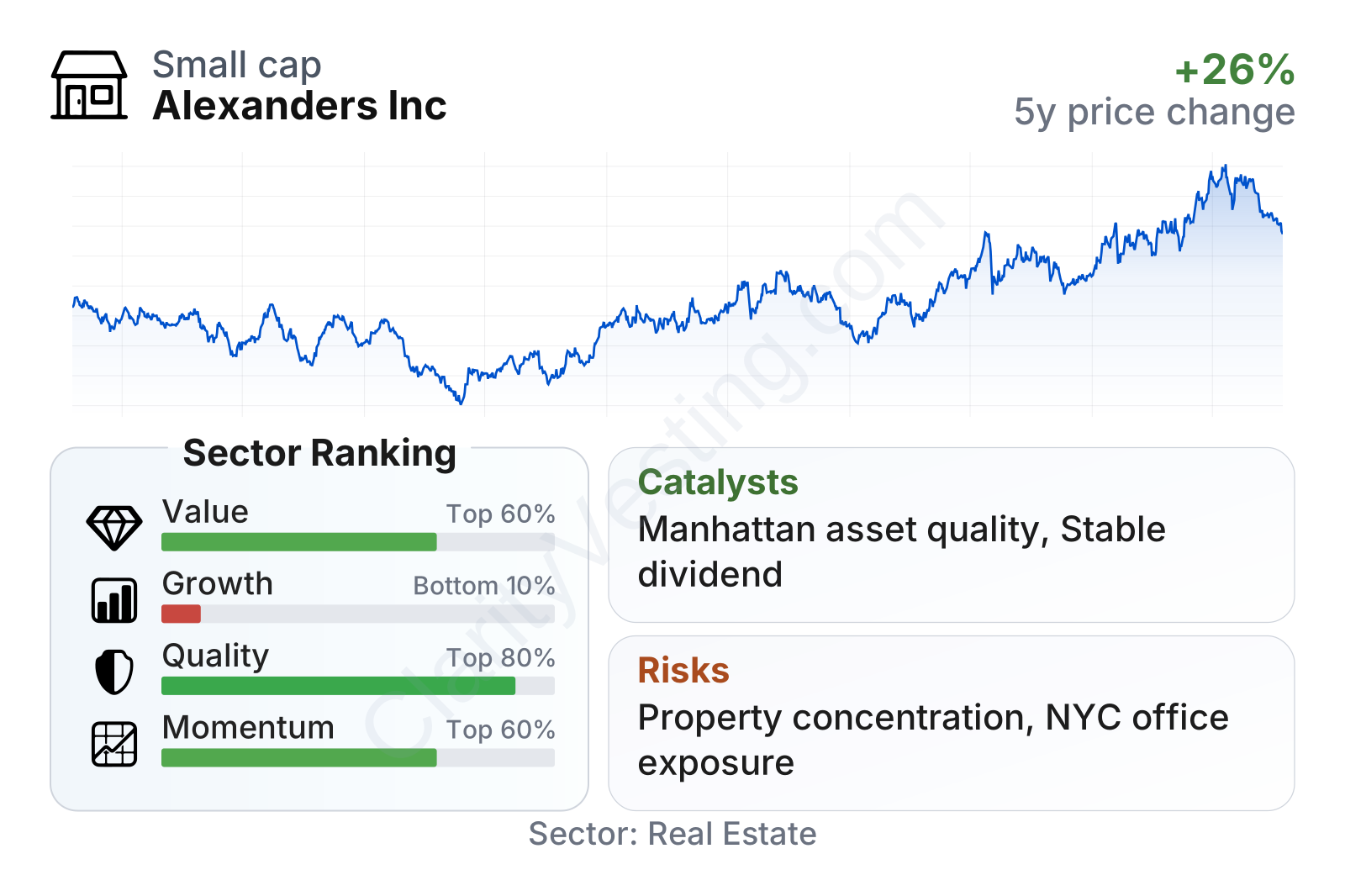
Alexander’s sits in an unusual position. On earnings, the shares look inexpensive versus much of the real estate sector, and the dividend yield is clearly above the sector median. Profitability and asset returns also rank strongly. However, growth metrics are weak, with several five-year trends trailing the sector by a wide margin. In other words, the market is looking at a company with strong current economics but limited long-term expansion. The stock has also shown better price momentum than many peers, suggesting the market has recently rewarded the stability of its assets and income profile.
The company is relatively small by public REIT standards, with a low beta that points to less share-price volatility than the broader market. That said, low trading volatility does not remove business concentration risk, which remains central to understanding the company.
Growth
Alexander’s operates in a mature sector rather than a high-growth one. New York real estate can create long-term value because premium locations are difficult to replicate, replacement costs are high, and zoning constraints can protect existing assets. But this is not the kind of company where growth usually comes from rapid expansion across dozens of markets. Growth depends more on leasing, redevelopment, rent resets, occupancy improvement, and extracting more value from a very limited portfolio.
The strategy makes sense for a concentrated asset owner: keep high-quality urban properties leased, maintain pricing power where location supports it, and rely on long-lived real estate rather than aggressive acquisition activity. That can work well over time if the properties remain relevant and financing stays manageable.
Revenue per share has been mostly stable over the last five years, with only modest movement up and down. That supports the view that Alexander’s is more of a cash-generating property vehicle than a business with strong built-in expansion. Stability can be valuable, but it also means future upside likely depends on specific leasing wins or property improvements rather than broad portfolio growth.
Dividend per share has been remarkably steady, around the same level year after year. For a REIT, that consistency matters because it signals that the company has so far been able to support distributions despite uneven earnings. It also suggests management is prioritizing income stability over aggressive reinvestment.
A key catalyst is the quality and location of the asset base, especially the exposure to irreplaceable Manhattan real estate. Another is the company’s relationship with Vornado Realty Trust, which brings operating experience in New York properties. If office and high-street retail conditions in Manhattan continue to normalize, Alexander’s could benefit from firmer leasing demand and stronger pricing on its core assets. The company’s small size also means that improvement at only one or two properties can noticeably affect overall results.
Recent company reporting has continued to emphasize property operations, leasing, debt management, and recurring income rather than transformational expansion. That points to a future shaped more by execution on existing assets than by major strategic reinvention.
Risks
This article is for informational purposes only and does not constitute financial advice. Some content is AI-generated. See Disclaimer


