Stock Analysis · Alvotech (ALVO)
Overview
Alvotech is a biotechnology company focused on developing and manufacturing biosimilars. A biosimilar is a medicine designed to be highly similar to an already approved biologic drug whose exclusivity period has expired. These products aim to offer lower-cost alternatives to some of the world’s biggest specialty medicines used in areas such as autoimmune disease, eye disease, osteoporosis, and cancer.
The company’s model is more specialized than that of a traditional generic drug maker. It invests heavily in product development, clinical work, regulatory filings, and manufacturing, then partners with larger pharmaceutical companies for commercialization in major markets. This means Alvotech is trying to build value through a pipeline of follow-on biologic medicines rather than through a broad portfolio of small-molecule generics.
Revenue is still concentrated in a limited number of streams, which is normal for a company at this stage. Based on recent company disclosures, the main sources of revenue are broadly:
- Product revenue and supply revenue – likely the largest source in the latest full year, supported by commercial launches and product supply to partners.
- License and milestone revenue – payments from partners tied to development, regulatory, and commercialization agreements.
- Other collaboration-related income – smaller items connected to strategic partnerships and related arrangements.
Because Alvotech’s reported sales can move sharply depending on launch timing, partner orders, and milestone recognition, a clean percentage split is not always stable from one period to the next. What is clear is that the business has been shifting from a mainly development-funded model toward a more commercial model with a growing role for product-based revenue.
Operationally, Alvotech’s core assets are its biosimilar pipeline, its integrated development and manufacturing capabilities, and its partner network across the United States, Europe, and other international markets.
The multi-year financial profile shows a business that spent heavily on research, manufacturing scale-up, and financing costs before revenue caught up. Revenue improved sharply in 2024 and again in 2025, and operating losses narrowed materially before turning into operating profit in 2025, which suggests the platform can become much more efficient once products move into commercial supply.
Key Figures
| Metric | Value | Sector ⓘ |
|---|---|---|
| Date | Oct 17, 2026 | |
| Context | ||
| Sector | Healthcare | |
| Industry | Drug Manufacturers - Specialty & Generic | |
| Market Cap ⓘ | $1.86B | |
| Beta ⓘ | 0.20 | |
Value (Cheapness) | ||
| P/E Ratio ⓘ | N/A | 24.79 |
| P/B Ratio ⓘ | N/A | 3.08 |
| FCF Yield ⓘ | -16.17% | 3.15% |
| Dividend Yield ⓘ | N/A | 1.94% |
| EBIT / EV ⓘ | -1.03% | 0.57% |
| PEG ⓘ | N/A | |
Growth (Business expansion) | ||
| Revenue Growth ⓘ | -38.90% | 7.45% |
| RPS Growth (5Y CAGR) ⓘ | 15.58% | 8.61% |
| EPS Growth (5Y CAGR) ⓘ | -58.77% | -17.81% |
| BVPS Growth (5Y CAGR) ⓘ | -30.39% | 3.72% |
| Margin Growth (5Y Trend) ⓘ | N/A | -0.62% |
| FCF Growth (5Y CAGR) ⓘ | -19.18% | 1.04% |
| DPS Growth (5Y CAGR) ⓘ | N/A | 6.77% |
Quality (Business durability) | ||
| ROIC (Latest) ⓘ | 31.00% | 3.24% |
| ROA (Latest) ⓘ | -11.99% | 3.01% |
| ROIC (5Y Median) ⓘ | -84.38% | 4.60% |
| ROA (5Y Median) ⓘ | -21.36% | 1.89% |
| Net Debt / EBIT (Latest) ⓘ | N/A | 1.34 |
| Net Debt / EBIT (5Y Median) ⓘ | N/A | 1.84 |
| Net Debt / EBITDA (Latest) ⓘ | 200.37 | 1.00 |
| Net Debt / Assets ⓘ | 82.46% | 5.45% |
| EBITDA / Interest ⓘ | 0.04 | 9.64 |
| Operating Margin (Latest) ⓘ | -7.07% | 9.27% |
| Operating Margin (5Y Median) ⓘ | -98.52% | 7.38% |
| Debt to Equity (Latest) ⓘ | -758.20% | 28.58% |
| Profit Margin (Latest) ⓘ | -36.31% | 3.59% |
| Free Cash Flow (Latest) ⓘ | -$300.25M | |
Momentum (Price trend) | ||
| 3Y Return ⓘ | -41.26% | +42.80% |
| 12M Return (excl. last month) ⓘ | -38.18% | +18.50% |
| 6M Return ⓘ | +45.08% | +7.57% |
| Price vs. 200-Day MA ⓘ | +26.17% | +5.12% |
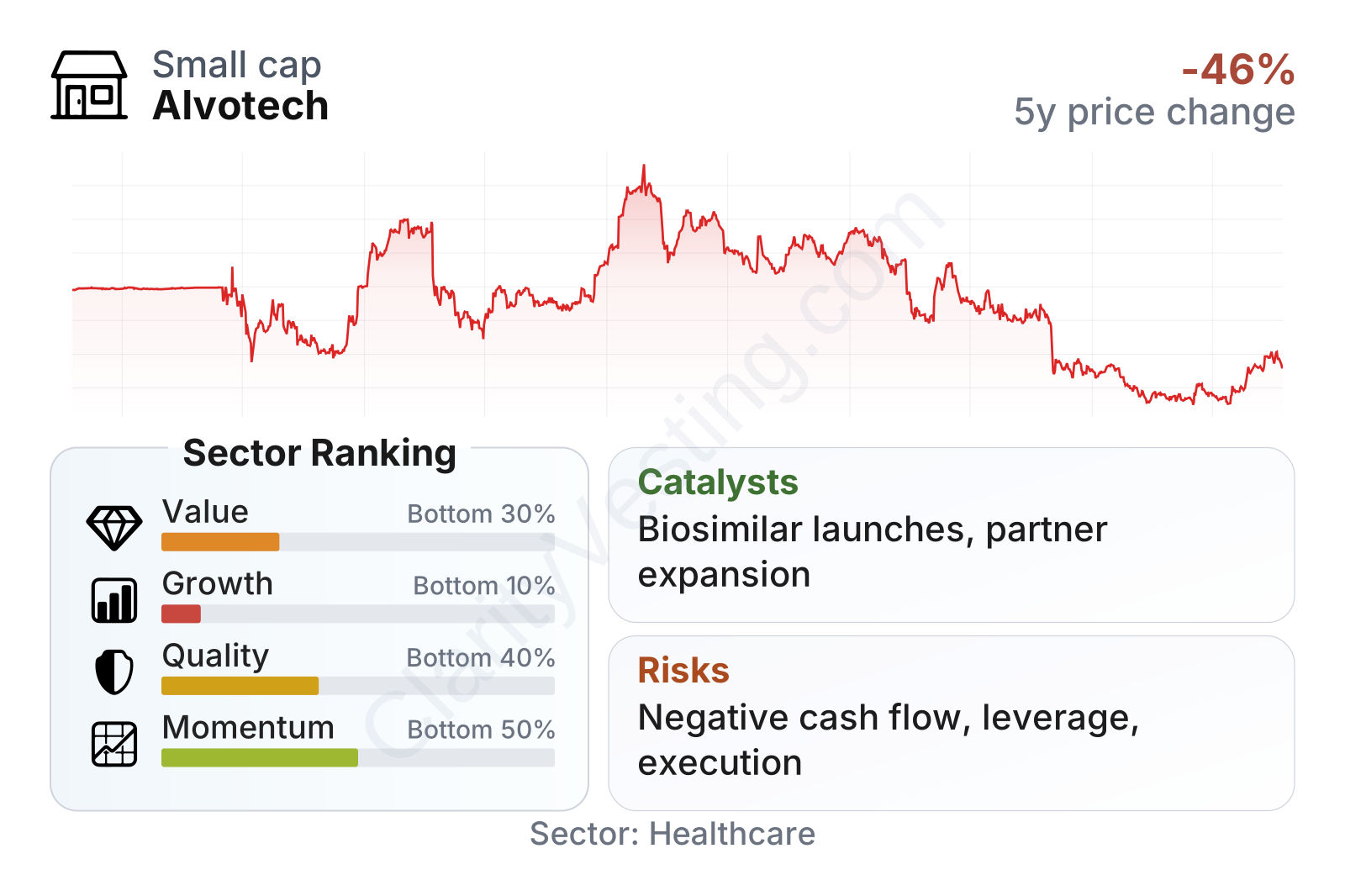
Alvotech is a mid-sized healthcare company by market value, but its financial profile is still unusual compared with most of the sector. The table points to weak rankings on value, growth, quality, and momentum versus the broader healthcare universe, largely because recent revenue has been volatile, free cash flow remains negative, and profitability has swung sharply. One notable offset is that recent return on invested capital looks strong on a trailing basis, but that should be read carefully because it follows a period of highly uneven earnings.
The stock price history shows a company with significant volatility rather than a steady long-term climb. There was a sharp decline through 2025 and into 2026, even after a strong earlier phase, which indicates that market confidence has been heavily affected by execution concerns and shifting expectations around launches, revenue timing, and financing.
Growth
The sector itself has a solid long-term backdrop. Biosimilars are one of the more attractive parts of the pharmaceutical market because many blockbuster biologic drugs are losing exclusivity, while health systems and insurers continue looking for lower-cost alternatives. That creates room for well-positioned manufacturers that can handle development complexity, regulatory standards, and large-scale biologic production.
Alvotech’s strategy is logical for that environment. Instead of trying to compete across hundreds of products, it is concentrating on a smaller number of high-value biologics where successful approval and launch can move revenue meaningfully. Its partner-led commercialization strategy also makes sense: large pharmaceutical partners already have market access, sales channels, and payer relationships, while Alvotech contributes development and manufacturing.
Revenue growth has been anything but smooth. The pattern shows very large jumps around launch and milestone periods, followed by declines when comparisons become harder or timing shifts between quarters. That is a reminder that this is not yet a mature, stable revenue base. Even so, the broader arc from 2021 through 2025 was one of substantial expansion before the most recent slowdown in 2026.
Cash generation remains an important point to watch. Free cash flow has stayed negative, although the losses have improved from earlier levels. That suggests the business is moving in the right direction operationally, but it has not yet reached the point where commercialization consistently funds development, capital needs, and financing costs.
A major catalyst is the company’s pipeline depth and the continuing rollout of approved biosimilars through partners in key markets. Recent company updates have highlighted regulatory progress, additional market launches, and commercial expansion with partners such as Teva and other regional distributors. For Alvotech, each new approval or geographic launch can matter disproportionately because a single product can open a meaningful revenue stream.
Another favorable factor is manufacturing leverage. Biosimilars are difficult to make at scale, and companies that already have approved facilities and validated processes may be able to add products more efficiently over time. If Alvotech converts more of its pipeline into launched products, the same platform could support stronger margins than those seen during the heavy build-out phase.
Risks
This article is for informational purposes only and does not constitute financial advice. Some content is AI-generated. See Disclaimer


