Stock Analysis · Alnylam Pharmaceuticals Inc (ALNY)
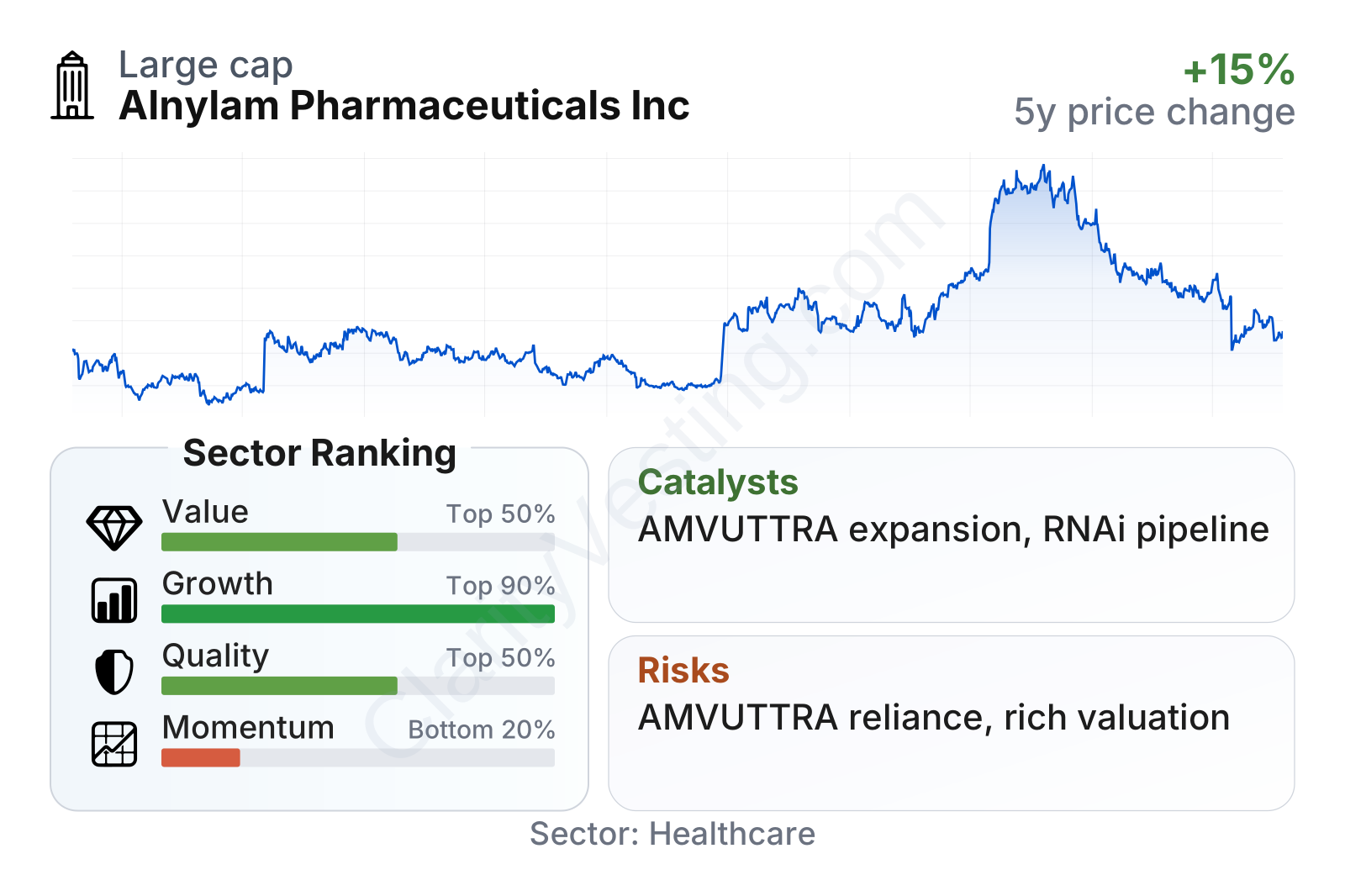
Overview
Alnylam Pharmaceuticals is a biotechnology company focused on medicines based on RNA interference, often shortened to RNAi. In simple terms, its drugs are designed to silence specific genes so the body produces less of a harmful protein. This is a specialized part of medicine, but the business model is straightforward: discover new therapies, win regulatory approvals, and then generate revenue from commercialized drugs, collaborations, and royalties.
Alnylam’s commercial business is now large enough to matter on its own, which is important for a biotech company. It is no longer only a research platform with future hopes attached to it. The company has multiple marketed products, mainly in rare disease and cardiometabolic conditions, and it continues to invest heavily in expanding the number of approved uses.
Based on recent annual results and company disclosures, its revenue mix is led by product sales, with collaboration-related revenue playing a smaller but still meaningful role.
- Net product revenue: about 80% to 90% of total revenue. This includes sales of products such as ONPATTRO, GIVLAARI, OXLUMO, AMVUTTRA, and more recently Leqvio royalties or partnered economics where applicable. The biggest driver has increasingly been AMVUTTRA, which is used in transthyretin-mediated diseases.
- Collaboration and license revenue: about 10% to 20% of total revenue. This typically includes milestone payments, partner reimbursements, and other agreement-related revenue from pharmaceutical partners.
- Royalty and other revenue: low single-digit share when separated. Depending on reporting periods, some royalty-related economics may be embedded within collaboration lines or disclosed separately in supporting commentary rather than as a major standalone category.
The most important business change in recent years is that Alnylam has moved from persistent heavy losses toward a more commercial, scale-driven model. Revenue has climbed sharply from under $1 billion a few years ago to more than $3.7 billion in 2025, while profitability has improved from deep losses to positive net income.
The long-term financial picture shows a major operating transition: revenue has expanded quickly, gross profit has grown even faster, and the company crossed into positive operating and net income in 2025 after several years of large research and commercialization spending. That does not remove execution risk, but it does show that the platform is producing a real commercial business rather than only pipeline potential.
Key Figures
| Metric | Value | Sector ⓘ |
|---|---|---|
| Date | Oct 17, 2026 | |
| Context | ||
| Sector | Healthcare | |
| Industry | Biotechnology | |
| Market Cap ⓘ | $30.04B | |
| Beta ⓘ | 0.27 | |
Value (Cheapness) | ||
| P/E Ratio ⓘ | 37.73 | 24.79 |
| P/B Ratio ⓘ | 23.89 | 3.08 |
| FCF Yield ⓘ | 1.81% | 3.15% |
| Dividend Yield ⓘ | N/A | 1.94% |
| EBIT / EV ⓘ | 3.54% | 0.57% |
| PEG ⓘ | 0.32 | |
Growth (Business expansion) | ||
| Revenue Growth ⓘ | 66.90% | 7.45% |
| RPS Growth (5Y CAGR) ⓘ | 40.25% | 8.61% |
| EPS Growth (5Y CAGR) ⓘ | N/A | -17.81% |
| BVPS Growth (5Y CAGR) ⓘ | 4.22% | 3.72% |
| Margin Growth (5Y Trend) ⓘ | N/A | -0.62% |
| FCF Growth (5Y CAGR) ⓘ | N/A | 1.04% |
| DPS Growth (5Y CAGR) ⓘ | N/A | 6.77% |
Quality (Business durability) | ||
| ROIC (Latest) ⓘ | 61.65% | 3.24% |
| ROA (Latest) ⓘ | 15.52% | 3.01% |
| ROIC (5Y Median) ⓘ | -29.37% | 4.60% |
| ROA (5Y Median) ⓘ | -11.94% | 1.89% |
| Net Debt / EBIT (Latest) ⓘ | -0.40 | 1.34 |
| Net Debt / EBIT (5Y Median) ⓘ | N/A | 1.84 |
| Net Debt / EBITDA (Latest) ⓘ | -0.38 | 1.00 |
| Net Debt / Assets ⓘ | -7.93% | 5.45% |
| EBITDA / Interest ⓘ | 3.54 | 9.64 |
| Operating Margin (Latest) ⓘ | 22.81% | 9.27% |
| Operating Margin (5Y Median) ⓘ | -17.08% | 7.38% |
| Debt to Equity (Latest) ⓘ | 93.60% | 28.58% |
| Profit Margin (Latest) ⓘ | 16.13% | 3.59% |
| Free Cash Flow (Latest) ⓘ | $542.54M | |
Momentum (Price trend) | ||
| 3Y Return ⓘ | +39.93% | +42.80% |
| 12M Return (excl. last month) ⓘ | -48.33% | +18.50% |
| 6M Return ⓘ | -29.80% | +7.57% |
| Price vs. 200-Day MA ⓘ | -20.70% | +5.12% |
Alnylam stands out for growth and recent operating improvement, while valuation remains rich compared with much of the healthcare sector. Growth metrics are far above sector medians, quality is supported by strong current profitability and a net cash position on an EBIT and EBITDA basis, but share-price momentum has been weak recently after a very strong earlier run. That mix usually points to a company the market still values for future expansion, even after a meaningful pullback from prior highs.
The stock history also shows how volatile sentiment can be in biotech. The shares rose dramatically into late 2025 and then gave back a notable part of that move in 2026. For long-term readers, that matters because the business may be improving even when the stock is not moving in a straight line.
Growth
Alnylam operates in an attractive part of healthcare: genetic medicines and RNA-based therapeutics. This is a growing field because it aims to treat disease at a deeper biological level rather than only reducing symptoms. The company is one of the best-known specialists in RNA interference and has already shown that this science can produce approved medicines, which gives it more credibility than many earlier-stage biotech peers.
The current strategy also makes sense for future expansion. Instead of relying on a single product, Alnylam is building a broader portfolio across rare disease and larger population categories. Rare diseases can support high pricing and faster specialist adoption, while cardiometabolic and cardiovascular indications can eventually open much larger markets. That combination can be powerful if execution remains strong.
Revenue growth has been unusually strong, though not perfectly smooth from quarter to quarter. Recent year-over-year increases have often been far above the healthcare sector median, reflecting expanding product adoption and a growing contribution from newer launches. That kind of growth is one reason the market has historically assigned Alnylam a premium valuation.
Cash generation has also improved meaningfully. Free cash flow was deeply negative in earlier years, turned positive, briefly dipped again, and then recovered strongly. That pattern is common in commercial-stage biotech businesses moving past a heavy investment phase. Positive free cash flow does not mean spending will stay restrained, but it does suggest the company now has more internal financial flexibility than it used to.
One of the clearest catalysts is the continued rollout of AMVUTTRA, especially as Alnylam seeks to expand its use beyond hereditary ATTR polyneuropathy into broader transthyretin-related disease settings. A successful move into larger patient populations could materially increase revenue potential. The company has also continued advancing other late-stage RNAi candidates, which keeps the pipeline relevant rather than dependent on one franchise alone.
Recent company updates have reinforced this opportunity set. In 2026, Alnylam continued to highlight commercial progress, pipeline execution, and the importance of additional label expansion opportunities. For a business already showing commercial scale, successful regulatory or clinical milestones can have an outsized effect because they build on an existing sales infrastructure instead of starting from zero.
Risks
This article is for informational purposes only and does not constitute financial advice. Some content is AI-generated. See Disclaimer


