Stock Analysis · Alignment Healthcare LLC (ALHC)
Overview
Alignment Healthcare is a Medicare-focused health insurance company. It mainly serves seniors through Medicare Advantage plans and combines insurance coverage with care coordination, technology tools, and a clinical model designed to improve outcomes while managing medical costs. The company operates under the Alignment Health brand and concentrates on specific local markets rather than trying to cover the entire country at once.
The business model is straightforward at a high level: Alignment receives premium revenue tied to enrolled members, then uses that money to pay for medical care, pharmacy benefits, broker commissions, administrative costs, and technology-enabled care management. Its results depend heavily on membership growth, reimbursement rates from the federal government, and its ability to keep medical costs under control.
Revenue is overwhelmingly concentrated in insurance premiums and related healthcare plan income. Based on company filings, the mix is approximately as follows:
- Premium revenue from Medicare Advantage and other health plan products: about 98% to 99%. This is the core of the business and reflects monthly payments linked to members, adjusted by health status and plan design.
- Other revenue: about 1% to 2%. This typically includes smaller service-related or ancillary items and is not a major driver of the company’s economics.
One notable operating trend is scale. Revenue rose from about $1.2 billion in 2021 to roughly $3.9 billion in 2025, while operating losses narrowed sharply and the company reached positive operating income in 2025. That progression suggests the model is becoming more efficient as membership grows, although profitability remains thin.
The business has become much larger over the past few years, and the cost structure shows a company moving from heavy losses toward breakeven. Gross profit expanded meaningfully as revenue scaled, while administrative spending grew more slowly than premium revenue, which is an encouraging sign for operating leverage.
Key Figures
| Metric | Value | Sector ⓘ |
|---|---|---|
| Date | Oct 17, 2026 | |
| Context | ||
| Sector | Healthcare | |
| Industry | Healthcare Plans | |
| Market Cap ⓘ | $1.71B | |
| Beta ⓘ | 1.14 | |
Value (Cheapness) | ||
| P/E Ratio ⓘ | 43.32 | 24.79 |
| P/B Ratio ⓘ | 6.61 | 3.08 |
| FCF Yield ⓘ | 12.04% | 3.15% |
| Dividend Yield ⓘ | N/A | 1.94% |
| EBIT / EV ⓘ | 4.37% | 0.57% |
| PEG ⓘ | N/A | |
Growth (Business expansion) | ||
| Revenue Growth ⓘ | 31.60% | 7.45% |
| RPS Growth (5Y CAGR) ⓘ | 30.91% | 8.61% |
| EPS Growth (5Y CAGR) ⓘ | N/A | -17.81% |
| BVPS Growth (5Y CAGR) ⓘ | -15.54% | 3.72% |
| Margin Growth (5Y Trend) ⓘ | N/A | -0.62% |
| FCF Growth (5Y CAGR) ⓘ | N/A | 1.04% |
| DPS Growth (5Y CAGR) ⓘ | N/A | 6.77% |
Quality (Business durability) | ||
| ROIC (Latest) ⓘ | 10.60% | 3.24% |
| ROA (Latest) ⓘ | 3.42% | 3.01% |
| ROIC (5Y Median) ⓘ | -23.88% | 4.60% |
| ROA (5Y Median) ⓘ | -23.65% | 1.89% |
| Net Debt / EBIT (Latest) ⓘ | -6.60 | 1.34 |
| Net Debt / EBIT (5Y Median) ⓘ | N/A | 1.84 |
| Net Debt / EBITDA (Latest) ⓘ | -4.19 | 1.00 |
| Net Debt / Assets ⓘ | -28.38% | 5.45% |
| EBITDA / Interest ⓘ | 5.33 | 9.64 |
| Operating Margin (Latest) ⓘ | 1.20% | 9.27% |
| Operating Margin (5Y Median) ⓘ | -6.96% | 7.38% |
| Debt to Equity (Latest) ⓘ | 124.66% | 28.58% |
| Profit Margin (Latest) ⓘ | 0.89% | 3.59% |
| Free Cash Flow (Latest) ⓘ | $205.55M | |
Momentum (Price trend) | ||
| 3Y Return ⓘ | +5.03% | +42.80% |
| 12M Return (excl. last month) ⓘ | -36.46% | +18.50% |
| 6M Return ⓘ | -61.04% | +7.57% |
| Price vs. 200-Day MA ⓘ | -53.43% | +5.12% |
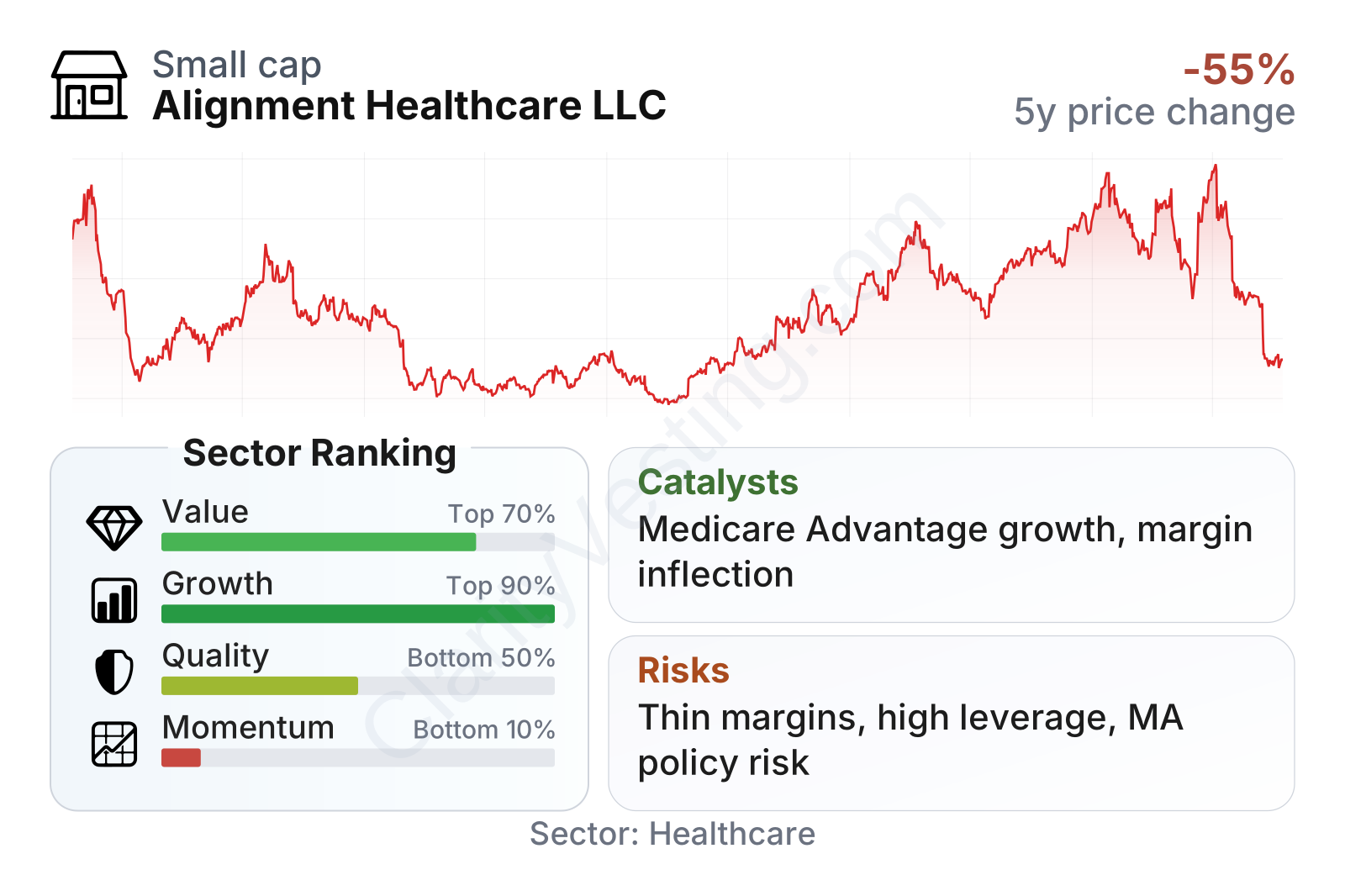
Alignment Healthcare is still a relatively small public company by market value, with share-price behavior that has been more volatile than the broader market. The factor profile is mixed but informative: growth ranks strongly versus the healthcare sector, value metrics are supported by solid cash generation, while quality and momentum are weaker. In plain terms, the company looks like a fast-growing operator that has only recently crossed into much better financial shape, and the market has not treated that transition as fully settled yet.
Growth
Alignment operates in a sector with a long runway. Medicare Advantage has benefited from aging demographics, rising senior healthcare needs, and consumer preference for plans that bundle medical coverage, drug benefits, and care coordination. As the U.S. senior population expands, companies with effective member acquisition and cost management have a clear opportunity to grow.
The company’s strategy appears coherent for that backdrop. Rather than competing everywhere, Alignment has focused on selected counties and states, building density in markets where provider relationships, star ratings, and care management can improve economics over time. That can be a sensible approach in healthcare plans, where local execution often matters more than national branding alone.
Recent growth has been strong even by healthcare plan standards. Revenue growth has remained well above the sector median, and although the pace has cooled from the exceptionally high levels seen in 2024 and 2025, growth around the low-30% range is still robust. Five-year revenue-per-share growth near 31% also points to a business that has expanded far faster than most peers in the sector.
Cash generation is another important change. Free cash flow was negative at points during the company’s buildout, but the trailing figure has turned strongly positive, reaching more than $200 million. That matters because healthcare insurers can report accounting improvements before cash economics fully stabilize; positive free cash flow suggests Alignment is now converting more of its growth into financial flexibility.
A meaningful catalyst is the company’s transition from losses toward profitability. In 2025, Alignment posted positive operating income and nearly reached net-income breakeven for the full year. By mid-2026, profit margin had turned slightly positive. For a company that spent years scaling up, this shift can be significant because it changes the debate from “can it grow?” to “can it sustain profitable growth?”
Another potential support is execution in Medicare Advantage quality measures and member retention. Better plan quality can improve reimbursement economics and strengthen enrollment momentum. In a business where fixed costs can be spread across a larger member base, even modest improvements in retention, pricing, or medical cost control can have an outsized effect on earnings.
Risks
This article is for informational purposes only and does not constitute financial advice. Some content is AI-generated. See Disclaimer


