Stock Analysis · Align Technology Inc (ALGN)
Overview
Align Technology is a medical device company best known for Invisalign, its system of clear removable aligners used to straighten teeth. The company also sells digital scanners and software that help dentists and orthodontists plan treatments, take 3D images of patients’ mouths, and connect scans with aligner production. In simple terms, Align operates at the intersection of orthodontics, dentistry, and digital workflow.
Its business is mainly organized into two reporting segments, with revenue heavily concentrated in clear aligners.
- Clear Aligner segment: about 81% of 2025 revenue. This includes comprehensive Invisalign treatments for teens and adults, non-comprehensive cases, and products sold to doctors to support aligner treatment.
- Imaging Systems and CAD/CAM Services segment: about 19% of 2025 revenue. This includes iTero intraoral scanners, related software, service contracts, and exocad dental design solutions.
The revenue mix matters because it shows that Align is still primarily an Invisalign company, even though its digital scanner and software ecosystem plays an important strategic role. That second segment can help attract and retain dental professionals inside Align’s broader platform, which may strengthen the core aligner business over time.
The business profile also shows a company with high gross profit but meaningful selling, marketing, and research spending. Over the last several years, revenue has recovered after the 2022 slowdown, but earnings have not returned to the peak seen during the pandemic-era surge. That suggests a business with real pricing power and scale, but also one still working through a slower growth phase and a more competitive market.
Revenue has been relatively stable around the $4 billion level in recent years, while operating income and net income have remained below 2021 highs. Selling and administrative costs continue to absorb a large share of gross profit, which helps explain why revenue resilience has not fully translated into earnings expansion.
Key Figures
| Metric | Value | Sector ⓘ |
|---|---|---|
| Date | Oct 24, 2026 | |
| Context | ||
| Sector | Healthcare | |
| Industry | Medical Instruments & Supplies | |
| Market Cap ⓘ | $10.75B | |
| Beta ⓘ | 1.67 | |
Value (Cheapness) | ||
| P/E Ratio ⓘ | 26.33 | 25.42 |
| P/B Ratio ⓘ | 2.63 | 3.08 |
| FCF Yield ⓘ | 7.03% | 3.12% |
| Dividend Yield ⓘ | N/A | 1.85% |
| EBIT / EV ⓘ | 6.59% | 0.56% |
| PEG ⓘ | 0.62 | |
Growth (Business expansion) | ||
| Revenue Growth ⓘ | 4.30% | 7.50% |
| RPS Growth (5Y CAGR) ⓘ | 2.88% | 8.60% |
| EPS Growth (5Y CAGR) ⓘ | -11.18% | -17.73% |
| BVPS Growth (5Y CAGR) ⓘ | 5.24% | 3.72% |
| Margin Growth (5Y Trend) ⓘ | -10.20% | -0.57% |
| FCF Growth (5Y CAGR) ⓘ | -10.69% | 0.96% |
| DPS Growth (5Y CAGR) ⓘ | N/A | 6.69% |
Quality (Business durability) | ||
| ROIC (Latest) ⓘ | 10.96% | 3.17% |
| ROA (Latest) ⓘ | 6.54% | 2.98% |
| ROIC (5Y Median) ⓘ | 12.35% | 4.56% |
| ROA (5Y Median) ⓘ | 6.85% | 1.87% |
| Net Debt / EBIT (Latest) ⓘ | -1.56 | 1.34 |
| Net Debt / EBIT (5Y Median) ⓘ | -1.26 | 1.86 |
| Net Debt / EBITDA (Latest) ⓘ | -1.25 | 1.00 |
| Net Debt / Assets ⓘ | -15.30% | 5.06% |
| EBITDA / Interest ⓘ | N/A | 9.55 |
| Operating Margin (Latest) ⓘ | 15.19% | 9.25% |
| Operating Margin (5Y Median) ⓘ | 16.80% | 7.33% |
| Debt to Equity (Latest) ⓘ | 2.86% | 26.68% |
| Profit Margin (Latest) ⓘ | 9.99% | 3.34% |
| Free Cash Flow (Latest) ⓘ | $755.70M | |
Momentum (Price trend) | ||
| 3Y Return ⓘ | -41.48% | +51.61% |
| 12M Return (excl. last month) ⓘ | +16.85% | +19.90% |
| 6M Return ⓘ | -20.68% | +10.10% |
| Price vs. 200-Day MA ⓘ | -8.17% | +6.44% |
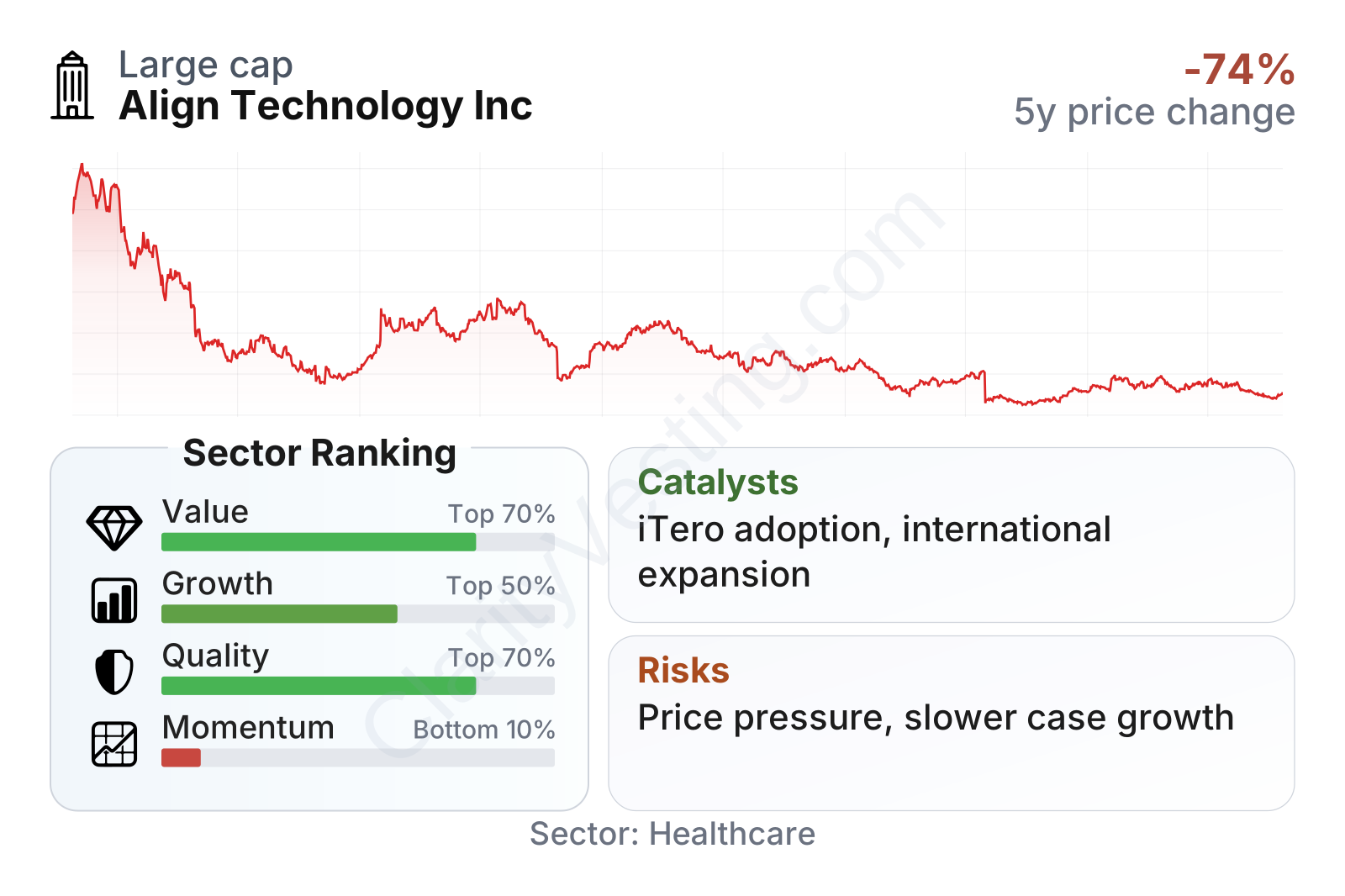
Align stands out for strong balance-sheet quality and cash generation. Profitability remains clearly above the sector median, debt is very low, and the company holds a net cash position rather than relying on leverage. Growth metrics are more mixed: recent revenue growth has turned positive again, but the longer-term record is less impressive than many healthcare peers. Market performance has been weak over the past few years, which helps explain why valuation measures look much more moderate than they once did.
The share price history shows a dramatic rerating from the 2021 peak, followed by a long period of volatility rather than a clean recovery. For long-term analysis, that matters because today’s stock no longer carries the extreme optimism that once surrounded the company.
Growth
Align operates in a sector with favorable long-term drivers. Orthodontic treatment is supported by a large global patient base, rising interest in aesthetics, ongoing digitization of dental practices, and growing use of treatment planning software and 3D scanning. Clear aligners also benefit from being easier for many patients to accept than traditional braces, especially adults who value appearance and convenience.
That said, this is no longer an early-stage market. The question is less about whether clear aligners will exist and more about how much of future demand Align can capture, at what price, and with what margins. The company’s strategy makes sense in that context: it is trying to reinforce its moat by combining brand recognition, doctor relationships, manufacturing scale, treatment data, digital scanning hardware, and workflow software into one ecosystem.
Recent sales trends point to a business that has returned to modest growth after the sharp slowdown in 2022. The latest year-over-year increases are positive, but still far below the expansion rates seen during the company’s strongest years. This supports the view that Align remains a grower, though currently a steadier and less explosive one.
Cash generation has improved noticeably over the last few years. That is important because it gives Align room to keep investing in product development, manufacturing capacity, software, and share repurchases without leaning on debt. For a company in medical technology, that financial flexibility can be a real growth enabler.
Several catalysts could support the next phase. One is continued adoption of iTero scanners and exocad tools, which can deepen integration with dentists and orthodontists. Another is international expansion, especially in markets where clear aligner penetration is still relatively low. Align has also continued to launch product upgrades and workflow improvements that aim to make treatment more predictable and easier for providers to adopt. Recent company updates have emphasized both Invisalign system innovations and AI-enabled digital tools, which could improve efficiency and strengthen doctor engagement if adoption continues.
Risks
This article is for informational purposes only and does not constitute financial advice. Some content is AI-generated. See Disclaimer


