Stock Analysis · Alamo Group Inc (ALG)
Overview
Alamo Group Inc. is an industrial equipment manufacturer focused on machines used to maintain infrastructure, manage vegetation, and support agriculture. In simple terms, the company makes specialized vehicles and attachments that help mow roadsides, clear brush, clean streets, remove snow, dig holes, and handle other demanding outdoor tasks. Its customers include government agencies, contractors, industrial users, and agricultural operators.
The business is organized into two main segments, and this is the clearest way to understand where revenue comes from. Based on the company’s recent annual reporting, revenue is split approximately as follows:
- Vegetation Management – about 67%: This is the largest activity. It includes mowing and brush-cutting equipment, boom-mounted mowers, forestry and tree-care equipment, and other tools used to control vegetation along roads, utilities, and public spaces.
- Industrial Equipment – about 33%: This includes street sweepers, excavators, vacuum trucks, snow and ice control equipment, pothole patchers, and other machinery used for public works, infrastructure maintenance, and specialized industrial tasks.
A useful feature of this mix is that a meaningful part of demand is tied to recurring maintenance rather than one-time mega projects. Roadsides still need mowing, cities still need street cleaning, and municipalities still need winter equipment even when broader construction markets slow down. At the same time, the company also sells into more cyclical areas such as agriculture, industrial projects, and equipment replacement cycles.
Over the last several years, the business expanded revenue meaningfully from 2021 through 2023, then went through a softer period in 2024 and 2025. Profitability also eased from the 2023 peak, but the company remained solidly profitable and cash generative. That combination matters for a long-term view because it suggests a business with real operating resilience, even if not immune to cycle swings.
The revenue and profit flow shows a business that scaled well through 2023, with gross profit and operating income rising faster than sales for a period, before moderating in 2024 and 2025. Even with that pullback, Alamo Group stayed profitable, which points to a business model that has held up better than many capital-goods companies during slower demand periods.
Key Figures
| Metric | Value | Sector ⓘ |
|---|---|---|
| Date | Oct 17, 2026 | |
| Context | ||
| Sector | Industrials | |
| Industry | Farm & Heavy Construction Machinery | |
| Market Cap ⓘ | $1.89B | |
| Beta ⓘ | 1.08 | |
Value (Cheapness) | ||
| P/E Ratio ⓘ | 18.36 | 22.10 |
| P/B Ratio ⓘ | 1.57 | 1.97 |
| FCF Yield ⓘ | 7.16% | 6.38% |
| Dividend Yield ⓘ | 0.84% | 1.94% |
| EBIT / EV ⓘ | 8.03% | 4.79% |
| PEG ⓘ | 0.86 | |
Growth (Business expansion) | ||
| Revenue Growth ⓘ | 7.60% | 9.30% |
| RPS Growth (5Y CAGR) ⓘ | 4.31% | 7.81% |
| EPS Growth (5Y CAGR) ⓘ | -11.82% | -13.06% |
| BVPS Growth (5Y CAGR) ⓘ | 12.53% | 6.14% |
| Margin Growth (5Y Trend) ⓘ | 0.63% | 0.88% |
| FCF Growth (5Y CAGR) ⓘ | 56.71% | 11.01% |
| DPS Growth (5Y CAGR) ⓘ | 20.99% | 9.48% |
Quality (Business durability) | ||
| ROIC (Latest) ⓘ | N/A | 10.84% |
| ROA (Latest) ⓘ | 6.09% | 5.41% |
| ROIC (5Y Median) ⓘ | 10.94% | 9.38% |
| ROA (5Y Median) ⓘ | 8.11% | 4.95% |
| Net Debt / EBIT (Latest) ⓘ | 0.47 | 2.08 |
| Net Debt / EBIT (5Y Median) ⓘ | 0.94 | 2.27 |
| Net Debt / EBITDA (Latest) ⓘ | 0.35 | 1.39 |
| Net Debt / Assets ⓘ | 4.53% | 19.28% |
| EBITDA / Interest ⓘ | 7.61 | 9.58 |
| Operating Margin (Latest) ⓘ | 10.01% | 10.50% |
| Operating Margin (5Y Median) ⓘ | 9.82% | 10.29% |
| Debt to Equity (Latest) ⓘ | 22.98% | 65.48% |
| Profit Margin (Latest) ⓘ | 6.08% | 6.67% |
| Free Cash Flow (Latest) ⓘ | $135.31M | |
Momentum (Price trend) | ||
| 3Y Return ⓘ | -8.08% | +61.68% |
| 12M Return (excl. last month) ⓘ | -17.47% | +12.58% |
| 6M Return ⓘ | -12.17% | 0.00% |
| Price vs. 200-Day MA ⓘ | -9.67% | +0.02% |
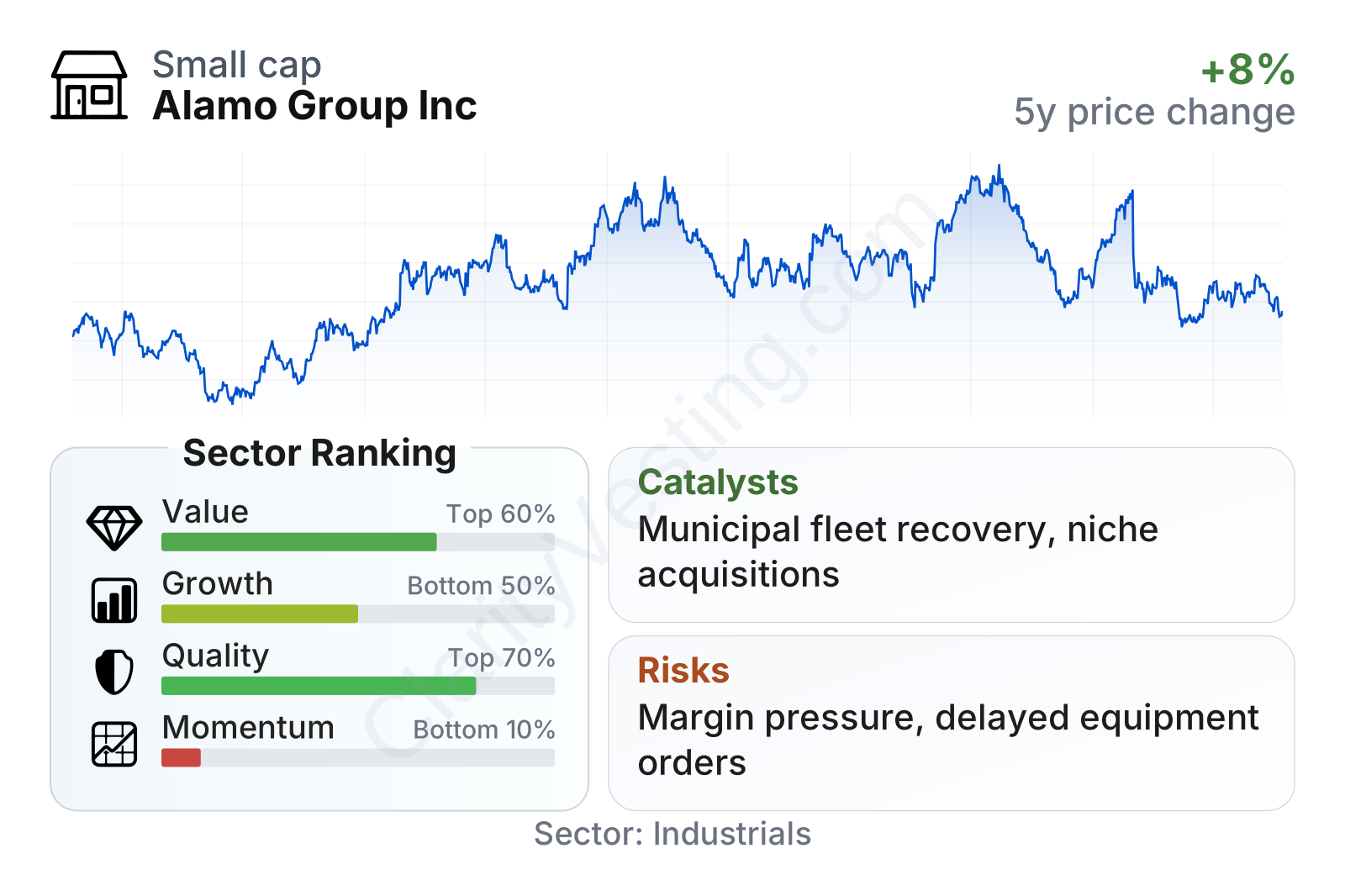
Alamo Group sits in the small-to-mid-cap range within industrials, with share-price behavior that is somewhat more volatile than the broad market but not unusually extreme for machinery companies. The latest factor picture is mixed in an understandable way: valuation and balance-sheet quality look better than much of the sector, while growth and recent stock momentum are weaker. In practical terms, the market appears to be recognizing slower near-term conditions, but it is not assigning a premium multiple to the company despite healthy cash generation and conservative leverage.
The stock’s recent path also reflects that tension. After a strong run into 2024 and a rebound during 2025, the shares pulled back again in 2026. That weak momentum contrasts with the company’s still-profitable operations and below-sector leverage, which makes the stock look more tied to concerns about the cycle than to balance-sheet stress.
Growth
Alamo Group operates in markets that have long-term support, even if yearly demand can move up and down. Infrastructure maintenance, roadside vegetation control, street sweeping, snow removal, and utility right-of-way work are not disappearing categories. Municipalities and contractors may delay purchases, but the underlying need to maintain roads, public spaces, and land access remains. That gives the company exposure to a sector with steady baseline demand, though not the kind of explosive structural growth seen in software or semiconductors.
Its strategy for future expansion is sensible because it is built around specialized niches rather than head-on competition in broad heavy equipment categories. Alamo Group has historically grown through a mix of product development, targeted acquisitions, and cross-selling a portfolio of brands into public-works and vegetation-management customers. That approach can work well over time because specialized equipment markets often reward application knowledge, dealer relationships, and dependable aftermarket support more than sheer scale alone.
The recent sales trend suggests the company is emerging from a softer patch rather than entering a collapse. Revenue growth turned negative during much of 2024 and parts of 2025, but it moved back into positive territory in the latest periods. Growth is still modest compared with the sector median, yet the direction has improved, which matters more than the absolute ranking at this stage of the cycle.
Cash generation is a more encouraging part of the picture. Free cash flow improved sharply over the last several years, even though it has come off its peak more recently. For a machinery manufacturer, the ability to remain strongly cash generative while demand is uneven is important because it supports acquisitions, debt reduction, product investment, and dividends without relying heavily on outside financing.
Potential catalysts are fairly concrete. A continued recovery in municipal equipment orders, replacement demand for aging fleets, and stronger activity in infrastructure maintenance could all help volumes. In addition, utilities and land-management work can support demand for mowing, forestry, and right-of-way equipment. If management continues to deploy capital selectively into bolt-on acquisitions, that could add incremental growth in the company’s usual niche markets.
Recent company communications have also pointed to order trends and market normalization as key watch items. For a business like this, a clearer improvement in bookings can translate into better factory utilization and margin recovery relatively quickly, especially after a period of cautious customer spending.
Risks
This article is for informational purposes only and does not constitute financial advice. Some content is AI-generated. See Disclaimer


