Stock Analysis · Alibaba Health Information Technology Limited (ALBHF)
Overview
Alibaba Health Information Technology Limited is a China-based healthcare platform focused on online pharmaceutical retail, healthcare services, and digital healthcare infrastructure. The company operates consumer-facing online pharmacies and health storefronts, provides health-related platform services to merchants and brands, and develops digital tools that connect patients, pharmacies, medical institutions, and supply-chain participants. Its positioning sits at the intersection of healthcare and e-commerce, with strong ties to Alibaba’s broader digital ecosystem.
The business has become increasingly centered on selling pharmaceutical and healthcare products directly to consumers. Based on the company’s recent annual reporting, revenue is mainly generated from the following activities:
- Pharmaceutical direct sales business: about 85% to 90% of revenue. This includes prescription drugs, over-the-counter medicines, medical devices, health supplements, and other healthcare-related products sold through the company’s self-operated online channels.
- Pharmaceutical e-commerce platform business and related services: about 10% to 15% of revenue. This includes merchant platform services, advertising and marketing services, and operational support for brands and pharmacies selling through Alibaba Health’s marketplace-based channels.
- Other healthcare and digital services: a small share of revenue. This can include internet healthcare, membership-related services, and digital healthcare solutions, though these are not the main revenue driver today.
The revenue mix shows a company that is no longer just a traffic or platform intermediary. It is now primarily a scaled online healthcare retailer, with platform and service revenue still adding ecosystem depth and supporting merchant relationships.
Over the last several years, the business has also shown a clearer earnings structure: revenue has continued to rise, gross profit has expanded, and operations have moved from losses to meaningful operating profit. That matters because it suggests the model is maturing rather than relying only on top-line expansion.
The long-term financial flow points to a notable improvement in business quality. Revenue has climbed steadily since fiscal 2022, while gross profit has grown faster than sales. The company also moved from operating losses to solid profitability by fiscal 2024 and strengthened that further in fiscal 2025 and fiscal 2026, even as it continued investing in research, technology, and selling expenses.
Key Figures
| Metric | Value | Sector ⓘ |
|---|---|---|
| Date | Oct 17, 2026 | |
| Context | ||
| Sector | Healthcare | |
| Industry | Pharmaceutical Retailers | |
| Market Cap ⓘ | $6.23B | |
| Beta ⓘ | 1.58 | |
Value (Cheapness) | ||
| P/E Ratio ⓘ | 19.25 | 24.79 |
| P/B Ratio ⓘ | 0.35 | 3.08 |
| FCF Yield ⓘ | 45.03% | 3.15% |
| Dividend Yield ⓘ | 15.58% | 1.94% |
| EBIT / EV ⓘ | N/A | 0.57% |
| PEG ⓘ | 0.76 | |
Growth (Business expansion) | ||
| Revenue Growth ⓘ | 7.60% | 7.45% |
| RPS Growth (5Y CAGR) ⓘ | 7.51% | 8.61% |
| EPS Growth (5Y CAGR) ⓘ | -6.19% | -17.81% |
| BVPS Growth (5Y CAGR) ⓘ | 1.23% | 3.72% |
| Margin Growth (5Y Trend) ⓘ | 6.57% | -0.62% |
| FCF Growth (5Y CAGR) ⓘ | 38.37% | 1.04% |
| DPS Growth (5Y CAGR) ⓘ | N/A | 6.77% |
Quality (Business durability) | ||
| ROIC (Latest) ⓘ | N/A | 3.24% |
| ROA (Latest) ⓘ | 13.16% | 3.01% |
| ROIC (5Y Median) ⓘ | 4.24% | 4.60% |
| ROA (5Y Median) ⓘ | 4.37% | 1.89% |
| Net Debt / EBIT (Latest) ⓘ | -1.80 | 1.34 |
| Net Debt / EBIT (5Y Median) ⓘ | N/A | 1.84 |
| Net Debt / EBITDA (Latest) ⓘ | -1.74 | 1.00 |
| Net Debt / Assets ⓘ | -24.65% | 5.45% |
| EBITDA / Interest ⓘ | N/A | 9.64 |
| Operating Margin (Latest) ⓘ | 5.42% | 9.27% |
| Operating Margin (5Y Median) ⓘ | 3.50% | 7.38% |
| Debt to Equity (Latest) ⓘ | 0.33% | 28.58% |
| Profit Margin (Latest) ⓘ | 5.65% | 3.59% |
| Free Cash Flow (Latest) ⓘ | $2.80B | |
Momentum (Price trend) | ||
| 3Y Return ⓘ | -32.48% | +42.80% |
| 12M Return (excl. last month) ⓘ | -52.30% | +18.50% |
| 6M Return ⓘ | -29.05% | +7.57% |
| Price vs. 200-Day MA ⓘ | -30.42% | +5.12% |
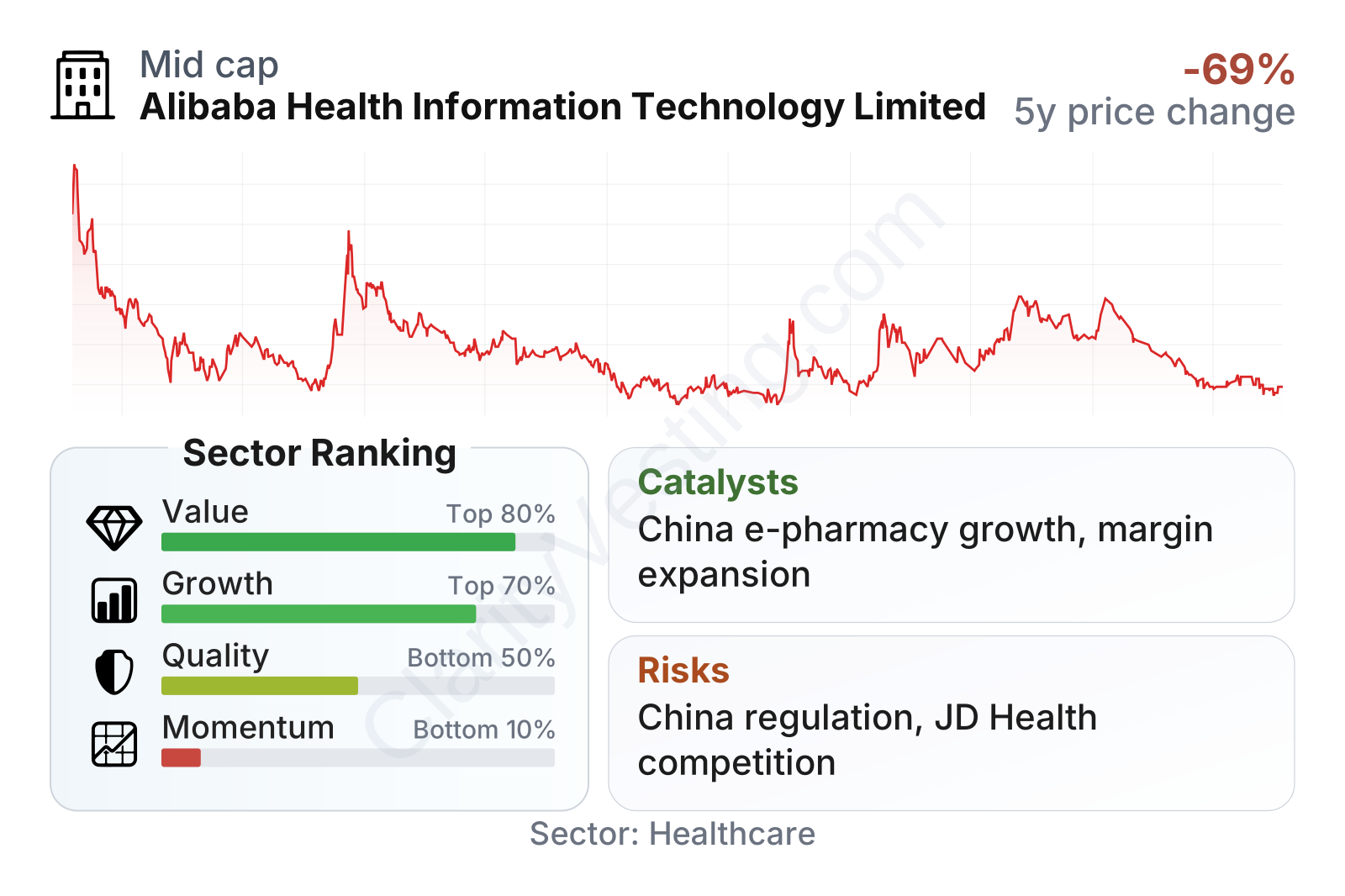
The market profile is unusual: valuation measures look inexpensive relative to much of the healthcare sector, while growth and balance-sheet metrics are stronger than the share-price trend suggests. The company’s earnings multiple sits below the sector median, the price-to-book ratio is far lower than typical peers, and cash generation is particularly strong. Growth has been respectable rather than explosive, but margin improvement and free cash flow expansion stand out. Quality is mixed: profitability on assets is healthy and leverage is minimal, yet operating margins remain below many healthcare peers. The weakest area is market momentum, with the stock having materially underperformed the sector over the last several years.
Growth
Alibaba Health operates in a sector with durable structural tailwinds. China’s population is aging, chronic disease management is becoming more important, and consumers are increasingly comfortable purchasing medicines and health products online. Digital healthcare adoption has also broadened beyond simple retail transactions into prescription fulfillment, medical consultation, health management, and integrated pharmacy services. Those trends create a large runway for companies that combine trusted product supply, consumer reach, and technology-enabled delivery.
The company’s strategy broadly fits those trends. Its direct-sales pharmacy business gives it scale in a category where convenience, product range, and fulfillment reliability matter. Its platform services deepen relationships with brands and merchants, while healthcare service capabilities can increase customer frequency and improve retention. This combination can help Alibaba Health become more embedded in the healthcare journey instead of remaining only a product seller.
A major positive sign is that growth has increasingly translated into profit. Revenue growth has been in the high-single-digit range recently, roughly in line with the broader sector median, but operating margin trends have improved more clearly than many peers. Over a five-year period, free cash flow growth has been exceptionally strong, and the company carries net cash rather than net debt. That gives it room to keep investing in logistics, technology, and customer acquisition without the financial pressure that often affects lower-margin retail models.
Another important catalyst is the company’s connection to the Alibaba ecosystem. Consumer traffic, payment integration, merchant access, and digital infrastructure can all support customer acquisition and operating efficiency. In healthcare, ecosystem advantages matter because users often value trust, search convenience, and fulfillment speed as much as price.
Recent annual results also point to a significant opportunity: the company has continued increasing revenue while expanding operating income and net income at a faster pace. This suggests that scale benefits and better operating discipline may still be unfolding. If that continues, the business could shift from being viewed mainly as an online health retailer to being recognized as a more mature healthcare platform with improving economics.
Risks
This article is for informational purposes only and does not constitute financial advice. Some content is AI-generated. See Disclaimer


