Stock Analysis · Alibaba Health Information Technology Limited (ALBBY)
Overview
Alibaba Health Information Technology Limited is a China-focused digital healthcare company that combines online retail, healthcare services, and health management tools. Its business sits at the intersection of e-commerce and healthcare: it helps consumers buy medicines and health products online, connects them with medical and pharmacy services, and provides digital infrastructure for healthcare merchants and partners. The company is closely associated with the broader Alibaba ecosystem, which gives it access to traffic, payments, logistics, and merchant relationships.
The company’s revenue is led by pharmaceutical and healthcare product sales, while service-based activities provide an additional layer of growth and ecosystem value. Based on recent annual disclosures, the revenue mix is approximately structured as follows:
- Pharmaceutical direct sales and self-operated healthcare product retail: about 85% to 90%. This includes prescription drugs, over-the-counter medicines, medical devices, supplements, and other health-related products sold through the company’s own retail operations.
- Platform-based services and healthcare commerce services: about 10% to 15%. This includes merchant services, advertising and marketing solutions, commission income, and other digital services tied to the company’s online healthcare marketplace and operating platform.
- Other healthcare services: a small portion. This can include internet healthcare, membership, and related digital health offerings, though these appear to remain much smaller than product retail.
This structure matters because Alibaba Health is no longer just a concept stock tied to online healthcare demand. It has become a large-scale operating business with meaningful sales volume, improving profitability, and a broad consumer reach inside one of the world’s largest e-commerce environments.
The business mix also shows an important trend: revenue has expanded steadily over the last several years, while profitability has improved much faster than sales. Gross profit has climbed materially, and the company has moved from operating losses a few years ago to solid positive operating income and net income more recently. That suggests scale benefits are starting to show, although selling and administrative costs remain an area to watch.
Key Figures
| Metric | Value | Sector ⓘ |
|---|---|---|
| Date | Oct 03, 2026 | |
| Context | ||
| Sector | Healthcare | |
| Industry | Pharmaceutical Retailers | |
| Market Cap ⓘ | $6.29B | |
| Beta ⓘ | 1.59 | |
Value (Cheapness) | ||
| P/E Ratio ⓘ | 21.61 | 24.06 |
| P/B Ratio ⓘ | 0.35 | 3.08 |
| FCF Yield ⓘ | 42.50% | 3.07% |
| Dividend Yield ⓘ | 2.25% | 2.05% |
| EBIT / EV ⓘ | N/A | 0.63% |
| PEG ⓘ | 0.69 | |
Growth (Business expansion) | ||
| Revenue Growth ⓘ | 7.60% | 7.50% |
| RPS Growth (5Y CAGR) ⓘ | 7.64% | 8.70% |
| EPS Growth (5Y CAGR) ⓘ | -6.19% | -18.20% |
| BVPS Growth (5Y CAGR) ⓘ | 1.23% | 3.95% |
| Margin Growth (5Y Trend) ⓘ | 6.57% | -0.58% |
| FCF Growth (5Y CAGR) ⓘ | 31.59% | 0.88% |
| DPS Growth (5Y CAGR) ⓘ | N/A | 6.80% |
Quality (Business durability) | ||
| ROIC (Latest) ⓘ | N/A | 3.29% |
| ROA (Latest) ⓘ | 13.15% | 3.02% |
| ROIC (5Y Median) ⓘ | 5.98% | 4.75% |
| ROA (5Y Median) ⓘ | 4.37% | 1.93% |
| Net Debt / EBIT (Latest) ⓘ | -1.80 | 1.33 |
| Net Debt / EBIT (5Y Median) ⓘ | -3.19 | 1.83 |
| Net Debt / EBITDA (Latest) ⓘ | -1.75 | 0.99 |
| Net Debt / Assets ⓘ | -24.65% | 5.33% |
| EBITDA / Interest ⓘ | N/A | 9.63 |
| Operating Margin (Latest) ⓘ | 5.42% | 9.25% |
| Operating Margin (5Y Median) ⓘ | 3.50% | 7.80% |
| Debt to Equity (Latest) ⓘ | 0.33% | 28.99% |
| Profit Margin (Latest) ⓘ | 5.65% | 3.60% |
| Free Cash Flow (Latest) ⓘ | $2.67B | |
Momentum (Price trend) | ||
| 3Y Return ⓘ | -33.04% | +37.48% |
| 12M Return (excl. last month) ⓘ | -33.43% | +20.85% |
| 6M Return ⓘ | -17.21% | +9.73% |
| Price vs. 200-Day MA ⓘ | -27.40% | +4.69% |
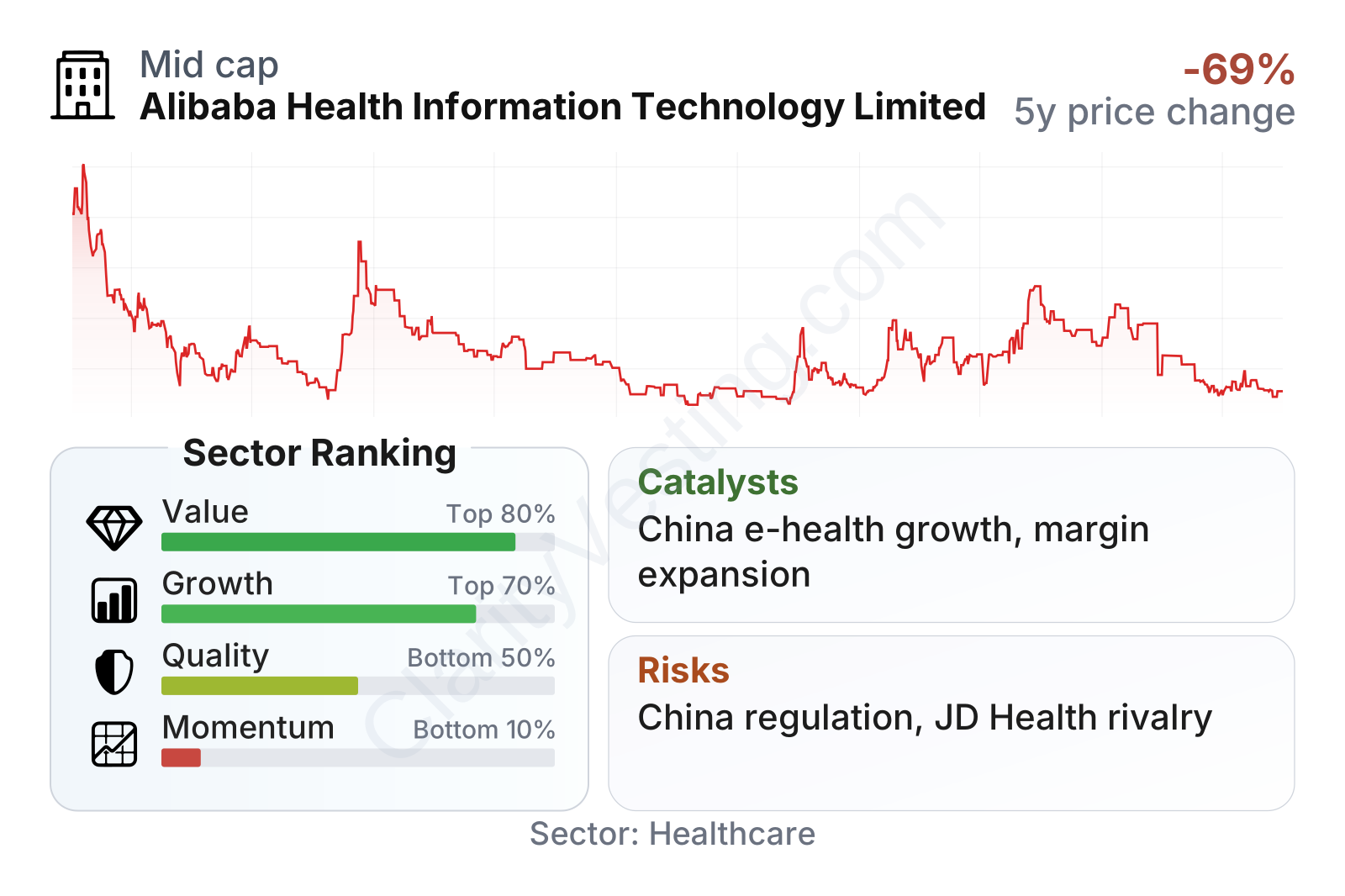
Alibaba Health currently sits in the larger mid-cap range and shows a mixed but interesting profile. On valuation, it screens better than much of the healthcare sector: earnings valuation is slightly below the sector median, price-to-book is far lower, and the cash generation profile stands out strongly. The free cash flow yield is unusually high relative to the sector, while the PEG ratio suggests the market is not assigning an aggressive price to its growth outlook.
On business quality, the balance sheet is a clear strength. Debt is extremely low, net cash metrics are comfortably positive, and profitability has become more credible, with profit margin above the sector median and returns on assets stronger than many peers. Operating margin is still below the sector median, but the multi-year trend has improved.
Growth is respectable rather than explosive. Recent revenue growth is slightly above the sector median, and free cash flow has expanded at a much faster pace than many healthcare peers over five years. The weaker point is market momentum: the stock has underperformed badly over the last several measured periods, and it trades well below its longer-term average trend. That gap between improving fundamentals and weak share-price behavior is one of the main things defining the current investment debate.
Growth
Alibaba Health operates in a sector with long-term structural support. China’s population is aging, healthcare spending continues to rise, and online penetration in medicine, wellness products, and healthcare services still has room to grow. Consumers are becoming more comfortable with digital consultations, online prescription fulfillment, and app-based healthcare management. That creates a favorable backdrop for companies that can combine trusted supply, broad selection, and convenient delivery.
The company’s strategy broadly makes sense for that environment. It is building scale in medicine and healthcare retail, while also linking users to services such as online medical support and chronic disease management. Its relationship with Alibaba’s digital ecosystem is especially important: traffic acquisition, consumer familiarity, payment tools, and logistics support can help reduce friction and improve repeat usage. In healthcare retail, convenience and trust are often more important than pure novelty, and Alibaba Health is trying to anchor itself in both.
Another positive sign is the operating trend. Revenue has grown from roughly RMB 20.6 billion in fiscal 2022 to about RMB 33.2 billion in fiscal 2026, while net income has shifted from a loss to a meaningful profit. Operating income has followed the same path. This matters because healthcare e-commerce can look attractive at the top line but disappointing after fulfillment, compliance, and customer acquisition costs. Alibaba Health has started to show that scale can translate into earnings and cash flow, not only gross merchandise activity.
Recent company updates have also pointed to continued expansion in pharmaceutical and health product demand, deeper integration of healthcare service capabilities, and stronger monetization of its platform. The largest opportunity is not a single product launch but the possibility of becoming a more central digital gateway for everyday healthcare consumption in China. If prescription penetration online rises further and healthcare services become more integrated with retail, the company’s ecosystem position could strengthen meaningfully.
Risks
This article is for informational purposes only and does not constitute financial advice. Some content is AI-generated. See Disclaimer


