Stock Analysis · Alba Mineral Resources plc (ALBAF)
Overview
Alba Mineral Resources plc is a very small natural resources company focused on early-stage mining and energy assets. Its business model is not built around producing and selling large volumes of commodities today. Instead, it holds interests in exploration and development projects that could become more valuable if technical progress, permitting, financing, and market conditions all move in the right direction.
The group is best known for its exposure to the Clogau-St David’s gold project in Wales and for its stake in GreenRoc Mining plc, which is advancing the Amitsoq graphite project in Greenland. Alba has also had interests in other exploration licenses, including base metals and energy-related assets, but the current long-term case is mainly tied to whether its project portfolio can be moved from exploration into commercially meaningful development.
For long-term readers, one point is crucial: Alba is not operating like a mature mining company with stable production, recurring sales, and predictable margins. It is closer to a venture-style resource company, where value depends heavily on drilling, sampling, permitting, asset monetization, and capital market access.
Its revenue base is currently extremely limited. Recent annual accounts show little to no meaningful operating revenue, so a normal revenue mix by business line is not really available. In practical terms, the company’s economic exposure is concentrated in asset value rather than sales generation.
- Mining and exploration interests: effectively the core of the business value. This includes gold exposure in Wales and indirect graphite exposure through its listed stake in GreenRoc.
- Direct operating revenue: approximately 0% in recent reporting periods, meaning the company is still pre-commercial rather than revenue-producing.
- Potential future value sources: project development, license advancement, farm-outs, stake sales, joint ventures, or eventual production if projects progress.
This makes Alba easier to understand as an asset development company than as a conventional mining operator. The financial profile reflects that distinction: costs are real today, while commercial income remains largely a future possibility.
The long-running pattern is clear: operating expenses have continued while revenue has remained near zero. Losses narrowed after a very large reported loss in 2023, but the business still has not crossed into self-funded operations.
Key Figures
| Metric | Value | Sector ⓘ |
|---|---|---|
| Date | Oct 31, 2026 | |
| Context | ||
| Sector | Basic Materials | |
| Industry | Other Industrial Metals & Mining | |
| Market Cap ⓘ | $9.09M | |
| Beta ⓘ | 0.95 | |
Value (Cheapness) | ||
| P/E Ratio ⓘ | N/A | 16.71 |
| P/B Ratio ⓘ | 1,426.56 | 1.72 |
| FCF Yield ⓘ | -12.20% | 5.78% |
| Dividend Yield ⓘ | N/A | 2.17% |
| EBIT / EV ⓘ | N/A | 7.05% |
| PEG ⓘ | N/A | |
Growth (Business expansion) | ||
| Revenue Growth ⓘ | N/A | 10.85% |
| RPS Growth (5Y CAGR) ⓘ | N/A | 4.49% |
| EPS Growth (5Y CAGR) ⓘ | -19.22% | -12.99% |
| BVPS Growth (5Y CAGR) ⓘ | -22.42% | 5.51% |
| Margin Growth (5Y Trend) ⓘ | N/A | -1.42% |
| FCF Growth (5Y CAGR) ⓘ | -38.51% | 0.52% |
| DPS Growth (5Y CAGR) ⓘ | N/A | 6.02% |
Quality (Business durability) | ||
| ROIC (Latest) ⓘ | -16.53% | 9.28% |
| ROA (Latest) ⓘ | -58.06% | 4.90% |
| ROIC (5Y Median) ⓘ | -6.88% | 7.76% |
| ROA (5Y Median) ⓘ | -19.23% | 3.88% |
| Net Debt / EBIT (Latest) ⓘ | N/A | 1.35 |
| Net Debt / EBIT (5Y Median) ⓘ | N/A | 1.70 |
| Net Debt / EBITDA (Latest) ⓘ | N/A | 0.93 |
| Net Debt / Assets ⓘ | -3.54% | 12.93% |
| EBITDA / Interest ⓘ | N/A | 12.36 |
| Operating Margin (Latest) ⓘ | N/A | 12.74% |
| Operating Margin (5Y Median) ⓘ | N/A | 11.87% |
| Debt to Equity (Latest) ⓘ | N/A | 40.30% |
| Profit Margin (Latest) ⓘ | N/A | 6.58% |
| Free Cash Flow (Latest) ⓘ | -$1.11M | |
Momentum (Price trend) | ||
| 3Y Return ⓘ | -91.03% | +75.47% |
| 12M Return (excl. last month) ⓘ | +16.67% | +22.27% |
| 6M Return ⓘ | +75.00% | -3.22% |
| Price vs. 200-Day MA ⓘ | +0.36% | -2.47% |
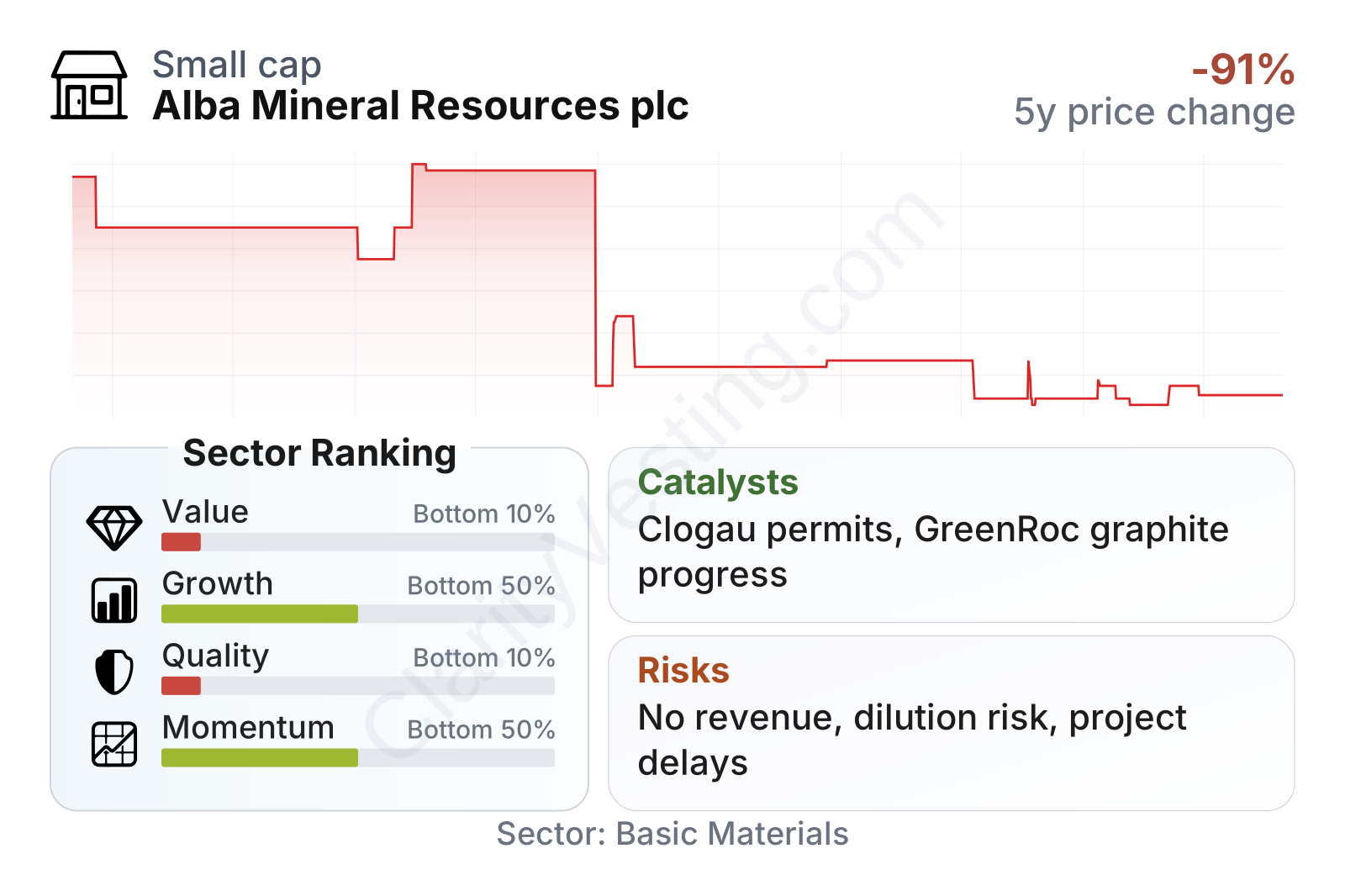
The share price history shows very high volatility and a steep decline from earlier levels, even though there have been shorter bursts of recovery. That pattern usually signals a market that is reacting to project news and financing expectations rather than steady operating performance.
The broader financial profile remains weak compared with most companies in the basic materials sector. The company ranks near the bottom of the sector on value and quality measures, which is not surprising for a pre-revenue explorer. Profitability is negative, free cash flow remains negative, and returns on capital and assets are well below sector norms.
At the same time, the balance sheet is not burdened by heavy net debt, which matters for a company of this size. In other words, Alba’s main constraint is less about leverage and more about the challenge of funding ongoing work without meaningful internal cash generation.
Growth metrics are also soft because reported revenue has not yet developed. The recent six-month share move has been stronger than the sector average, but that comes after a very weak multiyear performance and does not by itself change the underlying business stage.
Growth
Alba operates in areas that fit long-term resource themes, but the quality of that growth exposure depends on the specific asset. Gold can benefit from investor demand for hard assets and from geopolitical or inflation-driven interest. Graphite has a more direct industrial angle because it is used in battery anodes, making it relevant to electric vehicles and energy storage supply chains. That gives Alba at least some exposure to sectors with strategic importance.
The strongest strategic logic in Alba’s portfolio is probably its indirect link to graphite through GreenRoc Mining. Graphite is one of the minerals that Western governments and industrial groups increasingly want to source outside China-dominated supply chains. If GreenRoc continues to de-risk Amitsoq technically and commercially, Alba’s stake could remain an important part of the investment case.
Its gold asset in Wales has a different appeal. Clogau-St David’s carries heritage value and has the potential to attract attention disproportionate to its size because it is an unusual UK gold project. If Alba can improve permitting visibility, demonstrate mine development progress, or produce stronger technical results, that asset could become a more tangible driver of value than it is today.
Recent company updates have continued to focus on advancing project work rather than reporting operating revenue. That is typical for a company at this stage, but it also means the main catalysts are binary and project-specific rather than broad-based. The most important opportunities are likely to come from one or more of the following: a material permitting step forward at Clogau, encouraging exploration or development results, external validation of project economics, or a re-rating of GreenRoc as graphite supply chain interest grows.
So yes, Alba is positioned in segments that can grow over time, especially battery materials. But the path from sector growth to shareholder value is not automatic. The company still needs to convert resource exposure into clearer commercial outcomes.
Risks
This article is for informational purposes only and does not constitute financial advice. Some content is AI-generated. See Disclaimer


