Stock Analysis · Albemarle Corp (ALB)
Overview
Albemarle is a specialty chemicals company best known as one of the world’s largest lithium producers. Its products are used in electric vehicle batteries, energy storage systems, consumer electronics, petroleum refining, and fire safety applications. In simple terms, Albemarle sits near the beginning of several industrial supply chains: it extracts or processes raw materials and turns them into high-value chemical products that other manufacturers need.
The business is organized into three main segments. Based on Albemarle’s recent annual reporting structure, revenue is led by lithium, followed by bromine specialties, then catalysts. The mix can move materially from year to year because lithium prices are highly volatile, but the broad ranking has been consistent.
- Lithium: about 65% to 75% of revenue in recent years. This includes lithium carbonate, lithium hydroxide, and related compounds used mainly in electric vehicle batteries, grid storage, and other electronics applications.
- Bromine specialties: about 15% to 20% of revenue. This segment supplies bromine-based solutions used in fire safety materials, specialty products, and certain industrial applications.
- Catalysts: about 10% to 15% of revenue. This business mainly serves refiners with hydroprocessing catalyst solutions used to make cleaner transportation fuels.
That revenue mix shows why Albemarle’s results can swing sharply. Lithium is the growth engine and the largest profit contributor when pricing is favorable, while bromine and catalysts are generally steadier but much smaller.
Over the past several years, the company’s financial profile has reflected the lithium cycle very clearly: a surge in revenue and earnings through 2022 and 2023, followed by a sharp reset as lithium prices weakened and profitability compressed. More recently, free cash flow and sales growth have started to recover from those lows, although margins remain well below earlier peaks.
The operating picture shows an extreme boom-and-bust pattern. Revenue expanded rapidly into 2023, then dropped sharply in 2024 and stayed under pressure in 2025 as gross profit and operating income deteriorated. That matters for long-term analysis because Albemarle is not a stable compounder in the traditional sense; it is a large industrial materials company with powerful upside when lithium markets tighten, but with earnings that can fall quickly when supply outpaces demand.
Key Figures
| Metric | Value | Sector ⓘ |
|---|---|---|
| Date | Oct 24, 2026 | |
| Context | ||
| Sector | Basic Materials | |
| Industry | Specialty Chemicals | |
| Market Cap ⓘ | $11.30B | |
| Beta ⓘ | 1.36 | |
Value (Cheapness) | ||
| P/E Ratio ⓘ | 354.70 | 16.92 |
| P/B Ratio ⓘ | 1.28 | 1.66 |
| FCF Yield ⓘ | 11.88% | 5.83% |
| Dividend Yield ⓘ | 1.71% | 2.07% |
| EBIT / EV ⓘ | 2.76% | 6.38% |
| PEG ⓘ | 0.79 | |
Growth (Business expansion) | ||
| Revenue Growth ⓘ | 31.10% | 11.25% |
| RPS Growth (5Y CAGR) ⓘ | 11.22% | 4.49% |
| EPS Growth (5Y CAGR) ⓘ | -27.14% | -15.24% |
| BVPS Growth (5Y CAGR) ⓘ | 13.99% | 5.49% |
| Margin Growth (5Y Trend) ⓘ | -10.70% | -1.54% |
| FCF Growth (5Y CAGR) ⓘ | N/A | 0.37% |
| DPS Growth (5Y CAGR) ⓘ | 18.76% | 5.91% |
Quality (Business durability) | ||
| ROIC (Latest) ⓘ | 5.26% | 9.59% |
| ROA (Latest) ⓘ | 1.36% | 4.92% |
| ROIC (5Y Median) ⓘ | 3.20% | 7.91% |
| ROA (5Y Median) ⓘ | 1.15% | 3.92% |
| Net Debt / EBIT (Latest) ⓘ | 0.81 | 1.36 |
| Net Debt / EBIT (5Y Median) ⓘ | 1.53 | 1.69 |
| Net Debt / EBITDA (Latest) ⓘ | 0.33 | 0.93 |
| Net Debt / Assets ⓘ | 2.23% | 13.69% |
| EBITDA / Interest ⓘ | 6.25 | 12.38 |
| Operating Margin (Latest) ⓘ | 7.40% | 13.24% |
| Operating Margin (5Y Median) ⓘ | 8.74% | 11.82% |
| Debt to Equity (Latest) ⓘ | 19.33% | 40.30% |
| Profit Margin (Latest) ⓘ | 3.80% | 6.38% |
| Free Cash Flow (Latest) ⓘ | $1.34B | |
Momentum (Price trend) | ||
| 3Y Return ⓘ | -28.59% | +73.47% |
| 12M Return (excl. last month) ⓘ | +39.56% | +27.59% |
| 6M Return ⓘ | -52.11% | -4.02% |
| Price vs. 200-Day MA ⓘ | -37.72% | -0.65% |
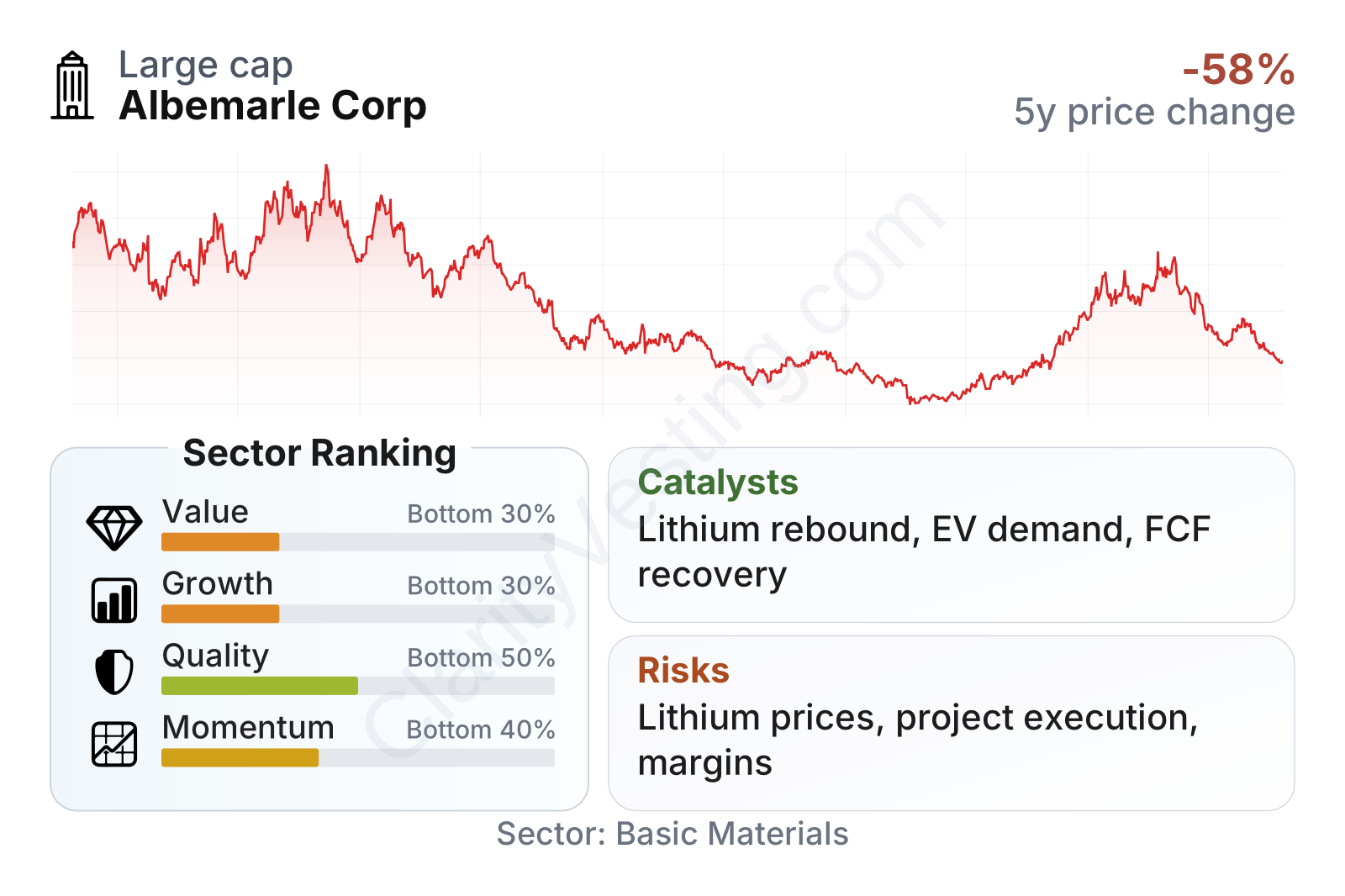
Albemarle is a large-cap chemicals company, but its current profile is unusual. On growth, recent year-over-year revenue has turned positive again and its five-year revenue-per-share growth remains stronger than the sector median. On quality, returns on capital, margins, and profitability are still below sector norms after the downturn. On balance sheet risk, leverage looks more conservative than many peers, with debt to equity around 19% and net debt measures below sector medians. On valuation, the picture is mixed: the headline P/E is not very useful because earnings were heavily depressed, while price-to-book is relatively moderate and free cash flow yield is notably higher than the sector median. Market behavior also reflects the uncertainty: the stock had a strong rebound over part of the past year, but the longer multi-year performance and recent six-month trend remain weak.
Growth
Albemarle operates in a sector that still has a strong long-term structural driver: electrification. Lithium demand is tied to electric vehicles, battery energy storage, and broader grid modernization. Even though short-term lithium prices have been volatile, the underlying end-market is still expected to grow over the coming decade as battery production scales globally.
The company’s strategy broadly makes industrial sense. Albemarle has focused on expanding lithium conversion capacity, strengthening resource access, and keeping a global footprint across the United States, Chile, Australia, and China-linked processing networks. For a producer in a cyclical commodity-like market, scale, reserve quality, processing expertise, and customer relationships matter a lot. These are not guarantees, but they are meaningful building blocks when the market tightens again.
The recent revenue trend suggests the deepest part of the downturn may be passing. After a severe contraction through much of 2024, year-over-year growth turned positive again in late 2025 and remained around 30% in the first half of 2026. That does not mean the business is back to peak conditions, but it does indicate that demand and pricing conditions are no longer deteriorating at the same pace.
Cash generation also deserves attention. Free cash flow moved from deeply negative territory to positive again by 2026. For a capital-intensive company, that shift is important because it suggests spending discipline, better working capital dynamics, or some operational recovery. If Albemarle can keep free cash flow positive while the lithium market remains imperfect, that would strengthen the case that the company is adjusting well to a lower-price environment.
A major catalyst remains any sustained improvement in lithium pricing. Albemarle does not need a repeat of the 2022 boom to benefit; even a more balanced market with firmer contract pricing could have a large effect on earnings because of the company’s operating leverage. Another favorable development is the continued buildout of Western battery supply chains, where local sourcing and processing capability are increasingly valuable for automakers and policymakers.
Recent company updates and public filings have also emphasized cost actions, project pacing, and capital allocation discipline rather than growth at any price. In the current environment, that is arguably the right approach. It lowers the risk of expanding too aggressively into a weak pricing cycle and may position the company better for the next upturn.
Risks
This article is for informational purposes only and does not constitute financial advice. Some content is AI-generated. See Disclaimer


