Stock Analysis · Aktis Oncology Inc (AKTS)
Overview
Aktis Oncology is a clinical-stage biotechnology company focused on targeted radiopharmaceuticals for cancer. In simple terms, it is developing drugs designed to deliver radiation directly to tumor cells while aiming to limit damage to healthy tissue. The company’s platform combines tumor-targeting molecules with radioactive payloads, with an emphasis on solid tumors that are often difficult to treat with standard oncology approaches.
At this stage, Aktis is not a mature commercial drug company. Its business is still centered on research and development, building its clinical pipeline, manufacturing capabilities, and the scientific platform behind its drug candidates. That matters for long-term analysis because the company’s value depends much more on future trial results and pipeline progress than on current sales.
The main sources of revenue are currently limited and uneven from year to year. Based on recent annual patterns, revenue appears to come primarily from collaboration, license, or other research-related arrangements rather than broad product sales.
- Collaboration and licensing-type revenue: likely the dominant source when present, and in some years effectively close to 100% of total revenue. This can include upfront payments, research support, or milestone-related accounting tied to partnerships.
- Product revenue: currently 0% or negligible. Aktis does not yet appear to have an approved commercial product generating recurring sales.
- Other revenue streams: limited or not material enough to break out consistently.
One important pattern is that reported revenue has been highly volatile: it was meaningful in some earlier years, dropped sharply in 2024, and remained modest in 2025, while operating expenses continued to rise. That is typical for early-stage biotech companies, but it also means the income statement is not yet supported by stable commercial demand.
The financial profile shows a company investing aggressively in research. Research and development has become the largest cost center by far, and it rose materially over the last few years. Selling and administrative expenses also increased, but much more slowly than R&D. In other words, Aktis is spending primarily to advance its science, not to support an already established commercial business.
Key Figures
| Metric | Value | Sector ⓘ |
|---|---|---|
| Date | Oct 17, 2026 | |
| Context | ||
| Sector | Healthcare | |
| Industry | Biotechnology | |
| Market Cap ⓘ | $1.00B | |
| Beta ⓘ | N/A | |
Value (Cheapness) | ||
| P/E Ratio ⓘ | N/A | 24.79 |
| P/B Ratio ⓘ | 2.02 | 3.08 |
| FCF Yield ⓘ | -8.45% | 3.15% |
| Dividend Yield ⓘ | N/A | 1.94% |
| EBIT / EV ⓘ | -13.66% | 0.57% |
| PEG ⓘ | N/A | |
Growth (Business expansion) | ||
| Revenue Growth ⓘ | 111.40% | 7.45% |
| RPS Growth (5Y CAGR) ⓘ | -18.77% | 8.61% |
| EPS Growth (5Y CAGR) ⓘ | N/A | -17.81% |
| BVPS Growth (5Y CAGR) ⓘ | N/A | 3.72% |
| Margin Growth (5Y Trend) ⓘ | N/A | -0.62% |
| FCF Growth (5Y CAGR) ⓘ | N/A | 1.04% |
| DPS Growth (5Y CAGR) ⓘ | N/A | 6.77% |
Quality (Business durability) | ||
| ROIC (Latest) ⓘ | -35.28% | 3.24% |
| ROA (Latest) ⓘ | -17.48% | 3.01% |
| ROIC (5Y Median) ⓘ | N/A | 4.60% |
| ROA (5Y Median) ⓘ | -21.56% | 1.89% |
| Net Debt / EBIT (Latest) ⓘ | N/A | 1.34 |
| Net Debt / EBIT (5Y Median) ⓘ | N/A | 1.84 |
| Net Debt / EBITDA (Latest) ⓘ | N/A | 1.00 |
| Net Debt / Assets ⓘ | -12.78% | 5.45% |
| EBITDA / Interest ⓘ | N/A | 9.64 |
| Operating Margin (Latest) ⓘ | -800.84% | 9.27% |
| Operating Margin (5Y Median) ⓘ | -689.00% | 7.38% |
| Debt to Equity (Latest) ⓘ | 2.32% | 28.58% |
| Profit Margin (Latest) ⓘ | N/A | 3.59% |
| Free Cash Flow (Latest) ⓘ | -$84.57M | |
Momentum (Price trend) | ||
| 3Y Return ⓘ | N/A | +42.80% |
| 12M Return (excl. last month) ⓘ | N/A | +18.50% |
| 6M Return ⓘ | +4.48% | +7.57% |
| Price vs. 200-Day MA ⓘ | N/A | +5.12% |
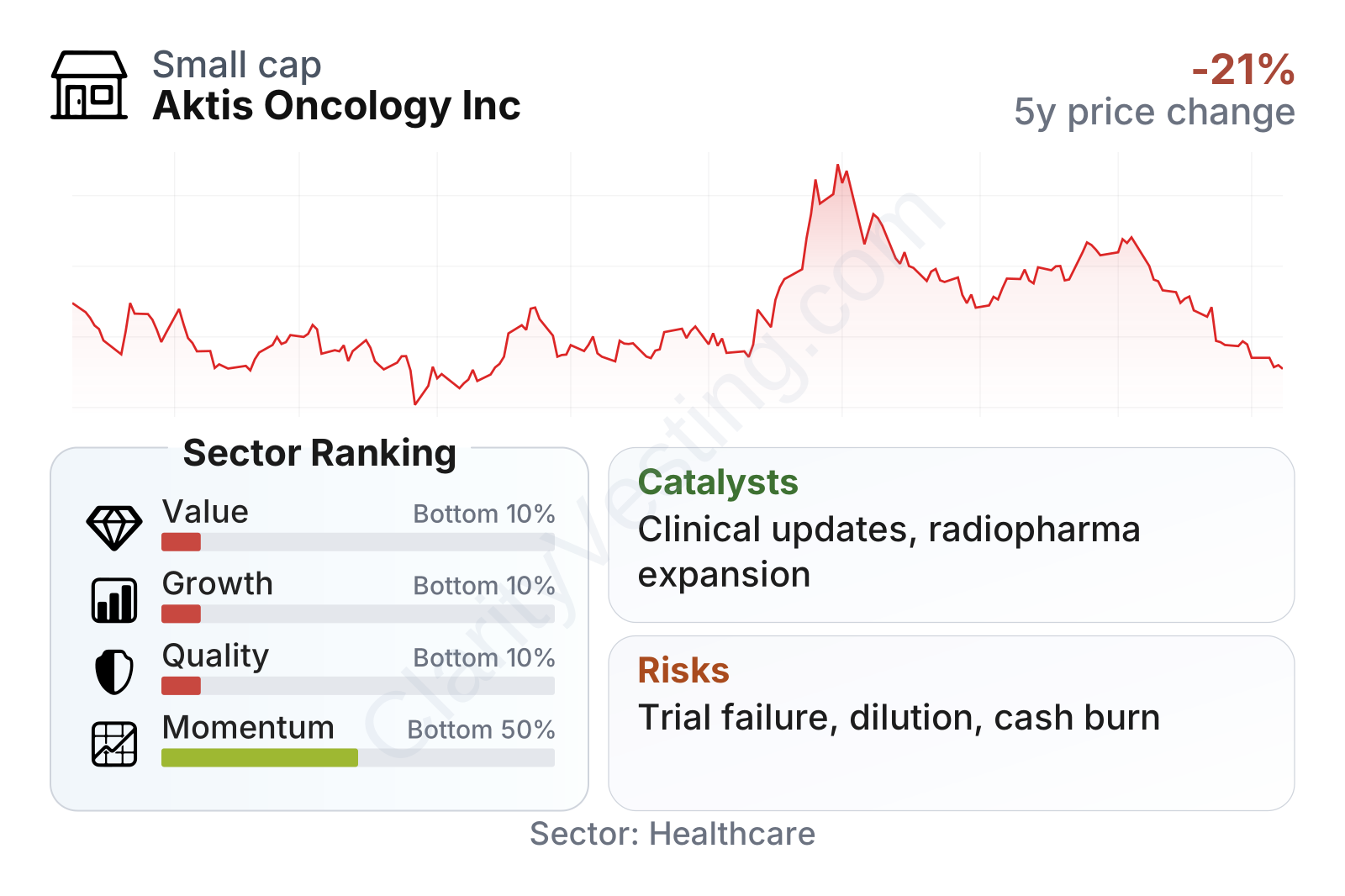
Aktis is still a relatively small public biotech company, with a market value around the low-billion-dollar range. The stock has been volatile in 2026, falling early in the year and then rebounding strongly by mid-year. That kind of movement is common for development-stage biotech names where expectations can shift quickly around pipeline milestones.
The factor profile is mixed but understandable for a company at this stage. On valuation, growth, and quality metrics, Aktis ranks near the lower end of its healthcare peer group. That is largely because traditional measures such as earnings, operating returns, and free cash flow are still negative. Price-to-book is below the sector median, which suggests the market is not assigning a rich balance-sheet multiple, but that alone does not make the shares cheap because the company is still consuming capital rather than producing durable profits.
The growth section of the metrics needs extra interpretation. Year-over-year revenue growth looks very strong, but this is not the same as steady business expansion in a commercial company. With small and partnership-driven revenue, percentages can swing dramatically from one period to another. The more important takeaway is that Aktis remains in an investment phase rather than an earnings phase.
Growth
Aktis operates in a part of oncology that has drawn growing industry attention: radiopharmaceuticals. This field has become increasingly important because targeted radiation is being explored as a way to improve precision in cancer treatment. Large pharmaceutical companies have shown interest in the area through partnerships, acquisitions, and internal pipeline expansion, which supports the idea that the sector itself has long-term growth potential.
Aktis’s strategy broadly fits that industry direction. Instead of trying to compete as a general cancer drug developer, it is focusing on a specialized platform intended to deliver radioactive isotopes to tumors with high precision. If the science works in human studies, the company could benefit from a combination of platform value and individual drug-candidate value. That is a meaningful distinction: success in one program can also increase confidence in the broader technology base.
A strong catalyst for companies like Aktis is clinical progress. New data from early-stage trials, dose-selection updates, safety findings, and evidence that the drugs are reaching tumors effectively can all change how the market views the company. Manufacturing progress also matters more here than in many other biotech categories because radiopharmaceuticals require specialized production and logistics. Any improvement in supply-chain readiness or isotope access can strengthen confidence in future development.
Recent company communications have highlighted continued pipeline advancement and work to support clinical execution. For a business without recurring product revenue, those milestones are more relevant than near-term sales trends. The key question for long-term analysis is whether Aktis can translate scientific promise into proof in patients and then into a broader development path.
Cash burn remains a central part of the growth picture. Free cash flow has stayed deeply negative and worsened into 2026, which reflects the cost of expanding research activity. That is not unusual in biotech, but it means growth currently depends on capital availability and efficient trial execution rather than self-funded expansion.
Risks
This article is for informational purposes only and does not constitute financial advice. Some content is AI-generated. See Disclaimer


