Stock Analysis · Aker BP ASA (AKRBY)
Overview
Aker BP ASA is a Norwegian oil and gas producer focused on offshore fields on the Norwegian continental shelf. In simple terms, it explores for hydrocarbons, develops offshore projects, operates producing fields, and sells the oil and natural gas it extracts. The company is one of the larger independent exploration and production businesses in Europe, but it is not a fully integrated major like Equinor, Shell, or TotalEnergies because it does not have large refining or retail operations.
The business is concentrated in one region, which gives Aker BP deep operating expertise in Norway, stable legal conditions, and access to high-quality offshore infrastructure. At the same time, that concentration means results are heavily tied to production volumes from a limited set of large assets and to commodity prices.
Its revenue mainly comes from selling petroleum produced from offshore fields. Based on the company’s reporting structure and business model, the main sources are approximately:
- Crude oil sales: about 70% to 80% of revenue in a typical year. This is the largest contributor and reflects Aker BP’s oil-weighted production base.
- Natural gas sales: about 20% to 30% of revenue. Gas revenue can swing meaningfully with European gas prices and export conditions.
- Other petroleum-related income: generally less than 5%. This can include liquids such as NGLs, tariff-related items, and other field-related revenue effects depending on the reporting period.
Over the last several years, revenue rose sharply in 2022 and remained high in 2023 and 2024 before easing in 2025 as price and earnings conditions became less favorable. Even so, the company still converted a large share of sales into operating profit, which reflects a low-cost offshore asset base compared with much of the broader exploration and production industry.
The long-term pattern shows a business that can generate very strong operating income when oil and gas markets are supportive, but after-tax profit can move far more than revenue because Norway’s petroleum tax system captures a large share of earnings in good years.
Key Figures
| Metric | Value | Sector ⓘ |
|---|---|---|
| Date | Oct 10, 2026 | |
| Context | ||
| Sector | Energy | |
| Industry | Oil & Gas E&P | |
| Market Cap ⓘ | $24.91B | |
| Beta ⓘ | 0.03 | |
Value (Cheapness) | ||
| P/E Ratio ⓘ | 17.63 | 14.91 |
| P/B Ratio ⓘ | 1.07 | 1.67 |
| FCF Yield ⓘ | 1.88% | 8.53% |
| Dividend Yield ⓘ | 6.58% | 3.63% |
| EBIT / EV ⓘ | 20.25% | 7.44% |
| PEG ⓘ | N/A | |
Growth (Business expansion) | ||
| Revenue Growth ⓘ | 42.00% | 27.10% |
| RPS Growth (5Y CAGR) ⓘ | 1.95% | 6.85% |
| EPS Growth (5Y CAGR) ⓘ | -1.51% | -15.33% |
| BVPS Growth (5Y CAGR) ⓘ | 28.54% | 6.02% |
| Margin Growth (5Y Trend) ⓘ | -25.30% | 0.64% |
| FCF Growth (5Y CAGR) ⓘ | N/A | 3.59% |
| DPS Growth (5Y CAGR) ⓘ | 16.79% | 16.79% |
Quality (Business durability) | ||
| ROIC (Latest) ⓘ | 24.13% | 11.33% |
| ROA (Latest) ⓘ | 1.79% | 6.03% |
| ROIC (5Y Median) ⓘ | 25.50% | 10.19% |
| ROA (5Y Median) ⓘ | 4.50% | 5.40% |
| Net Debt / EBIT (Latest) ⓘ | 0.98 | 1.60 |
| Net Debt / EBIT (5Y Median) ⓘ | 0.35 | 1.91 |
| Net Debt / EBITDA (Latest) ⓘ | 0.72 | 1.05 |
| Net Debt / Assets ⓘ | 12.64% | 17.29% |
| EBITDA / Interest ⓘ | 201.43 | 9.65 |
| Operating Margin (Latest) ⓘ | 53.07% | 16.21% |
| Operating Margin (5Y Median) ⓘ | 65.77% | 19.99% |
| Debt to Equity (Latest) ⓘ | N/A | 54.41% |
| Profit Margin (Latest) ⓘ | 11.94% | 8.79% |
| Free Cash Flow (Latest) ⓘ | $467.60M | |
Momentum (Price trend) | ||
| 3Y Return ⓘ | +96.13% | +70.76% |
| 12M Return (excl. last month) ⓘ | +64.13% | +46.44% |
| 6M Return ⓘ | +12.19% | +0.36% |
| Price vs. 200-Day MA ⓘ | +19.23% | +8.00% |
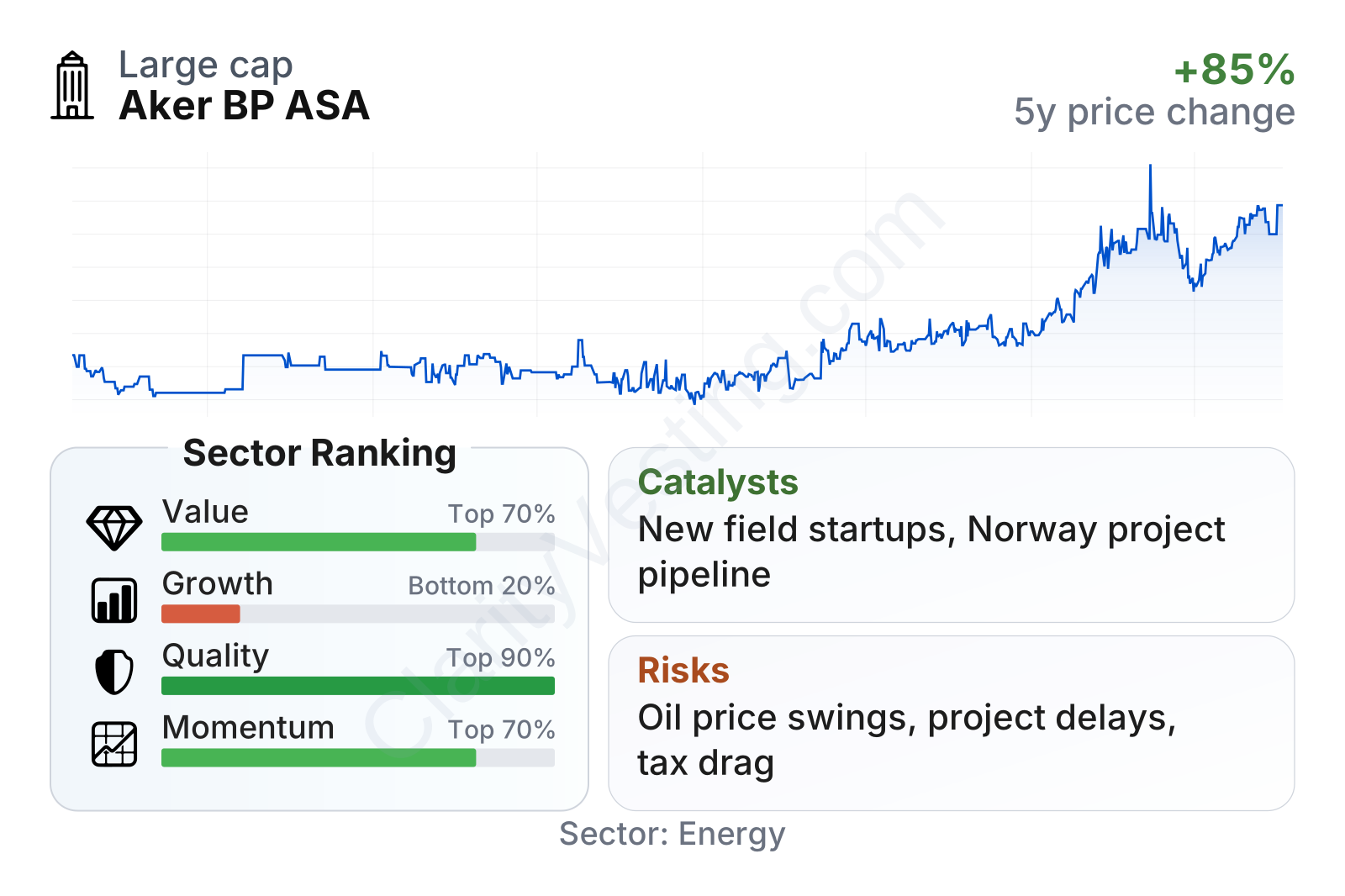
Aker BP stands out most clearly on business quality rather than on classic deep-value screens. Profitability remains well above the sector median, with operating margin above 50% and return on invested capital far ahead of many peers. Balance-sheet pressure also looks contained, with net debt below many sector competitors and very high interest coverage.
Growth metrics are more mixed. Recent year-over-year revenue rebounded strongly in the latest period, but the longer five-year trend is weaker, especially for revenue per share and margin direction. On valuation, the stock trades at a somewhat higher earnings multiple than the sector median, while book value looks less demanding. The cash distribution is notable, with a trailing dividend yield around 6.6%, above the sector median, but free cash flow yield appears lower than many energy peers, which suggests the market is already assigning value to the company’s asset quality and project pipeline.
The share price trend has also been strong. Over three years and across recent shorter periods, the stock has outperformed the sector median, indicating that the market has increasingly rewarded its operating consistency and project visibility.
Growth
Oil and gas is not a classic high-growth sector, but it remains essential to the global energy system and especially important to Europe’s energy security. Aker BP’s niche is more attractive than the broad industry average because it is concentrated in Norwegian offshore production, where regulations are stable, infrastructure is advanced, and resource recovery rates are high. That does not remove commodity cyclicality, but it does improve the odds of disciplined long-term field development.
The company’s strategy is centered on getting more out of existing hubs, tying new discoveries back to established infrastructure, and progressing a sizable project portfolio. That approach usually carries lower risk than frontier exploration because it can reduce development cost per barrel and bring volumes online faster. Aker BP has repeatedly emphasized production efficiency, digital tools, subsea developments, and standardized project execution as key operating levers.
Recent revenue growth has been volatile, which is normal for a producer exposed to both realized prices and field timing. The latest rebound is encouraging, but it should be read together with the wider pattern: Aker BP’s growth path is driven less by smooth demand expansion and more by project startups, production regularity, and energy prices.
Cash generation has moderated from earlier peaks, yet the business remains cash generative. That matters because upstream energy companies fund development spending, dividends, debt management, and acquisitions largely through operating cash flow. When Aker BP combines a strong asset base with disciplined capital spending, even a lower free cash flow phase can still support strategic flexibility.
A major catalyst for future growth is the company’s portfolio of sanctioned and near-field developments on the Norwegian continental shelf, including projects tied to core producing areas. New field startups, higher recovery from existing assets, and better uptime can all lift production without requiring a major geographic expansion. Another important support is Europe’s continued demand for reliable non-Russian energy supply, which keeps Norwegian offshore production strategically relevant.
Recent company updates have also highlighted ongoing project execution and production development across its operated areas. For a business like Aker BP, meaningful opportunity usually comes from delivering large projects on time and on budget rather than from headline-making acquisitions.
Risks
This article is for informational purposes only and does not constitute financial advice. Some content is AI-generated. See Disclaimer


