Stock Analysis · Akbank Turk Anonim Sirketi (AKBTY)
Overview
Akbank Turk Anonim Sirketi is one of Turkey’s largest private-sector banks. It provides everyday banking services such as deposits, loans, credit cards, payments, money transfers, treasury services, and wealth-related products for retail customers, small businesses, commercial clients, and large corporations. The bank also operates in investment banking, foreign exchange, and digital banking, making it a broad financial platform rather than a niche lender.
Its revenue base is typical of a universal bank, with income coming primarily from lending and related banking services. Based on Akbank’s recent annual reporting structure, the largest sources of revenue are generally:
- Net interest income: usually the dominant source, generated from the spread between what the bank earns on loans and securities and what it pays on deposits and other funding.
- Fees and commissions: an important secondary source, including payment systems, credit cards, money transfers, asset management-related fees, and other banking service charges.
- Trading and treasury income: income tied to foreign exchange, securities, derivatives, and balance sheet management.
- Other banking income: smaller items such as recoveries, insurance-related distribution income, and miscellaneous operating revenue.
Because Turkish banks can see sharp swings between interest income, funding costs, and trading-related contributions during periods of inflation and rate changes, a fixed percentage split is less stable than in many U.S. or European banks. What is clear is that traditional spread income remains the core engine, while fees and commissions provide a useful diversification layer.
The business mix also shows a bank that is still fundamentally deposit-funded and domestically focused. That matters for long-term analysis: Akbank is closely tied to Turkey’s economic cycle, interest-rate policy, inflation path, and currency conditions.
The long-term pattern points to a bank that has expanded revenue strongly over the last several years, but with profitability moving unevenly as funding costs and macro conditions changed. Revenue growth has remained strong, while interest expense has risen sharply, which is a key feature to monitor in a high-rate environment.
Key Figures
| Metric | Value | Sector ⓘ |
|---|---|---|
| Date | Nov 21, 2026 | |
| Context | ||
| Sector | Financial Services | |
| Industry | Banks - Regional | |
| Market Cap ⓘ | $6.97B | |
| Beta ⓘ | 0.74 | |
Value (Cheapness) | ||
| P/E Ratio ⓘ | 4.87 | 12.01 |
| P/B Ratio ⓘ | N/A | 1.48 |
| FCF Yield ⓘ | 8.49% | 8.77% |
| Dividend Yield ⓘ | N/A | 3.01% |
| EBIT / EV ⓘ | N/A | 8.31% |
| PEG ⓘ | N/A | |
Growth (Business expansion) | ||
| Revenue Growth ⓘ | 19.50% | 6.70% |
| RPS Growth (5Y CAGR) ⓘ | 55.34% | 12.35% |
| EPS Growth (5Y CAGR) ⓘ | 93.01% | -0.27% |
| BVPS Growth (5Y CAGR) ⓘ | 42.16% | 4.83% |
| Margin Growth (5Y Trend) ⓘ | N/A | -4.16% |
| FCF Growth (5Y CAGR) ⓘ | N/A | 4.69% |
| DPS Growth (5Y CAGR) ⓘ | 78.49% | 8.82% |
Quality (Business durability) | ||
| ROIC (Latest) ⓘ | N/A | 9.49% |
| ROE (Latest) ⓘ | 20.07% | 14.02% |
| ROA (Latest) ⓘ | 1.66% | 1.53% |
| ROIC (5Y Median) ⓘ | N/A | 7.80% |
| ROE (5Y Median) ⓘ | 20.80% | 12.09% |
| ROA (5Y Median) ⓘ | 1.95% | 1.28% |
| Net Debt / EBIT (Latest) ⓘ | N/A | 0.88 |
| Net Debt / EBIT (5Y Median) ⓘ | N/A | 0.73 |
| Net Debt / EBITDA (Latest) ⓘ | N/A | 0.71 |
| Operating Margin (Latest) ⓘ | N/A | 23.37% |
| Operating Margin (5Y Median) ⓘ | N/A | 24.29% |
| Debt to Equity (Latest) ⓘ | N/A | 59.34% |
| Profit Margin (Latest) ⓘ | 27.29% | 26.65% |
| Free Cash Flow (Latest) ⓘ | $591.63M | |
Momentum (Price trend) | ||
| 3Y Return ⓘ | +35.95% | +73.29% |
| 12M Return (excl. last month) ⓘ | +3.37% | +18.35% |
| 6M Return ⓘ | -17.48% | +3.24% |
| Price vs. 200-Day MA ⓘ | -17.01% | +2.17% |
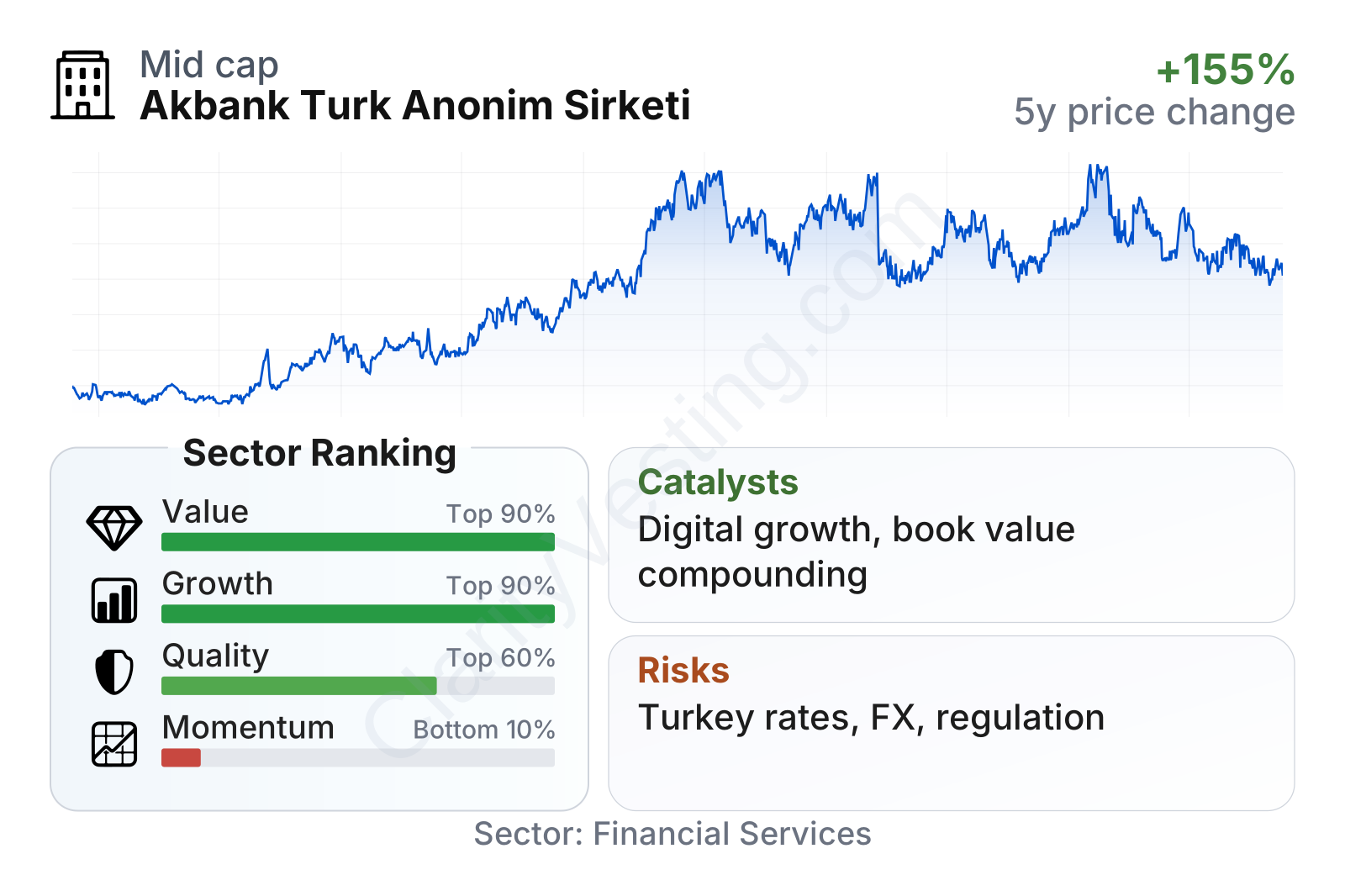
Akbank stands out as a large regional bank with a market value in the multi-billion-dollar range and a below-market beta, suggesting the stock has historically moved less violently than the broader market. In valuation terms, it screens as inexpensive relative to many financial peers, with a P/E far below the sector median. Growth metrics are especially strong: revenue growth, earnings growth over five years, book value per share growth, and dividend growth all rank near the top of the sector sample. Quality is solid rather than flawless, with profitability measures above sector medians, while share-price momentum has recently been weak compared with peers.
Growth
Akbank operates in a sector that remains essential and structurally relevant: banking demand grows alongside household formation, business activity, payments, and savings. In Turkey, the long-term opportunity is amplified by a large population, rising digital adoption, and still-developing financial penetration in some product categories. That does not mean a smooth path, but it does mean the underlying market is active and large enough to support growth for well-run banks.
The company’s strategy makes sense for future expansion because it combines scale, branch banking, and digital delivery. Akbank has invested heavily in mobile and digital channels, which can improve efficiency, deepen customer relationships, and support fee generation in cards, payments, and daily transaction banking. For a bank, this matters because digital engagement often leads to lower servicing costs and more cross-selling opportunities over time.
Another favorable point is capital compounding. Book value per share has risen strongly over the last five years, indicating that the bank has been building shareholder equity even through a volatile macro backdrop.
The upward trend in book value per share is important for a bank because book value is closely tied to lending capacity, resilience, and long-term earnings power. Strong expansion here suggests that Akbank has not simply benefited from a short-lived earnings spike; it has also been adding to its balance-sheet strength.
Earnings per share have been more volatile year to year, which is common in banks exposed to rapid changes in rates, inflation, and currency conditions. Even so, the multi-year trajectory remains strong.
The large jump in earnings over the full five-year period shows that the company has materially increased its profit base, even if annual results have not moved in a straight line. That combination of long-term earnings growth and short-term variability fits the profile of a bank operating in a high-volatility economy.
Recent company communications have also emphasized disciplined loan growth, strong capital ratios, digital customer expansion, and continued focus on Turkish lira funding and balance-sheet management. These are meaningful catalysts because, for a bank in Turkey, deposit quality, pricing discipline, and capital strength are central to preserving profitability across cycles. If inflation cools and monetary conditions normalize over time, stronger credit demand and healthier funding dynamics could support a better earnings mix.
Risks
This article is for informational purposes only and does not constitute financial advice. Some content is AI-generated. See Disclaimer


