Stock Analysis · Aker ASA (AKAAF)
Overview
Aker ASA is a Norwegian industrial investment company. Rather than operating one single business, it owns large stakes in several companies and projects, with a strong emphasis on energy, offshore services, marine biotechnology, and industrial technology. In practice, Aker works as a capital allocator and active owner: it builds, finances, restructures, and develops portfolio companies, then benefits through dividends, asset value growth, and occasional transactions.
Its economic exposure is concentrated in a few major holdings. Based on Aker’s recent annual reporting and portfolio disclosures, the largest value drivers are its stakes in listed and privately held companies connected to offshore energy and related industries. Because Aker is a holding company, reported revenue does not always capture the full economic value of all subsidiaries and associates in a simple operating-company format. A useful way to think about the business is through its underlying portfolio.
The portfolio is mainly tied to the following areas:
- Aker BP – the largest underlying exposure, representing a substantial share of Aker’s net asset value. This business is an oil and gas producer on the Norwegian Continental Shelf and is the group’s main source of dividend capacity and commodity-linked value.
- Offshore and marine services – including companies such as DOF and other ocean-based industrial activities. These operations benefit from offshore project activity, vessel demand, and subsea services.
- Industrial software, carbon capture, and energy transition ventures – including holdings connected to digital tools, decarbonization, and low-carbon industrial development. These are smaller than the oil-and-gas exposure but are strategically important for long-term repositioning.
- Marine biotechnology and seafood-related assets – businesses tied to krill-based nutrition and related products, where the value creation case depends more on scaling and margins than on commodity production.
- Cash, treasury assets, and other investments – a smaller but important part of the structure because Aker often uses liquidity and balance-sheet flexibility to support portfolio changes and new projects.
For readers looking for simple revenue buckets, consolidated revenue is influenced most by subsidiaries that Aker controls directly, while major listed holdings such as Aker BP are often more important to asset value and cash generation than to headline revenue. That makes Aker less straightforward than a normal industrial company: its results reflect both operations and investment revaluations.
Approximate economic exposure by major holdings is heavily concentrated, with Aker BP typically accounting for the largest share of underlying value, followed by offshore services and then a mix of industrial technology, marine biotech, and transition-related assets. Exact percentages move with market prices and transactions, so portfolio value is a more reliable lens than income statement revenue alone.
The income flow has been unusually volatile over the last five years. Revenue has trended upward overall, but operating income and net income have swung sharply from year to year, which is typical for a holding company with asset revaluations, transaction effects, and cyclical energy exposure. The latest period shows higher revenue than earlier years, but profitability remains influenced by items beyond ordinary operating sales.
Key Figures
| Metric | Value | Sector ⓘ |
|---|---|---|
| Date | Oct 24, 2026 | |
| Context | ||
| Sector | Industrials | |
| Industry | Conglomerates | |
| Market Cap ⓘ | $9.79B | |
| Beta ⓘ | 0.36 | |
Value (Cheapness) | ||
| P/E Ratio ⓘ | 3.45 | 22.29 |
| P/B Ratio ⓘ | 0.16 | 1.98 |
| FCF Yield ⓘ | 114.84% | 6.26% |
| Dividend Yield ⓘ | 21.84% | 1.92% |
| EBIT / EV ⓘ | N/A | 4.83% |
| PEG ⓘ | N/A | |
Growth (Business expansion) | ||
| Revenue Growth ⓘ | 360.50% | 9.30% |
| RPS Growth (5Y CAGR) ⓘ | 9.79% | 7.76% |
| EPS Growth (5Y CAGR) ⓘ | N/A | -13.17% |
| BVPS Growth (5Y CAGR) ⓘ | 10.46% | 6.13% |
| Margin Growth (5Y Trend) ⓘ | 15.81% | 0.74% |
| FCF Growth (5Y CAGR) ⓘ | N/A | 10.79% |
| DPS Growth (5Y CAGR) ⓘ | 18.88% | 9.41% |
Quality (Business durability) | ||
| ROIC (Latest) ⓘ | -29.72% | 10.75% |
| ROA (Latest) ⓘ | 26.99% | 5.41% |
| ROIC (5Y Median) ⓘ | 3.61% | 9.37% |
| ROA (5Y Median) ⓘ | 6.23% | 4.95% |
| Net Debt / EBIT (Latest) ⓘ | 1.31 | 2.04 |
| Net Debt / EBIT (5Y Median) ⓘ | 4.86 | 2.27 |
| Net Debt / EBITDA (Latest) ⓘ | 1.20 | 1.39 |
| Net Debt / Assets ⓘ | 34.54% | 19.27% |
| EBITDA / Interest ⓘ | 6.35 | 9.58 |
| Operating Margin (Latest) ⓘ | 129.78% | 10.49% |
| Operating Margin (5Y Median) ⓘ | 8.79% | 10.30% |
| Debt to Equity (Latest) ⓘ | 67.64% | 64.82% |
| Profit Margin (Latest) ⓘ | 69.30% | 6.67% |
| Free Cash Flow (Latest) ⓘ | $11.24B | |
Momentum (Price trend) | ||
| 3Y Return ⓘ | +326.36% | +67.77% |
| 12M Return (excl. last month) ⓘ | +258.92% | +12.05% |
| 6M Return ⓘ | +62.48% | 0.00% |
| Price vs. 200-Day MA ⓘ | +79.46% | +0.67% |
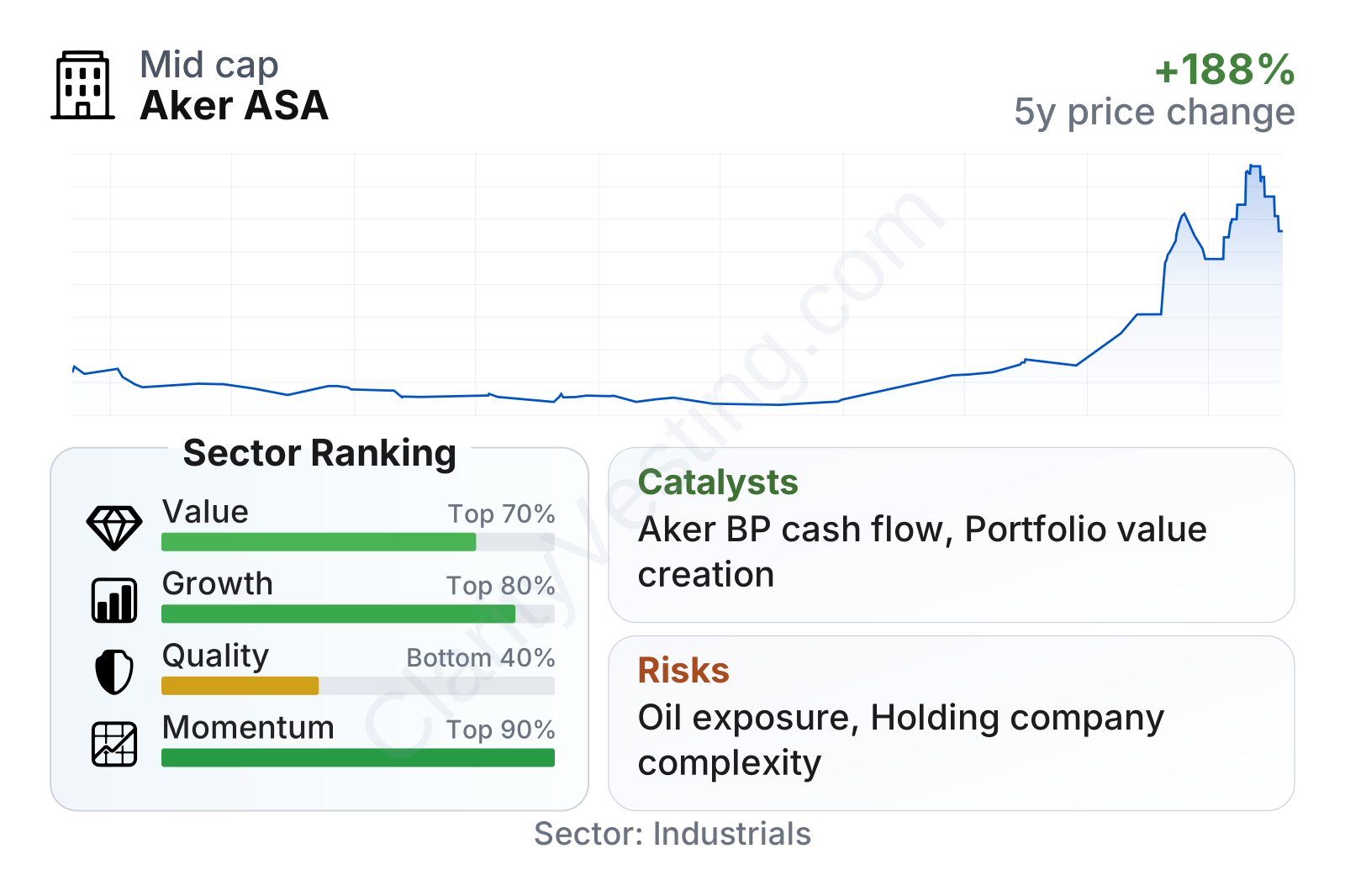
Aker currently stands out on valuation and market performance. Relative to the broader industrial sector, the shares screen as very inexpensive on earnings and book value, while free cash flow yield and dividend yield are exceptionally high. Growth metrics also rank well, helped by strong recent revenue expansion and solid multi-year growth in revenue per share, book value per share, and dividends. The weaker area is quality: leverage is somewhat above sector norms, interest coverage is lower than average, and long-term returns on invested capital have been less impressive than the most attractive industrial peers. Momentum is very strong, showing that the market has already recognized part of the improvement.
Aker is also a large company by market value, but its beta is low, which suggests the stock has historically moved less violently than the market overall. That lower sensitivity can be misleading, however, because a holding company with energy exposure can still face sharp changes in value when oil prices, portfolio valuations, or major holdings move.
Growth
Aker operates across sectors that sit at two very different stages. The mature engine is upstream oil and gas through Aker BP, which remains a highly cash-generative business as long as production stays strong and commodity prices remain supportive. Alongside that, Aker has been building exposure to areas linked to energy transition, carbon management, digital industrial tools, and ocean-based industries. This combination gives the company one foot in today’s cash flows and another in longer-duration opportunities.
The broad offshore energy market remains active, especially in Norway, where long reserve lives, infrastructure, and technical expertise support continued development. That backdrop matters because Aker’s largest holding benefits from project execution, disciplined costs, and production visibility. At the same time, offshore services have improved as vessel markets and subsea demand tightened after years of underinvestment.
Recent growth has been unusually strong compared with the industrial sector median. That does not mean Aker will expand at the same pace every year, because part of the growth profile comes from portfolio effects and cyclical businesses. Still, the longer-term trend in revenue per share and book value per share suggests that value creation has not been limited to one isolated year.
Cash generation is one of the clearest positives in the current profile. Free cash flow is very strong, and that matters more for a holding company than accounting earnings alone. Strong cash flow supports dividends, debt service, portfolio support, and selective new investments. It also gives Aker flexibility when markets are weak and asset prices are more attractive.
As for strategy, the logic is coherent. Aker uses cash from established energy assets to fund shareholder distributions and to seed newer platforms in decarbonization, industrial software, and ocean industries. This is not a pure clean-energy transformation, but it is a practical capital-recycling model that can work if management remains disciplined and avoids overpaying for new ventures.
Recent company communications have continued to emphasize active portfolio development, value realization, and industrial partnerships. The most meaningful catalysts are continued high cash distributions from core holdings, project execution at Aker BP, and progress in maturing newer businesses into commercially viable contributors rather than perpetual investment cases.
Risks
This article is for informational purposes only and does not constitute financial advice. Some content is AI-generated. See Disclaimer