Stock Analysis · Applied Industrial Technologies (AIT)
Overview
Applied Industrial Technologies is an industrial distributor and service company focused on keeping factories, processing plants, and other industrial operations running. In simple terms, it sells the parts, systems, and technical support that customers need to move power, control fluid flow, automate equipment, and maintain machinery. Its customers are spread across many end markets, which helps reduce dependence on any single industry.
The business is organized around two main revenue engines. Based on the latest annual filing, the largest contributor remains traditional distribution of maintenance, repair, and operations products, while the faster-growing and higher-technical-content business is engineered solutions. The mix can shift slightly with acquisitions and end-market demand, but the latest split is approximately:
- Service Center Based Distribution — about 63%: bearings, power transmission products, fluid power components, industrial supplies, and maintenance items sold through a broad branch network.
- Engineered Solutions — about 37%: higher-value technical offerings including fluid power systems, automation, flow control, specialty fabricated solutions, and related design and integration services.
This mix matters because engineered solutions usually carries more technical differentiation than plain product distribution, which can support better margins and stronger customer relationships. Over the last several years, the company has also expanded through acquisitions in automation, flow control, and specialized fluid power, reinforcing that shift toward more value-added work.
The financial flow also shows a business that has been scaling steadily: revenue has moved from roughly $3.8 billion in fiscal 2022 to nearly $5.0 billion in fiscal 2026, while operating income and net income have also advanced. Interest expense has fallen sharply over that period, pointing to a cleaner balance sheet as profits have grown.
Key Figures
| Metric | Value | Sector ⓘ |
|---|---|---|
| Date | Oct 24, 2026 | |
| Context | ||
| Sector | Industrials | |
| Industry | Industrial Distribution | |
| Market Cap ⓘ | $12.15B | |
| Beta ⓘ | 0.85 | |
Value (Cheapness) | ||
| P/E Ratio ⓘ | 30.21 | 22.29 |
| P/B Ratio ⓘ | 6.89 | 1.98 |
| FCF Yield ⓘ | 3.78% | 6.26% |
| Dividend Yield ⓘ | 0.58% | 1.92% |
| EBIT / EV ⓘ | 4.46% | 4.83% |
| PEG ⓘ | 2.78 | |
Growth (Business expansion) | ||
| Revenue Growth ⓘ | 10.40% | 9.30% |
| RPS Growth (5Y CAGR) ⓘ | 7.72% | 7.76% |
| EPS Growth (5Y CAGR) ⓘ | 13.56% | -13.17% |
| BVPS Growth (5Y CAGR) ⓘ | 13.73% | 6.13% |
| Margin Growth (5Y Trend) ⓘ | 1.76% | 0.74% |
| FCF Growth (5Y CAGR) ⓘ | 28.40% | 10.79% |
| DPS Growth (5Y CAGR) ⓘ | 9.69% | 9.41% |
Quality (Business durability) | ||
| ROIC (Latest) ⓘ | 18.18% | 10.75% |
| ROA (Latest) ⓘ | 13.38% | 5.41% |
| ROIC (5Y Median) ⓘ | 22.72% | 9.37% |
| ROA (5Y Median) ⓘ | 13.35% | 4.95% |
| Net Debt / EBIT (Latest) ⓘ | 0.65 | 2.04 |
| Net Debt / EBIT (5Y Median) ⓘ | 0.59 | 2.27 |
| Net Debt / EBITDA (Latest) ⓘ | 0.58 | 1.39 |
| Net Debt / Assets ⓘ | 11.84% | 19.27% |
| EBITDA / Interest ⓘ | 77.87 | 9.58 |
| Operating Margin (Latest) ⓘ | 11.12% | 10.49% |
| Operating Margin (5Y Median) ⓘ | 11.12% | 10.30% |
| Debt to Equity (Latest) ⓘ | 25.97% | 64.82% |
| Profit Margin (Latest) ⓘ | 8.35% | 6.67% |
| Free Cash Flow (Latest) ⓘ | $458.91M | |
Momentum (Price trend) | ||
| 3Y Return ⓘ | +125.04% | +67.77% |
| 12M Return (excl. last month) ⓘ | +23.84% | +12.05% |
| 6M Return ⓘ | +15.78% | 0.00% |
| Price vs. 200-Day MA ⓘ | +10.17% | +0.67% |
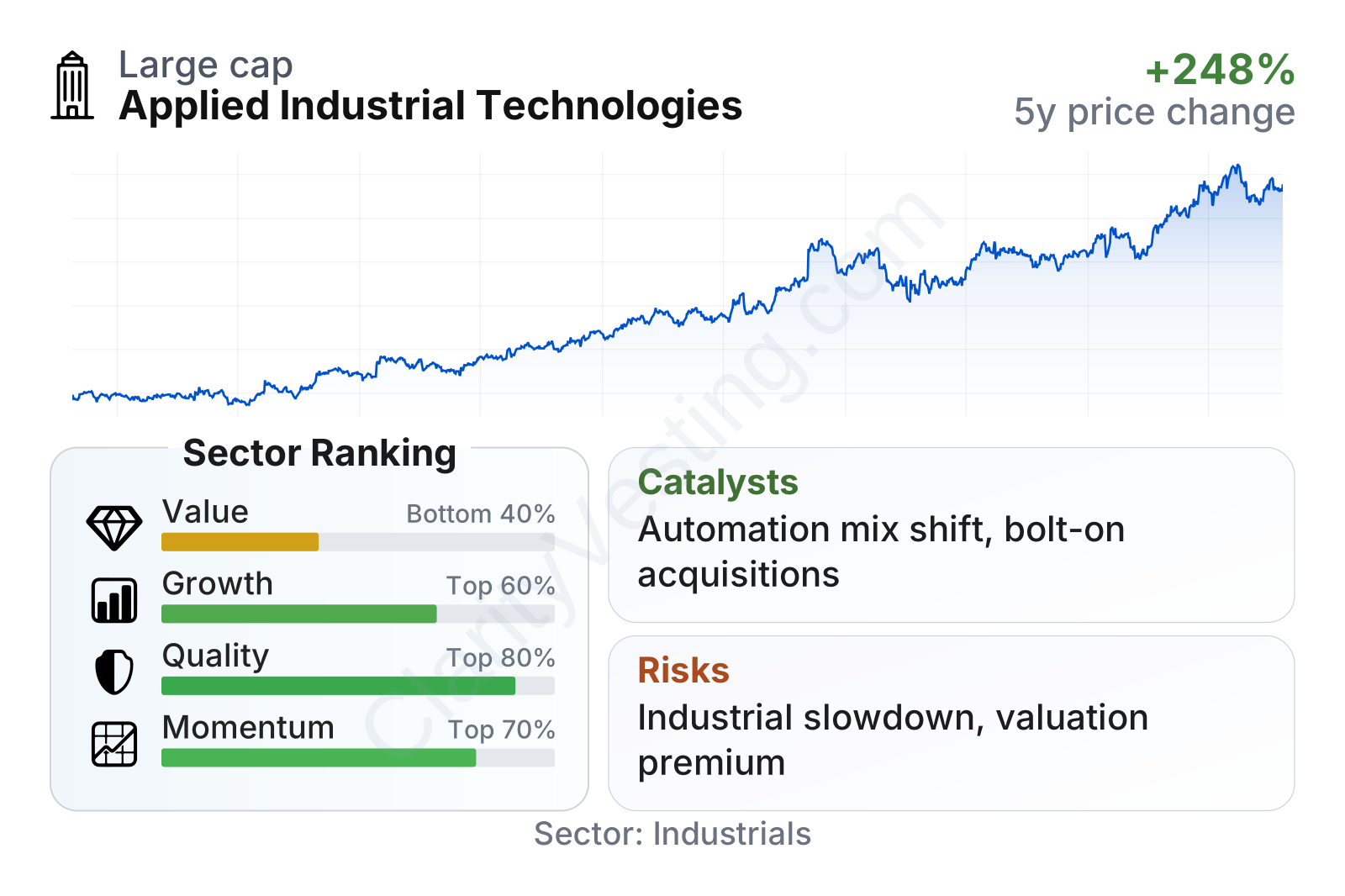
Applied Industrial Technologies sits in the large mid-cap range, with a share price record that has compounded strongly over the last five years. The quality profile stands out more than the value profile: returns on capital and assets are well above sector medians, leverage is modest, and interest coverage is exceptionally strong. Growth is respectable rather than explosive, but earnings, book value, and free cash flow have all improved at solid rates over a multi-year period. The weaker point in the snapshot is valuation, where multiples are above sector norms and the cash flow yield is lower than the typical industrial peer.
Growth
Applied Industrial Technologies operates in parts of the industrial economy that benefit from long-term trends rather than one short-lived theme. Factory automation, fluid power modernization, reliability services, and process optimization all remain relevant as manufacturers try to improve uptime, labor efficiency, and energy productivity. That gives the company exposure to an industrial sector that is mature overall, but still supported by structural demand for more automated and more efficient operations.
The company’s strategy appears coherent for future expansion. Management has been steadily shifting the mix toward engineered solutions and technical categories where customer needs are more complex and relationships are harder to replace. That matters because simple distribution can be highly competitive, while technical integration, design support, and specialized service tend to create stickier business. The company has also used acquisitions as a bolt-on growth tool, especially in automation and flow-control niches, which can deepen local expertise and broaden its product portfolio.
Recent growth has not been perfectly linear, which is normal for an industrial supplier tied to customer production cycles. Revenue growth was very strong in the earlier post-pandemic period, slowed materially in fiscal 2024, briefly dipped around flat to slightly negative in one period, and then reaccelerated into fiscal 2026 to around 10%. That pattern suggests the company is still cyclical, but it also shows resilience: after a softer industrial patch, the business returned to healthier expansion.
Cash generation is another positive signal. Free cash flow has risen meaningfully versus levels seen a few years ago and has stayed at a solid level more recently, even after that initial jump. For a distribution business, this is important because working capital can consume cash when inventories and receivables rise. Sustained free cash flow supports acquisitions, dividends, and balance-sheet flexibility without requiring heavy borrowing.
A current catalyst is the ongoing industrial push toward automation and process efficiency in North America. Applied Industrial’s exposure to automation platforms, fluid power systems, and flow control should keep it relevant as customers modernize plants. In addition, the company’s acquisition-led portfolio building creates the possibility of continued mix improvement, not just revenue expansion. The latest annual results, showing nearly $5.0 billion of revenue and record earnings, reinforce that the strategy is still producing forward momentum.
Risks
This article is for informational purposes only and does not constitute financial advice. Some content is AI-generated. See Disclaimer