Stock Analysis · AAR Corp (AIR)
Overview
AAR Corp is an aerospace services company focused mainly on keeping aircraft flying. Instead of designing or manufacturing large aircraft platforms, it works in the aftermarket part of aviation: maintenance, repairs, parts distribution, and operational support. Its customers include commercial airlines, cargo carriers, government and defense operators, and business aviation clients. That makes the company more tied to aircraft usage, fleet aging, and maintenance demand than to new aircraft production cycles alone.
In its latest fiscal year, AAR generated revenue from two main segments. Based on the company’s 2026 annual report, the business mix was led by its commercial-focused Parts Supply segment, followed by Repair & Engineering.
- Parts Supply: about 76% of revenue. This includes distribution of new aviation parts, sale of used serviceable material, consignment programs, and supply-chain services for airlines and other operators.
- Repair & Engineering: about 24% of revenue. This includes maintenance, repair, and overhaul work, component repair, landing gear services, and engineering support.
AAR has become more streamlined over time, with a clearer focus on aviation services where recurring demand can be supported by flight activity, regulatory maintenance requirements, and airlines’ need to control costs by repairing aircraft and sourcing parts efficiently.
The company’s revenue and gross profit have risen strongly over the last several years, and the 2026 fiscal year also showed a sharp recovery in operating income and net income after a weaker 2025. That pattern suggests the recent growth has not only come from higher sales volume, but also from better operating execution.
The recent income flow shows a business that is scaling up meaningfully: revenue has climbed from roughly $1.8 billion to more than $3.3 billion in four fiscal years, while operating profit rebounded sharply in 2026 after pressure from higher costs and interest expense in 2024 and 2025.
Key Figures
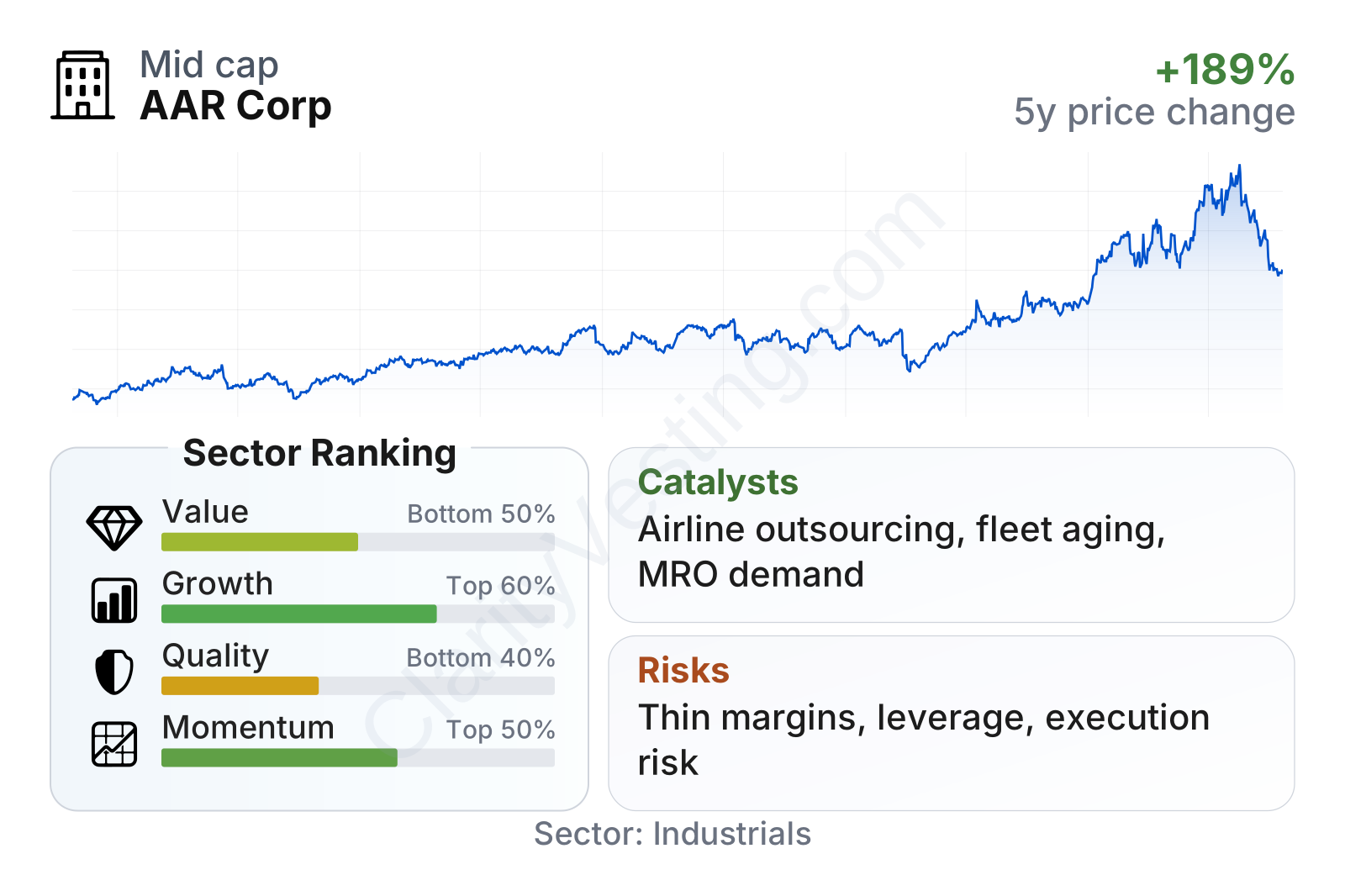
The long-term stock trend has been strong, with the shares rising several times over from late 2021 to mid-2026. The path has not been smooth, but the overall direction reflects improved business momentum and a much stronger earnings base than during the earlier recovery period.
| Metric | Value | Sector ⓘ |
|---|---|---|
| Date | Oct 24, 2026 | |
| Context | ||
| Sector | Industrials | |
| Industry | Aerospace & Defense | |
| Market Cap ⓘ | $4.01B | |
| Beta ⓘ | 1.13 | |
Value (Cheapness) | ||
| P/E Ratio ⓘ | 20.45 | 22.29 |
| P/B Ratio ⓘ | 2.28 | 1.98 |
| FCF Yield ⓘ | 3.73% | 6.26% |
| Dividend Yield ⓘ | N/A | 1.92% |
| EBIT / EV ⓘ | 5.67% | 4.83% |
| PEG ⓘ | 2.40 | |
Growth (Business expansion) | ||
| Revenue Growth ⓘ | 24.10% | 9.30% |
| RPS Growth (5Y CAGR) ⓘ | 14.25% | 7.76% |
| EPS Growth (5Y CAGR) ⓘ | -18.34% | -13.17% |
| BVPS Growth (5Y CAGR) ⓘ | 11.47% | 6.13% |
| Margin Growth (5Y Trend) ⓘ | 2.08% | 0.74% |
| FCF Growth (5Y CAGR) ⓘ | -12.92% | 10.79% |
| DPS Growth (5Y CAGR) ⓘ | 105.87% | 9.41% |
Quality (Business durability) | ||
| ROIC (Latest) ⓘ | 9.81% | 10.75% |
| ROA (Latest) ⓘ | 5.80% | 5.41% |
| ROIC (5Y Median) ⓘ | 7.40% | 9.37% |
| ROA (5Y Median) ⓘ | 5.06% | 4.95% |
| Net Debt / EBIT (Latest) ⓘ | 2.69 | 2.04 |
| Net Debt / EBIT (5Y Median) ⓘ | 3.37 | 2.27 |
| Net Debt / EBITDA (Latest) ⓘ | 2.17 | 1.39 |
| Net Debt / Assets ⓘ | 25.50% | 19.27% |
| EBITDA / Interest ⓘ | 5.82 | 9.58 |
| Operating Margin (Latest) ⓘ | 9.30% | 10.49% |
| Operating Margin (5Y Median) ⓘ | 6.10% | 10.30% |
| Debt to Equity (Latest) ⓘ | 56.15% | 64.82% |
| Profit Margin (Latest) ⓘ | 5.55% | 6.67% |
| Free Cash Flow (Latest) ⓘ | $149.70M | |
Momentum (Price trend) | ||
| 3Y Return ⓘ | +71.38% | +67.77% |
| 12M Return (excl. last month) ⓘ | +54.40% | +12.05% |
| 6M Return ⓘ | -14.50% | 0.00% |
| Price vs. 200-Day MA ⓘ | -15.82% | +0.67% |
AAR stands out more for growth and improving operating trends than for classic low-valuation or high-profitability metrics. Revenue expansion is clearly above the sector median, while quality measures remain mixed because debt is still meaningful and margins, although improving, remain below many aerospace peers. The company is also mid-sized rather than a large industry heavyweight, which can create both flexibility and volatility.
Growth
AAR operates in a favorable long-term niche. The broader aerospace and defense sector can be cyclical, but aircraft aftermarket services often benefit from durable structural demand. Airlines and cargo operators must maintain fleets regardless of whether they are buying many new aircraft. That dynamic can become even stronger when OEM production delays keep older aircraft in service longer. In practical terms, more years in service usually mean more inspections, more replacement parts, and more repair work.
The company’s strategy also fits this backdrop well. AAR is positioned around supply-chain support, used serviceable material, repair capabilities, and outsourced maintenance solutions. These offerings can appeal to airlines trying to reduce turnaround times and manage operating costs. It is a practical value proposition: when fleets are constrained and new aircraft deliveries are delayed, efficient sourcing and repair become more important.
Recent growth has been consistently strong. Year-over-year revenue growth has mostly remained in the low-teens to mid-20% range over the last several reporting periods, well above the sector median. The latest annual revenue level also confirms that this is not just a short quarterly spike but part of a larger expansion phase.
Cash generation has been less smooth than revenue growth, which is common in distribution and maintenance businesses where working capital can move around sharply. Even so, free cash flow has returned to positive territory, and the latest trailing twelve-month level is materially better than the earlier swings around break-even. For a company growing this quickly, the key point is whether cash flow becomes more dependable as scale increases.
Recent company developments also support the growth case. AAR has continued to expand its commercial aviation services footprint and has highlighted demand tied to airline outsourcing, parts availability constraints, and defense-related support programs. Its acquisition activity in recent years has also broadened capabilities, especially in maintenance and component services, giving the company more ways to cross-sell customers and capture more of the aftermarket spending pool.
Risks
This article is for informational purposes only and does not constitute financial advice. Some content is AI-generated. See Disclaimer


