Stock Analysis · Air Global PLC (AIIR)
Overview
Air Global PLC operates in the tobacco industry and focuses on smokeless nicotine products. The company is best known for modern oral nicotine pouches sold under the ZYN brand outside the United States through licensing and distribution arrangements, while also having a portfolio tied to traditional tobacco and related nicotine products. In simple terms, it is a consumer goods business built around products that deliver nicotine without relying only on cigarettes, which places it in a part of the tobacco market that has been changing quickly as consumers and regulators push for reduced-risk alternatives.
The business model is relatively straightforward: Air Global earns revenue by manufacturing, marketing, licensing, and distributing nicotine products through retail and commercial channels. Based on recent annual reporting, revenue appears to be concentrated in modern oral products, with a smaller contribution from legacy tobacco-related activities and other product lines. Public disclosures do not always break every category out with perfect precision, but the broad mix can be summarized as follows:
- Modern oral nicotine products: the largest revenue source, likely representing a clear majority of sales. This includes nicotine pouch products and associated brand licensing economics.
- Traditional tobacco and related products: a smaller but still meaningful share, tied to established smokeless or tobacco-adjacent categories.
- Other revenue: a limited contribution from miscellaneous commercial arrangements, which appears modest relative to the core nicotine portfolio.
From a high-level financial view, the company has been expanding revenue steadily over the last three reported years, from roughly $364 million in 2023 to nearly $400 million in 2025. Gross profit also moved higher over that period, showing that the core product base still converts a solid share of sales into profit before overhead, financing, and taxes. One notable improvement is that interest expense has trended down, which helps earnings quality, even though debt remains an important part of the balance sheet picture.
The main operating pattern is encouraging on the surface: sales, gross profit, and operating income have generally improved over time. However, the path has not been perfectly smooth, because selling and administrative expenses also rose materially, and net income has been more volatile than operating profit. That suggests the underlying business is growing, but the full benefit to shareholders still depends on execution, costs, and debt management.
Key Figures
| Metric | Value | Sector ⓘ |
|---|---|---|
| Date | Oct 17, 2026 | |
| Context | ||
| Sector | Consumer Defensive | |
| Industry | Tobacco | |
| Market Cap ⓘ | $1.17B | |
| Beta ⓘ | N/A | |
Value (Cheapness) | ||
| P/E Ratio ⓘ | N/A | 17.88 |
| P/B Ratio ⓘ | 1.36 | 1.29 |
| FCF Yield ⓘ | N/A | 12.39% |
| Dividend Yield ⓘ | N/A | 2.85% |
| EBIT / EV ⓘ | N/A | 6.43% |
| PEG ⓘ | N/A | |
Growth (Business expansion) | ||
| Revenue Growth ⓘ | N/A | 4.10% |
| RPS Growth (5Y CAGR) ⓘ | 120.21% | 6.18% |
| EPS Growth (5Y CAGR) ⓘ | N/A | -13.59% |
| BVPS Growth (5Y CAGR) ⓘ | 189.73% | 3.20% |
| Margin Growth (5Y Trend) ⓘ | 1.46% | -0.15% |
| FCF Growth (5Y CAGR) ⓘ | 35.32% | 4.10% |
| DPS Growth (5Y CAGR) ⓘ | N/A | 6.79% |
Quality (Business durability) | ||
| ROIC (Latest) ⓘ | N/A | 12.34% |
| ROA (Latest) ⓘ | -13.65% | 6.30% |
| ROIC (5Y Median) ⓘ | N/A | 10.49% |
| ROA (5Y Median) ⓘ | N/A | 5.44% |
| Net Debt / EBIT (Latest) ⓘ | N/A | 1.96 |
| Net Debt / EBIT (5Y Median) ⓘ | 3.44 | 2.35 |
| Net Debt / EBITDA (Latest) ⓘ | 11.15 | 1.38 |
| Net Debt / Assets ⓘ | 44.35% | 21.51% |
| EBITDA / Interest ⓘ | N/A | 9.46 |
| Operating Margin (Latest) ⓘ | N/A | 8.87% |
| Operating Margin (5Y Median) ⓘ | 20.81% | 9.53% |
| Debt to Equity (Latest) ⓘ | 218.89% | 72.35% |
| Profit Margin (Latest) ⓘ | N/A | 5.40% |
| Free Cash Flow (Latest) ⓘ | N/A | |
Momentum (Price trend) | ||
| 3Y Return ⓘ | N/A | +20.92% |
| 12M Return (excl. last month) ⓘ | N/A | +2.13% |
| 6M Return ⓘ | -27.69% | +1.26% |
| Price vs. 200-Day MA ⓘ | N/A | +1.39% |
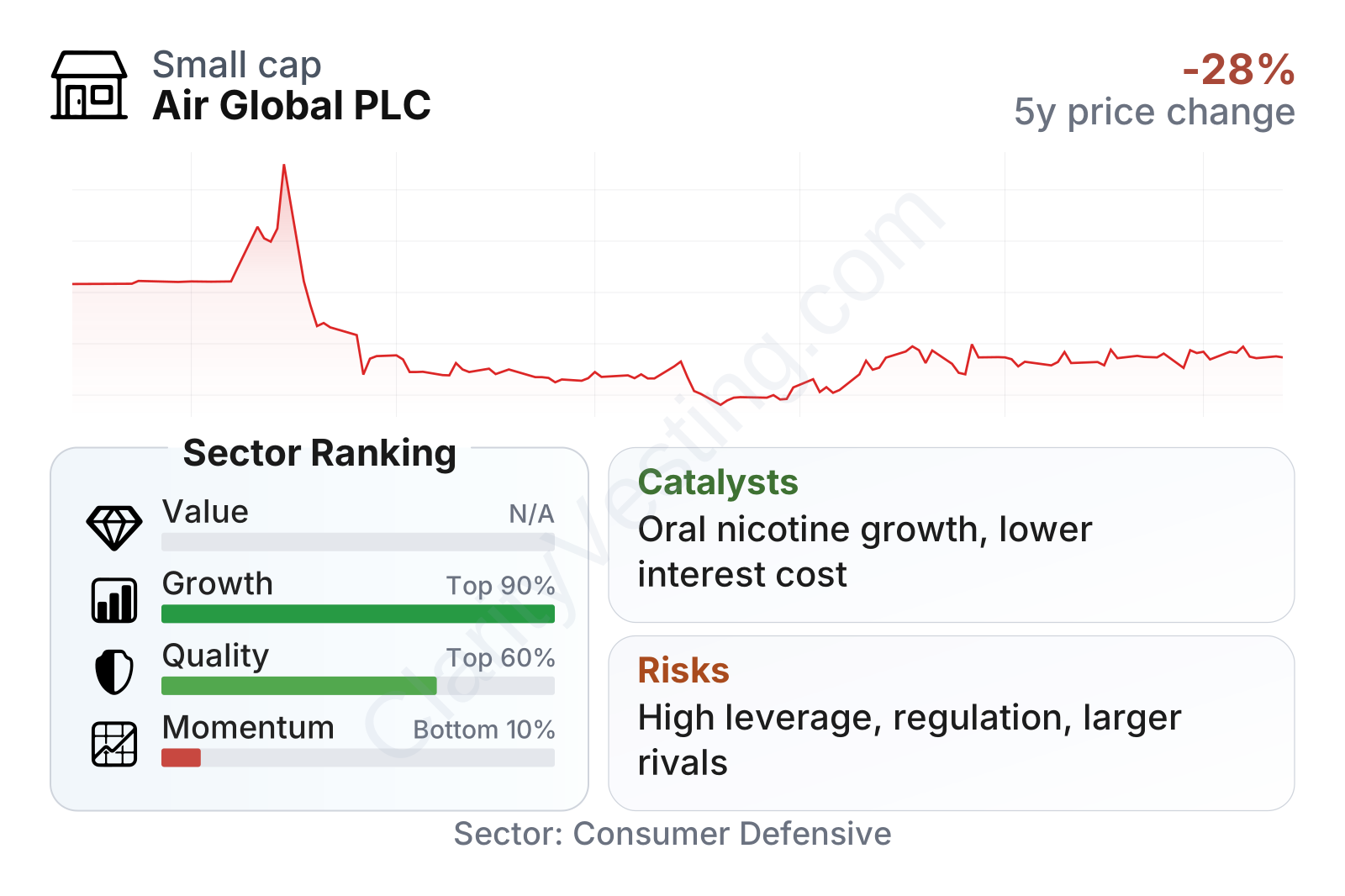
The key metrics paint a mixed picture. On growth, Air Global ranks strongly versus much of its sector, helped by exceptional multi-year expansion in revenue per share, book value per share, and free cash flow. That is the clearest quantitative strength in the company’s profile. At the same time, recent year-over-year revenue growth appears flat, which means the market is likely watching for evidence that the long-term growth engine is still active rather than fading into a slower phase.
On quality, the company sits around the middle of the sector rather than near the top. Historical operating margins have been strong, but balance sheet leverage stands out as a weakness. Debt-to-equity is well above the sector median, net debt relative to EBITDA is unusually elevated, and return on assets is negative on a trailing basis. In practical terms, that means the business has shown it can generate attractive margins, but the capital structure adds pressure and limits flexibility.
The recent share price decline is also meaningful. The stock fell sharply between mid-April 2026 and mid-July 2026, indicating that market sentiment weakened materially in a short period. Without assigning too much importance to a few months of trading, that kind of move usually signals concern about future growth, leverage, execution, or all three together.
Growth
Air Global operates in a part of the tobacco sector that still has room to grow: smoke-free nicotine products. This category has benefited from changing consumer habits, especially among adult nicotine users looking for alternatives to combustible products. Within tobacco, that makes the company more exposed to one of the industry’s more dynamic segments rather than to the slowest-moving categories.
The company’s strategy makes sense in that context. A business centered on oral nicotine pouches can potentially scale through brand strength, distribution gains, repeat purchasing, and expansion across geographies where regulation allows these products to grow. The financial history supports the idea that this strategy has had traction: revenue has risen each year from 2023 through 2025, gross profit expanded, and five-year growth metrics compare favorably with the broader consumer defensive universe.
A second growth support is margin structure. Gross profit has remained healthy, and operating margins over the last five years have been stronger than the sector median. That matters because in branded consumer products, growth becomes more valuable when a company can keep a good portion of each additional sales dollar after product costs. If Air Global can keep distribution momentum while limiting overhead growth, future earnings conversion could improve.
Another positive element is lower interest expense over time. Even though leverage is still high, the reduction in financing costs between 2023 and 2025 suggests some improvement in the debt burden. If that trend continues, more operating profit can flow through to net income and cash generation.
The strongest near-term catalyst is likely any confirmation that smoke-free product demand remains durable and that the company can keep translating category growth into market share, pricing power, or broader distribution. Because recent annual revenue growth has slowed, the next phase depends less on the general attractiveness of the category and more on whether Air Global can show that its brands and commercial relationships still have momentum.
Risks
This article is for informational purposes only and does not constitute financial advice. Some content is AI-generated. See Disclaimer


