Stock Analysis · American Healthcare REIT Inc (AHR)
Overview
American Healthcare REIT Inc is a healthcare real estate investment trust that owns properties tied to medical and senior care needs. In simple terms, it buys, develops, and operates buildings used for senior housing, medical offices, skilled nursing, and other healthcare-related services. The company’s portfolio is spread across the United States, the United Kingdom, and the Isle of Man, which gives it exposure to several healthcare systems and tenant groups rather than relying on a single niche.
Its business model combines rental income from leased properties with operating income from communities where results depend more directly on occupancy, resident rates, and day-to-day management. That mix makes the company different from some healthcare REITs that focus almost entirely on collecting contractual rent.
The main revenue sources are broadly organized by property type. Based on company disclosures, the largest categories are:
- Integrated senior health campuses: approximately 35% to 45% of rent and other property revenue. These campuses typically combine independent living, assisted living, memory care, and sometimes skilled nursing on one site.
- Senior housing operating properties: approximately 20% to 30%. These are communities where performance depends on resident demand, occupancy, and pricing rather than only fixed lease payments.
- Outpatient medical / medical office buildings: approximately 15% to 25%. These properties are used by physicians, clinics, and healthcare systems for ambulatory care.
- Triple-net leased senior housing and healthcare facilities: approximately 10% to 20%. Under this structure, tenants generally cover property-level costs such as maintenance, taxes, and insurance.
- Skilled nursing facilities and other healthcare assets: a smaller share, generally under 10%, depending on the period and asset mix.
The company has also been repositioning its portfolio toward assets with stronger demographic support and more private-pay exposure, especially in senior housing. That matters because private-pay properties are less dependent on government reimbursement than some nursing-focused assets.
The financial flow over recent years shows a useful pattern: revenue has risen steadily from 2021 through 2025, gross profit has expanded, and interest expense has come down materially from its 2023 peak. Just as important, net income moved from losses into positive territory in 2025, suggesting the portfolio is becoming more productive as financing pressure eases.
Key Figures
| Metric | Value | Sector ⓘ |
|---|---|---|
| Date | Oct 17, 2026 | |
| Context | ||
| Sector | Real Estate | |
| Industry | REIT - Healthcare Facilities | |
| Market Cap ⓘ | $11.56B | |
| Beta ⓘ | 0.80 | |
Value (Cheapness) | ||
| P/E Ratio ⓘ | 79.12 | 17.38 |
| P/B Ratio ⓘ | 2.77 | 0.85 |
| FCF Yield ⓘ | 2.27% | 7.38% |
| Dividend Yield ⓘ | 1.91% | 4.85% |
| EBIT / EV ⓘ | 1.39% | 3.78% |
| PEG ⓘ | N/A | |
Growth (Business expansion) | ||
| Revenue Growth ⓘ | 24.70% | 5.30% |
| RPS Growth (5Y CAGR) ⓘ | -8.22% | 6.02% |
| EPS Growth (5Y CAGR) ⓘ | N/A | -11.37% |
| BVPS Growth (5Y CAGR) ⓘ | -4.75% | 0.45% |
| Margin Growth (5Y Trend) ⓘ | 5.50% | -0.22% |
| FCF Growth (5Y CAGR) ⓘ | N/A | 5.40% |
| DPS Growth (5Y CAGR) ⓘ | 29.90% | 5.02% |
Quality (Business durability) | ||
| ROIC (Latest) ⓘ | 4.53% | 5.69% |
| ROE (Latest) ⓘ | 3.85% | 7.56% |
| ROA (Latest) ⓘ | 2.31% | 2.85% |
| ROIC (5Y Median) ⓘ | 1.88% | 4.22% |
| ROE (5Y Median) ⓘ | -3.91% | 6.03% |
| ROA (5Y Median) ⓘ | -1.22% | 2.44% |
| Net Debt / EBIT (Latest) ⓘ | 8.01 | 7.59 |
| Net Debt / EBIT (5Y Median) ⓘ | 34.22 | 8.40 |
| Net Debt / EBITDA (Latest) ⓘ | 3.09 | 5.27 |
| Net Debt / Assets ⓘ | 24.73% | 37.76% |
| EBITDA / Interest ⓘ | 5.88 | 4.10 |
| Operating Margin (Latest) ⓘ | 7.04% | 35.29% |
| Operating Margin (5Y Median) ⓘ | 4.53% | 37.31% |
| Debt to Equity (Latest) ⓘ | 42.42% | 88.87% |
| Profit Margin (Latest) ⓘ | 4.83% | 19.61% |
| Free Cash Flow (Latest) ⓘ | $261.84M | |
Momentum (Price trend) | ||
| 3Y Return ⓘ | N/A | +30.75% |
| 12M Return (excl. last month) ⓘ | +26.82% | +4.36% |
| 6M Return ⓘ | +8.17% | -2.52% |
| Price vs. 200-Day MA ⓘ | +4.55% | -2.34% |
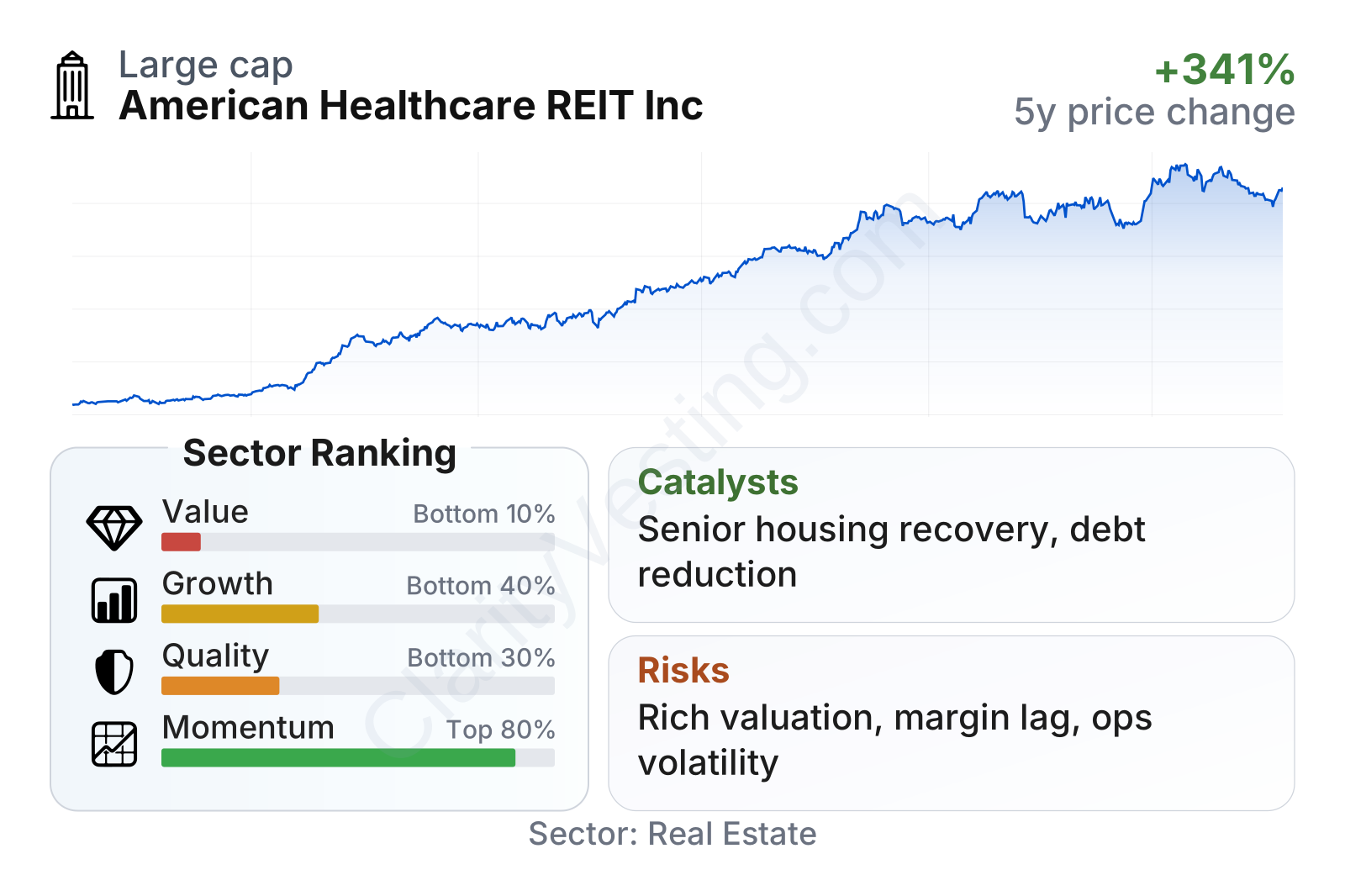
The market is valuing AHR as a large healthcare property owner with strong recent share-price momentum, but the underlying fundamentals are more mixed. Recent revenue growth has been strong relative to the sector, while profitability and returns on capital still rank below many peers. The table also shows a clear contrast: leverage metrics have improved and interest coverage is healthy, yet the stock trades at richer valuation multiples than the typical healthcare REIT.
The share-price chart reflects a major re-rating since the 2024 listing period. That move usually means the market has become more confident in earnings normalization, balance-sheet improvement, and the value of the senior housing portfolio.
Growth
AHR operates in a sector with an attractive long-term demand backdrop. An aging population supports higher need for assisted living, memory care, outpatient services, and other healthcare real estate. This is especially relevant in senior housing, where supply growth has been relatively restrained in many markets while demand is gradually improving as older age cohorts expand.
The company’s strategy is aligned with that theme. It has meaningful exposure to senior housing operating properties, which can benefit more directly when occupancy rises and monthly resident rates increase. It also holds outpatient medical properties, a segment supported by the shift away from inpatient hospital settings toward lower-cost ambulatory care.
One point that needs context is revenue per share. While total revenue has been moving higher, revenue per share has declined over the last two years. That usually means share count growth, asset mix changes, or both have diluted the per-share benefit. For long-term analysis, this is important because growing total revenue is not enough on its own if each share captures a smaller portion of that growth.
The dividend pattern is also notable. Dividend per share increased strongly over the full multi-year period, although there was a reset after 2023 before growth resumed. At the same time, the trailing yield has compressed to about 2%, well below the sector median, mainly because the stock price has climbed much faster than the dividend. That suggests the market is currently assigning more value to future operating improvement than to current income generation.
A significant catalyst has been the company’s improving profitability profile. Revenue rose from roughly $1.3 billion in 2021 to about $2.3 billion in 2025, while net income turned positive in 2025. The reduction in interest expense is another meaningful support for future results, because REIT earnings are highly sensitive to financing costs.
Recent company communications have also emphasized portfolio optimization, operating gains in senior housing, and capital recycling. In practical terms, this means selling or pruning weaker assets, concentrating on stronger properties, and using capital where returns look better. If that discipline continues, it could help lift occupancy, margins, and cash generation over time.
Risks
This article is for informational purposes only and does not constitute financial advice. Some content is AI-generated. See Disclaimer


