Stock Analysis · Argan Inc (AGX)
Overview
Argan Inc. is a construction and engineering company focused mainly on large industrial projects in the United States. Its best-known activity is building highly technical facilities for power generation, especially natural gas-fired power plants. The company also works on industrial construction, telecommunications infrastructure, and services related to renewable energy and utility systems, but power projects have historically been the main driver.
Argan operates through several subsidiaries, including Gemma Power Systems, which is the core engine of the group. In practical terms, the company is hired to design, build, and sometimes procure major equipment for customers developing energy and industrial assets. That makes results heavily tied to the timing and size of project awards rather than a steady subscription-like revenue model.
Based on recent company disclosures, revenue is concentrated in a few activities, with power construction clearly dominating.
- Power industry services: approximately 80% to 90% of revenue in recent periods. This includes engineering, procurement, construction, commissioning, and related work for natural gas power plants and certain renewable or utility projects.
- Industrial construction and field services: approximately 10% to 20% of revenue. This covers site work, industrial maintenance, fabrication-related activity, and other construction services outside the core power segment.
- Telecommunications and other activities: a small share of revenue, generally below 10%. This includes infrastructure services and smaller miscellaneous operations.
The business mix also shows an important financial change: revenue has grown strongly over the last two years, while operating profit and net income have expanded even faster. That suggests recent projects have been not only larger, but also more profitable than the company’s earlier work.
The financial flow highlights a business that has recently become much more efficient. Revenue has risen sharply since fiscal 2024, but profit has climbed even faster, helped by stronger gross profit and relatively contained overhead costs.
Key Figures
| Metric | Value | Sector ⓘ |
|---|---|---|
| Date | Oct 10, 2026 | |
| Context | ||
| Sector | Industrials | |
| Industry | Engineering & Construction | |
| Market Cap ⓘ | $5.89B | |
| Beta ⓘ | 0.55 | |
Value (Cheapness) | ||
| P/E Ratio ⓘ | 30.65 | 22.32 |
| P/B Ratio ⓘ | 11.30 | 1.98 |
| FCF Yield ⓘ | 9.27% | 6.34% |
| Dividend Yield ⓘ | 0.52% | 1.95% |
| EBIT / EV ⓘ | 5.09% | 4.71% |
| PEG ⓘ | N/A | |
Growth (Business expansion) | ||
| Revenue Growth ⓘ | 61.50% | 9.25% |
| RPS Growth (5Y CAGR) ⓘ | 20.10% | 7.75% |
| EPS Growth (5Y CAGR) ⓘ | 30.10% | -13.37% |
| BVPS Growth (5Y CAGR) ⓘ | 12.21% | 6.12% |
| Margin Growth (5Y Trend) ⓘ | 6.70% | 0.81% |
| FCF Growth (5Y CAGR) ⓘ | 97.52% | 11.01% |
| DPS Growth (5Y CAGR) ⓘ | 14.83% | 9.48% |
Quality (Business durability) | ||
| ROIC (Latest) ⓘ | 38.51% | 10.70% |
| ROA (Latest) ⓘ | 14.63% | 5.38% |
| ROIC (5Y Median) ⓘ | 12.29% | 9.26% |
| ROA (5Y Median) ⓘ | 6.62% | 4.94% |
| Net Debt / EBIT (Latest) ⓘ | -1.69 | 2.08 |
| Net Debt / EBIT (5Y Median) ⓘ | -3.97 | 2.29 |
| Net Debt / EBITDA (Latest) ⓘ | -1.67 | 1.43 |
| Net Debt / Assets ⓘ | -26.02% | 19.34% |
| EBITDA / Interest ⓘ | N/A | 9.54 |
| Operating Margin (Latest) ⓘ | 18.16% | 10.34% |
| Operating Margin (5Y Median) ⓘ | 10.29% | 10.29% |
| Debt to Equity (Latest) ⓘ | N/A | 65.52% |
| Profit Margin (Latest) ⓘ | 15.09% | 6.63% |
| Free Cash Flow (Latest) ⓘ | $545.70M | |
Momentum (Price trend) | ||
| 3Y Return ⓘ | +783.44% | +61.33% |
| 12M Return (excl. last month) ⓘ | +98.57% | +14.82% |
| 6M Return ⓘ | -29.79% | +3.53% |
| Price vs. 200-Day MA ⓘ | -21.86% | +0.88% |
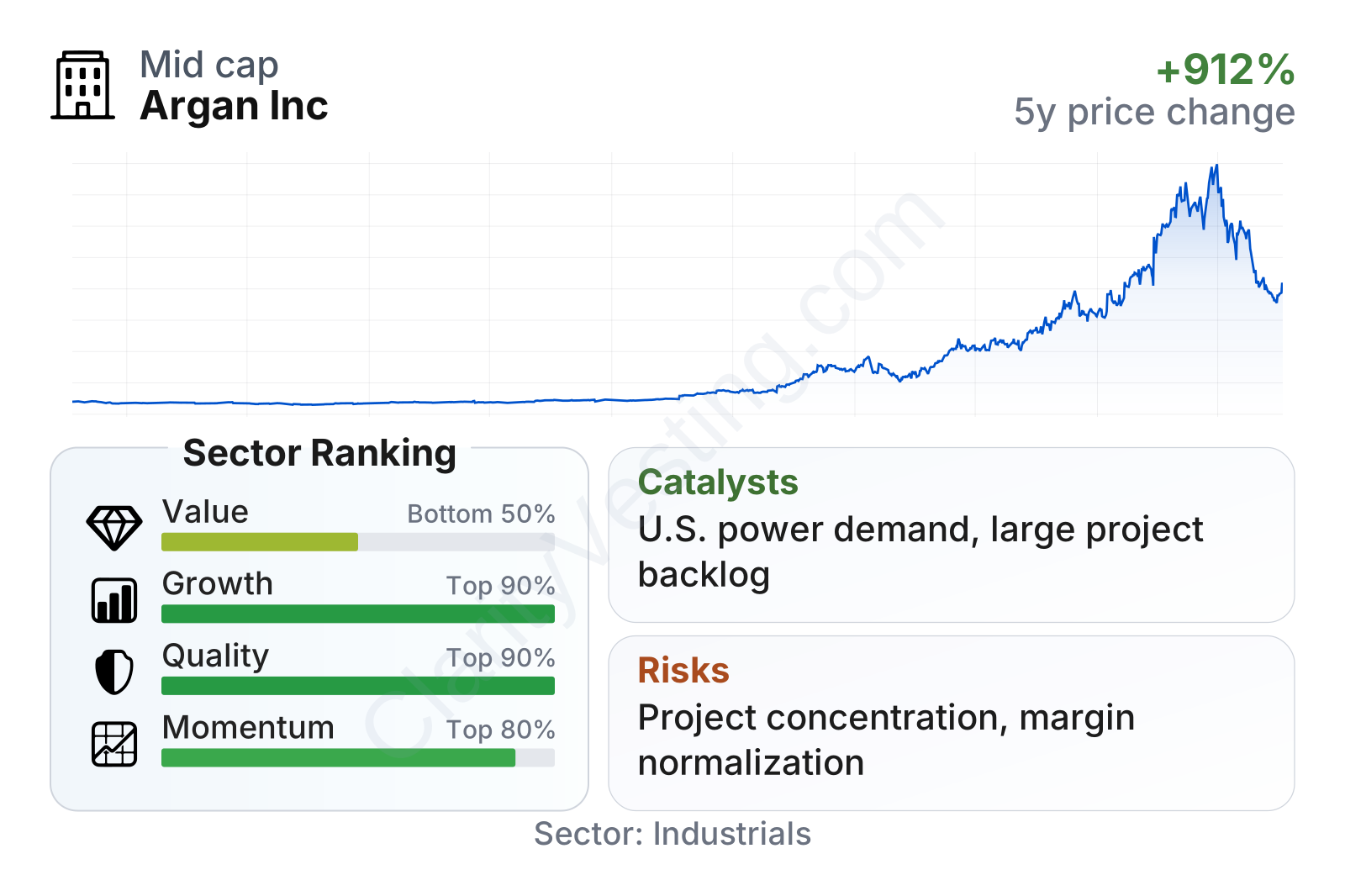
Argan stands out on growth and business quality versus most companies in its sector. Revenue growth, earnings growth, returns on capital, and cash generation all rank well above the industry median. The balance sheet is also unusually strong for construction, with net cash rather than heavy leverage. The weaker point is valuation: the shares trade above the sector median on earnings and far above it on book value, which means the market is already pricing in a meaningful amount of future success.
Growth
Argan is exposed to a favorable long-term market. Power demand in the United States is being pushed by data centers, manufacturing reshoring, electrification, and grid reliability needs. At the same time, utilities and independent power producers still need dispatchable generation that can run when solar and wind output fluctuate. That supports demand for the kind of natural gas-fired plants that Argan has specialized in building.
The company’s strategy is fairly easy to understand: stay focused on complex projects where execution matters, avoid overstretching the balance sheet, and use its track record to win additional large contracts. This approach makes sense because customers in power infrastructure usually care less about choosing the absolute cheapest contractor and more about getting a plant delivered on time and working properly.
Recent growth has been exceptional. Year-over-year revenue was negative or uneven a few years ago, then accelerated dramatically, reaching levels far above the sector median. That pattern reflects the lumpy nature of project work, but it also shows that Argan has moved into a much stronger award and execution cycle.
Cash generation has improved even more impressively than revenue. Free cash flow moved from modest levels and even a negative period to a very large positive figure more recently. For a construction company, that matters because accounting earnings can be affected by project timing, while strong cash flow gives clearer evidence that contracts are converting into real financial strength.
A major catalyst is the company’s exposure to the current buildout of U.S. power capacity. Public company releases in 2026 pointed to continued large project activity and a substantial backlog, which gives Argan a visible base of future work. Another positive factor is that rising electricity needs from data centers and industrial expansion could keep new power plant development active for years, especially in regions needing reliable baseload or flexible generation.
Risks
This article is for informational purposes only and does not constitute financial advice. Some content is AI-generated. See Disclaimer