Stock Analysis · Adecoagro SA (AGRO)
Overview
Adecoagro S.A. is a South American agribusiness and renewable energy company with operations mainly in Brazil, Argentina, and Uruguay. It produces food and agricultural commodities at scale, while also owning farmland, industrial plants, and energy-related assets. In simple terms, Adecoagro is not just a farm operator: it combines crop production, sugar and ethanol processing, dairy operations, rice, and electricity generation from biomass.
The business is built around a mix of activities that serve both food and energy markets. That combination matters because it can spread risk across different products, although it also makes results more exposed to commodity cycles, weather, and local currencies.
Based on the company’s recent annual disclosures, Adecoagro’s revenue is primarily generated by its farming and industrial operations, with sugar, ethanol, and energy in Brazil clearly representing the largest source. A simplified breakdown is as follows:
- Sugar, ethanol, and energy: approximately 60% to 70% of revenue. This includes sugar sales, ethanol for fuel and industrial uses, and electricity generated from sugarcane biomass.
- Farming: approximately 20% to 30% of revenue. This includes grains and oilseeds such as soybean, corn, wheat, and other crops grown and commercialized by the company.
- Rice, dairy, and other businesses: approximately 10% to 15% of revenue. This includes branded and bulk rice products, milk production, and related agricultural activities.
Adecoagro’s revenue mix can shift from year to year because selling prices, harvest volumes, and ethanol-sugar allocation change with market conditions. Over the last several years, total revenue has generally stayed in the roughly $1.1 billion to $1.5 billion range, but profitability has been much less stable. Revenue reached a recent high in 2024, while earnings weakened afterward as costs and financing pressure increased.
One notable pattern is that operating profitability has often remained solid even when net income became weak, which suggests the core assets can generate decent operating returns but are heavily influenced by interest costs, taxes, and commodity swings lower down the income statement.
The business has shown that it can produce strong gross and operating profit in good years, but the path from revenue to net income has become less favorable recently. Interest expense has risen materially, and net income moved from strongly positive in 2023 to slightly negative in 2025, highlighting how sensitive the model is to financing costs and market conditions.
Key Figures
| Metric | Value | Sector ⓘ |
|---|---|---|
| Date | Oct 17, 2026 | |
| Context | ||
| Sector | Consumer Defensive | |
| Industry | Farm Products | |
| Market Cap ⓘ | $1.49B | |
| Beta ⓘ | -0.05 | |
Value (Cheapness) | ||
| P/E Ratio ⓘ | 26.41 | 17.88 |
| P/B Ratio ⓘ | 4.79 | 1.29 |
| FCF Yield ⓘ | 3.21% | 12.39% |
| Dividend Yield ⓘ | N/A | 2.85% |
| EBIT / EV ⓘ | 7.00% | 6.43% |
| PEG ⓘ | 75.97 | |
Growth (Business expansion) | ||
| Revenue Growth ⓘ | 39.00% | 4.10% |
| RPS Growth (5Y CAGR) ⓘ | -26.83% | 6.18% |
| EPS Growth (5Y CAGR) ⓘ | -26.95% | -13.59% |
| BVPS Growth (5Y CAGR) ⓘ | -24.37% | 3.20% |
| Margin Growth (5Y Trend) ⓘ | -16.41% | -0.15% |
| FCF Growth (5Y CAGR) ⓘ | -37.58% | 4.10% |
| DPS Growth (5Y CAGR) ⓘ | -31.07% | 6.79% |
Quality (Business durability) | ||
| ROIC (Latest) ⓘ | 5.63% | 12.34% |
| ROA (Latest) ⓘ | 1.12% | 6.30% |
| ROIC (5Y Median) ⓘ | 10.71% | 10.49% |
| ROA (5Y Median) ⓘ | 3.80% | 5.44% |
| Net Debt / EBIT (Latest) ⓘ | 8.07 | 1.96 |
| Net Debt / EBIT (5Y Median) ⓘ | 5.15 | 2.35 |
| Net Debt / EBITDA (Latest) ⓘ | 3.50 | 1.38 |
| Net Debt / Assets ⓘ | 38.72% | 21.51% |
| EBITDA / Interest ⓘ | 3.14 | 9.46 |
| Operating Margin (Latest) ⓘ | 15.26% | 8.87% |
| Operating Margin (5Y Median) ⓘ | 16.07% | 9.53% |
| Debt to Equity (Latest) ⓘ | 134.14% | 72.35% |
| Profit Margin (Latest) ⓘ | 3.00% | 5.40% |
| Free Cash Flow (Latest) ⓘ | $47.72M | |
Momentum (Price trend) | ||
| 3Y Return ⓘ | +8.57% | +20.92% |
| 12M Return (excl. last month) ⓘ | +50.86% | +2.13% |
| 6M Return ⓘ | -25.44% | +1.26% |
| Price vs. 200-Day MA ⓘ | -3.02% | +1.39% |
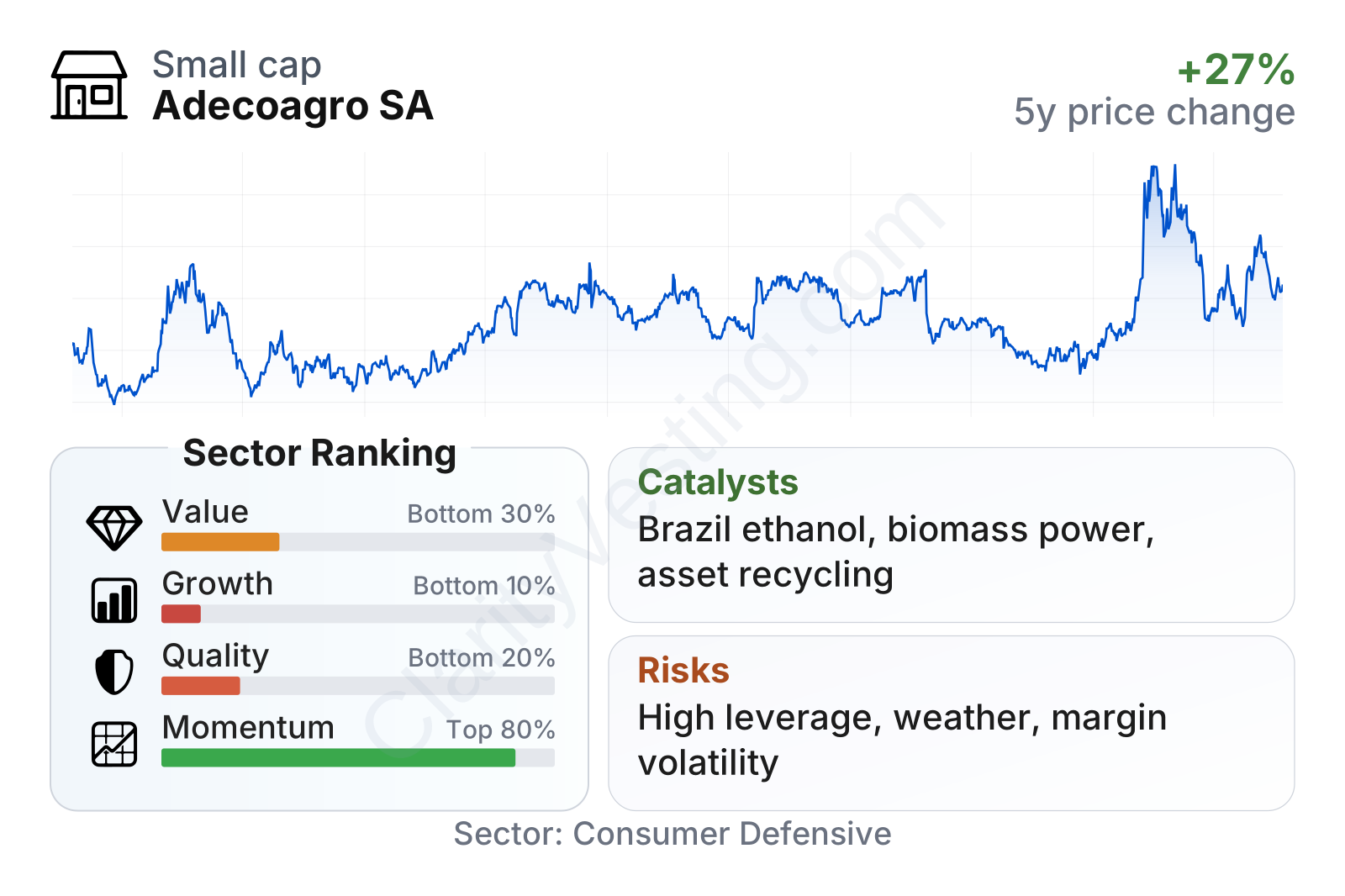
Adecoagro is a mid-sized company by market value, and its overall profile looks mixed. Recent growth in revenue has been strong, but most longer-term growth and quality indicators rank in the weaker part of the sector. Profitability at the operating level is still better than many peers, yet balance sheet pressure and weaker returns on assets reduce that advantage. The share price has also been volatile, with a sharp rise earlier in 2026 followed by a notable pullback.
The stock’s recent valuation measures look demanding compared with much of the sector. That is especially important because the company’s earnings base has been uneven, which can make common multiples like P/E less reliable than usual.
Growth
Adecoagro operates in sectors that have long-term structural relevance. Food demand tends to grow with population, changing diets, and biofuel blending needs, while renewable energy linked to agricultural residues benefits from decarbonization trends. Ethanol and biomass power in Brazil are particularly important because they sit at the intersection of agriculture and energy transition.
The company’s strategy also makes industrial sense. It owns productive farmland, processing facilities, logistics assets, and power generation capacity, which gives it vertical integration rather than exposure only to raw crop prices. In principle, that can create more flexibility: sugarcane can be directed toward sugar or ethanol depending on economics, and biomass can add another revenue stream from the same crop base.
Near-term revenue momentum has improved significantly. After a period of weak and uneven year-over-year performance, the latest readings show growth accelerating well above the sector median. That suggests a better operating backdrop in the most recent periods, even if the longer five-year record remains much weaker and more cyclical.
The more cautious point is cash generation. Free cash flow was very strong in 2023 and 2024, then dropped sharply into 2026. For a capital-intensive agricultural and industrial company, this matters a lot: growth is more attractive when it converts into durable cash rather than only higher revenue. At the moment, the trend points to a business still capable of producing cash, but with less margin for error than in earlier periods.
A relevant catalyst is the company’s exposure to Brazilian ethanol and energy markets. If domestic fuel demand, biofuel pricing, or power monetization remain favorable, Adecoagro has assets that can benefit quickly. Another support for growth is operating leverage: because the company already owns large-scale infrastructure, better pricing or utilization can improve results without requiring the same pace of new investment.
Recent company communications have also emphasized capital recycling and portfolio discipline, including transactions involving land and strategic assets in past years. That approach can help unlock value from the balance sheet, although it is not the same as recurring operating growth.
Risks
This article is for informational purposes only and does not constitute financial advice. Some content is AI-generated. See Disclaimer


