Stock Analysis · AGNC Investment Corp (AGNC)
Overview
AGNC Investment Corp is a mortgage real estate investment trust, or mortgage REIT. Unlike a traditional property REIT that owns buildings, AGNC mainly invests in mortgage-backed securities, especially agency residential mortgage-backed securities. These are pools of home loans that carry guarantees from U.S. government-sponsored entities such as Fannie Mae, Freddie Mac, or Ginnie Mae. In simple terms, AGNC earns money by financing large portfolios of mortgage bonds and capturing the spread between the yield on those assets and its own funding costs, while also using hedging instruments to manage interest-rate risk.
The business is heavily centered on one core activity, but the earnings line can still move sharply from year to year because mortgage REIT accounting includes both recurring net interest income and changes in the market value of investments and hedges. Based on company filings, AGNC’s assets are overwhelmingly concentrated in agency residential mortgage-backed securities, with smaller allocations to cash and cash equivalents, reverse repurchase agreements, and certain hedging positions such as interest rate swaps, swaptions, U.S. Treasury positions, and TBA dollar-roll positions.
For a simple breakdown, AGNC’s economic engine can be viewed as follows:
- Net interest income from agency mortgage-backed securities: the main source of recurring earnings and clearly the dominant contributor to the business.
- Gains or losses on derivatives and hedges: meaningful and sometimes very large, depending on interest-rate moves and mortgage spreads.
- TBA dollar-roll income and trading-related results: a secondary contribution tied to mortgage market positioning and portfolio management.
- Other investment and cash management income: comparatively small.
Because AGNC is a mortgage REIT rather than an operating company selling products or services, a neat revenue split by customer segment is not really available in the usual way. The most useful takeaway for long-term readers is that AGNC is essentially a leveraged portfolio manager focused primarily on agency-backed U.S. housing credit, with returns shaped by interest rates, financing conditions, hedging execution, and changes in book value.
The profit profile has been unusually volatile over the last several years. Revenue and operating income have swung widely with the mortgage-rate cycle, while interest expense rose sharply as short-term rates moved higher. That pattern fits the nature of the business: AGNC can report large changes in accounting income even when the underlying portfolio remains focused on the same asset class.
Key Figures
| Metric | Value | Sector ⓘ |
|---|---|---|
| Date | Oct 23, 2026 | |
| Context | ||
| Sector | Real Estate | |
| Industry | REIT - Mortgage | |
| Market Cap ⓘ | $10.54B | |
| Beta ⓘ | 1.34 | |
Value (Cheapness) | ||
| P/E Ratio ⓘ | 177.80 | 17.85 |
| P/B Ratio ⓘ | 0.92 | 0.87 |
| FCF Yield ⓘ | 8.41% | 7.30% |
| Dividend Yield ⓘ | 16.40% | 4.83% |
| EBIT / EV ⓘ | N/A | 3.78% |
| PEG ⓘ | 3.48 | |
Growth (Business expansion) | ||
| Revenue Growth ⓘ | 546.10% | 5.35% |
| RPS Growth (5Y CAGR) ⓘ | 4.28% | 6.02% |
| EPS Growth (5Y CAGR) ⓘ | -35.64% | -10.65% |
| BVPS Growth (5Y CAGR) ⓘ | -7.60% | 0.43% |
| Margin Growth (5Y Trend) ⓘ | 146.81% | -0.69% |
| FCF Growth (5Y CAGR) ⓘ | -19.30% | 5.40% |
| DPS Growth (5Y CAGR) ⓘ | -0.92% | 5.07% |
Quality (Business durability) | ||
| ROIC (Latest) ⓘ | N/A | 5.69% |
| ROE (Latest) ⓘ | 0.49% | 7.37% |
| ROA (Latest) ⓘ | 0.05% | 2.85% |
| ROIC (5Y Median) ⓘ | 31.51% | 4.26% |
| ROE (5Y Median) ⓘ | 7.06% | 6.04% |
| ROA (5Y Median) ⓘ | 1.00% | 2.45% |
| Net Debt / EBIT (Latest) ⓘ | N/A | 7.55 |
| Net Debt / EBIT (5Y Median) ⓘ | -0.14 | 8.26 |
| Net Debt / EBITDA (Latest) ⓘ | 57.88 | 5.26 |
| Net Debt / Assets ⓘ | 72.13% | 37.45% |
| EBITDA / Interest ⓘ | 0.56 | 4.11 |
| Operating Margin (Latest) ⓘ | N/A | 33.86% |
| Operating Margin (5Y Median) ⓘ | 89.49% | 37.49% |
| Debt to Equity (Latest) ⓘ | 836.67% | 88.76% |
| Profit Margin (Latest) ⓘ | 43.64% | 18.94% |
| Free Cash Flow (Latest) ⓘ | $886.00M | |
Momentum (Price trend) | ||
| 3Y Return ⓘ | +70.23% | +36.33% |
| 12M Return (excl. last month) ⓘ | +18.86% | +4.32% |
| 6M Return ⓘ | -12.75% | -1.74% |
| Price vs. 200-Day MA ⓘ | -11.39% | -1.42% |
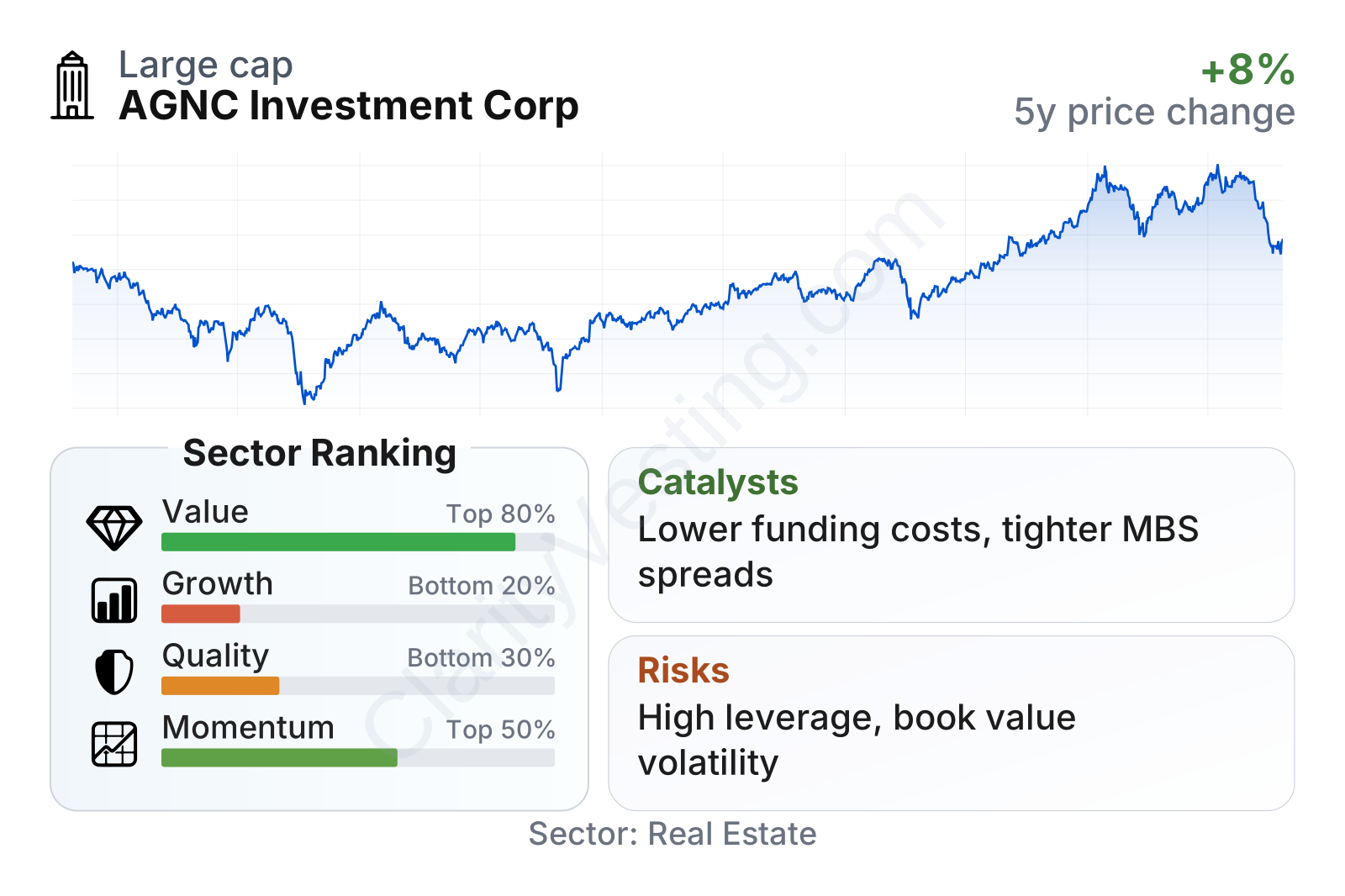
AGNC is a sizable mortgage REIT with a market value above $10 billion, so it has meaningful scale in its niche. The table points to a mixed profile. On income-related metrics, the stock stands out with a very high trailing dividend yield and free-cash-flow yield above the sector median. On the other hand, growth and quality rankings are weak versus the broader real estate sector, which reflects how hard it has been for mortgage REITs to grow book value and earnings consistently through a period of aggressive Federal Reserve tightening and changing mortgage spreads.
The share price has recovered strongly from the lows seen during the 2022 rate shock and has moved materially higher over the last three years, although the path has been uneven. Beta above 1 also suggests the shares can move more sharply than the market, which matches the company’s sensitivity to rate expectations and financing conditions.
Growth
AGNC operates in a sector that is not a classic long-term structural growth industry. Mortgage REITs do not expand by selling more products to more customers in the usual corporate sense. Their growth depends more on capital allocation, access to funding, portfolio spreads, and management’s ability to protect book value while generating attractive income. That makes AGNC less of a secular growth company and more of an interest-rate-cycle business.
Even so, the strategy can support future expansion in earnings power if the environment becomes more favorable. AGNC’s focus on agency-backed securities is important because it removes most credit risk from the mortgage bonds themselves. The larger question is whether the spread between asset yields and funding costs becomes more attractive. If short-term borrowing costs ease while mortgage yields stay comparatively elevated, the company’s net spread and earnings capacity can improve.
Revenue per share has been highly erratic rather than steadily rising. That is normal for this type of company, but it also shows why AGNC should not be judged like a conventional operating business with smooth sales growth. A better lens is whether the company can maintain attractive spread income and limit book value damage across a full cycle.
The dividend per share has been comparatively more stable than revenue, though it has still trended modestly lower over five years. That fits AGNC’s role as an income-oriented mortgage REIT: the payout remains a central part of the equity case, but its long-term durability depends on portfolio earnings and balance-sheet resilience rather than on straightforward business expansion.
A meaningful catalyst is the possibility of a more supportive rate backdrop. Public company updates in 2026 continued to emphasize active portfolio repositioning, liquidity management, and hedging around a still-uncertain path for Federal Reserve policy. If financing costs decline faster than mortgage asset yields, AGNC could see better net interest spreads, firmer comprehensive income, and improved book value stability. Another positive factor is that agency mortgage-backed securities remain a deep, systemically important market where AGNC has long operating experience and scale.
Risks
This article is for informational purposes only and does not constitute financial advice. Some content is AI-generated. See Disclaimer


