Stock Analysis · agilon health Inc (AGL)
Overview
agilon health works with primary care physicians, mainly serving older adults in Medicare Advantage and other senior-focused insurance arrangements. Its model is built around value-based care: instead of being paid mainly for each visit or procedure, the company partners with physician groups and health plans to manage the total cost and quality of care for a population of patients. If medical spending is controlled while quality targets are met, agilon can keep part of the savings. If costs run higher than expected, results can deteriorate quickly.
The business is designed to help independent physician practices move into more complex risk-based contracts without building all the data, care coordination, and administrative infrastructure on their own. agilon provides technology, payer contracting support, analytics, and operational services, while local physicians remain the front line of patient relationships.
Revenue is reported largely as a single stream rather than many separate segments, because the company’s economics are tied to capitated and risk-bearing medical arrangements. Based on company filings, the main revenue sources can be described as follows:
- Capitated revenue and medical services revenue: approximately 95%+ of total revenue in recent years. This reflects payments linked to managing care for attributed members, especially seniors under value-based arrangements, and includes amounts tied to medical cost responsibility.
- Other revenue: less than 5% of total revenue. This includes smaller service-related and ancillary items that are not the core driver of the business.
The important point for readers is that very high reported revenue does not automatically mean high profitability here. A large share of revenue passes through to medical costs, so the real question is whether agilon can accurately price risk, manage patient outcomes, and keep administrative spending under control.
The operating picture shows that revenue expanded sharply over the last several years, but gross profit remained thin and even turned negative in the latest annual period shown. That gap highlights the central issue in this business model: scale alone is not enough if medical costs rise faster than reimbursement.
Key Figures
| Metric | Value | Sector ⓘ |
|---|---|---|
| Date | Oct 17, 2026 | |
| Context | ||
| Sector | Healthcare | |
| Industry | Medical Care Facilities | |
| Market Cap ⓘ | $1.47B | |
| Beta ⓘ | 3.00 | |
Value (Cheapness) | ||
| P/E Ratio ⓘ | N/A | 24.79 |
| P/B Ratio ⓘ | 6.69 | 3.08 |
| FCF Yield ⓘ | -7.66% | 3.15% |
| Dividend Yield ⓘ | N/A | 1.94% |
| EBIT / EV ⓘ | -20.67% | 0.57% |
| PEG ⓘ | N/A | |
Growth (Business expansion) | ||
| Revenue Growth ⓘ | 7.20% | 7.45% |
| RPS Growth (5Y CAGR) ⓘ | 36.90% | 8.61% |
| EPS Growth (5Y CAGR) ⓘ | N/A | -17.81% |
| BVPS Growth (5Y CAGR) ⓘ | -43.14% | 3.72% |
| Margin Growth (5Y Trend) ⓘ | N/A | -0.62% |
| FCF Growth (5Y CAGR) ⓘ | -7.36% | 1.04% |
| DPS Growth (5Y CAGR) ⓘ | N/A | 6.77% |
Quality (Business durability) | ||
| ROIC (Latest) ⓘ | -81.12% | 3.24% |
| ROA (Latest) ⓘ | -15.76% | 3.01% |
| ROIC (5Y Median) ⓘ | -31.38% | 4.60% |
| ROA (5Y Median) ⓘ | -15.27% | 1.89% |
| Net Debt / EBIT (Latest) ⓘ | N/A | 1.34 |
| Net Debt / EBIT (5Y Median) ⓘ | N/A | 1.84 |
| Net Debt / EBITDA (Latest) ⓘ | N/A | 1.00 |
| Net Debt / Assets ⓘ | -4.63% | 5.45% |
| EBITDA / Interest ⓘ | N/A | 9.64 |
| Operating Margin (Latest) ⓘ | -4.43% | 9.27% |
| Operating Margin (5Y Median) ⓘ | -4.35% | 7.38% |
| Debt to Equity (Latest) ⓘ | 14.70% | 28.58% |
| Profit Margin (Latest) ⓘ | -3.92% | 3.59% |
| Free Cash Flow (Latest) ⓘ | -$112.38M | |
Momentum (Price trend) | ||
| 3Y Return ⓘ | -80.94% | +42.80% |
| 12M Return (excl. last month) ⓘ | +231.96% | +18.50% |
| 6M Return ⓘ | +229.06% | +7.57% |
| Price vs. 200-Day MA ⓘ | +44.44% | +5.12% |
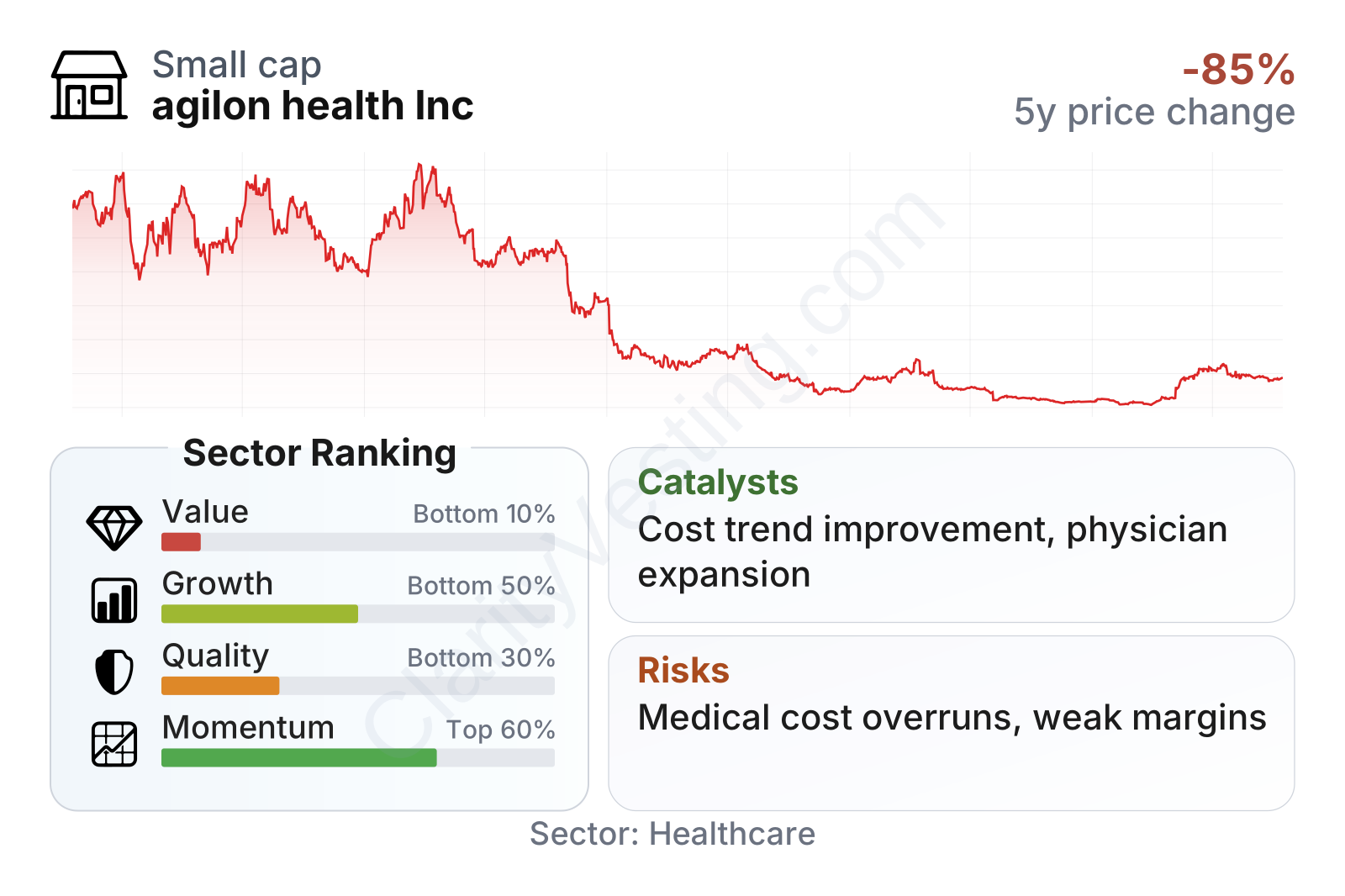
agilon is now a small-cap healthcare company with unusually high share-price volatility, reflected in a beta above 3. On relative measures, value metrics rank weakly because the company is still loss-making and free cash flow remains negative. Growth is mixed: long-term revenue per share expansion has been strong, but recent year-over-year revenue growth has slowed to roughly the sector median. Quality indicators remain weak, with negative returns on capital, negative returns on assets, and margins below sector norms. The more favorable area is recent price momentum, which has improved sharply after a very deep multi-year decline.
Growth
The sector backdrop is supportive. Healthcare spending for seniors continues to rise, and value-based care remains an important theme as insurers, government programs, and providers look for better cost control. An aging U.S. population also supports long-term demand for coordinated care models built around chronic-condition management and primary care.
agilon’s strategy makes sense on paper. The company focuses on partnering with community-based physician groups rather than replacing them, which can be attractive in markets where doctors want support but not full consolidation. If the model works, agilon can expand by adding new physician partners, increasing patient membership within existing geographies, and improving medical cost performance over time.
That said, the growth profile has become less straightforward. Earlier years showed very rapid expansion, often well above 30% and at times much higher, but more recent quarters have been uneven, including periods of contraction before returning to modest positive growth. This suggests agilon is moving out of its early hypergrowth phase and into a stage where execution quality matters more than simple market entry.
A meaningful catalyst is any evidence that medical cost trends are stabilizing and that newer partner groups are maturing profitably. The company has emphasized market and member expansion, physician enablement, and operating discipline in its public communications. If those efforts translate into better care-cost management, the earnings impact could be much larger than the revenue change alone because margins are currently so thin.
Cash generation is improving compared with the worst periods, but free cash flow remains negative. For a long-term growth case to strengthen, the company likely needs to show that revenue growth can convert into durable cash production rather than just larger premium and medical-cost flows.
Recent company updates have also centered on refining its operating model and focusing on profitability improvement. In agilon’s case, that matters more than headline top-line expansion. A significant opportunity would come from demonstrating that its physician network can manage senior populations at scale with more predictable cost outcomes across multiple markets.
Risks
This article is for informational purposes only and does not constitute financial advice. Some content is AI-generated. See Disclaimer


