Stock Analysis · Agios Pharm (AGIO)
Overview
Agios Pharmaceuticals is a biotechnology company focused on rare diseases and genetically defined conditions, with a particular emphasis on red blood cell disorders. After previously building and then selling a commercial oncology business, Agios is now centered on hematology and on developing medicines that target the biology of pyruvate kinase activation and related pathways. Its best-known marketed product is Pyrukynd (mitapivat), an oral medicine approved for adults with pyruvate kinase deficiency, and the company is also advancing additional programs for sickle cell disease, thalassemia, and other rare indications.
For long-term readers, the business is easiest to understand as a mix of early commercial revenue plus a pipeline-driven research platform. The challenge is that the company is still spending far more on research and development than it generates from product sales, so the long-term case depends heavily on whether its lead medicine can expand into larger patient populations and whether newer programs succeed in clinical development.
Based on recent annual reporting, Agios’s revenue base is highly concentrated.
- Product revenue: about 100% of ongoing revenue, primarily from Pyrukynd. This includes sales to specialty distributors and specialty pharmacies serving patients with pyruvate kinase deficiency.
- Collaboration and license revenue: minimal to none in the most recent annual revenue mix. Agios has historically had collaboration-related items and milestone-related accounting effects, but current recurring revenue is overwhelmingly tied to product sales rather than a diversified stream of royalties or partnerships.
- Other revenue: negligible. There is no broad non-pharma business segment offsetting the core drug-development risk.
The financial picture over the last several years shows a company that has gradually increased recurring sales from a very small base, while operating expenses remain large because of ongoing trials and pipeline investment. One important nuance is that reported profit has at times been heavily affected by non-recurring items, so recurring operating performance matters more than headline earnings.
The revenue build remains small compared with the company’s expense base. Research and development has consistently been the largest use of cash, while selling and administrative costs have also risen as commercial efforts expanded. That pattern is typical for a biotech moving from a single rare-disease launch toward broader label-expansion ambitions.
Key Figures
| Metric | Value | Sector ⓘ |
|---|---|---|
| Date | Oct 24, 2026 | |
| Context | ||
| Sector | Healthcare | |
| Industry | Biotechnology | |
| Market Cap ⓘ | $2.22B | |
| Beta ⓘ | 0.63 | |
Value (Cheapness) | ||
| P/E Ratio ⓘ | N/A | 25.42 |
| P/B Ratio ⓘ | 2.16 | 3.08 |
| FCF Yield ⓘ | -16.45% | 3.12% |
| Dividend Yield ⓘ | N/A | 1.85% |
| EBIT / EV ⓘ | -29.02% | 0.56% |
| PEG ⓘ | N/A | |
Growth (Business expansion) | ||
| Revenue Growth ⓘ | 259.30% | 7.50% |
| RPS Growth (5Y CAGR) ⓘ | 507.32% | 8.60% |
| EPS Growth (5Y CAGR) ⓘ | -5.87% | -17.73% |
| BVPS Growth (5Y CAGR) ⓘ | -0.94% | 3.72% |
| Margin Growth (5Y Trend) ⓘ | N/A | -0.57% |
| FCF Growth (5Y CAGR) ⓘ | -2.24% | 0.96% |
| DPS Growth (5Y CAGR) ⓘ | N/A | 6.69% |
Quality (Business durability) | ||
| ROIC (Latest) ⓘ | N/A | 3.17% |
| ROA (Latest) ⓘ | -32.98% | 2.98% |
| ROIC (5Y Median) ⓘ | -23.61% | 4.56% |
| ROA (5Y Median) ⓘ | -17.32% | 1.87% |
| Net Debt / EBIT (Latest) ⓘ | N/A | 1.34 |
| Net Debt / EBIT (5Y Median) ⓘ | N/A | 1.86 |
| Net Debt / EBITDA (Latest) ⓘ | N/A | 1.00 |
| Net Debt / Assets ⓘ | -6.18% | 5.06% |
| EBITDA / Interest ⓘ | N/A | 9.55 |
| Operating Margin (Latest) ⓘ | -429.29% | 9.25% |
| Operating Margin (5Y Median) ⓘ | -1312.63% | 7.33% |
| Debt to Equity (Latest) ⓘ | 3.04% | 26.68% |
| Profit Margin (Latest) ⓘ | N/A | 3.34% |
| Free Cash Flow (Latest) ⓘ | -$365.25M | |
Momentum (Price trend) | ||
| 3Y Return ⓘ | +77.43% | +51.61% |
| 12M Return (excl. last month) ⓘ | -8.43% | +19.90% |
| 6M Return ⓘ | +39.18% | +10.10% |
| Price vs. 200-Day MA ⓘ | +18.23% | +6.44% |
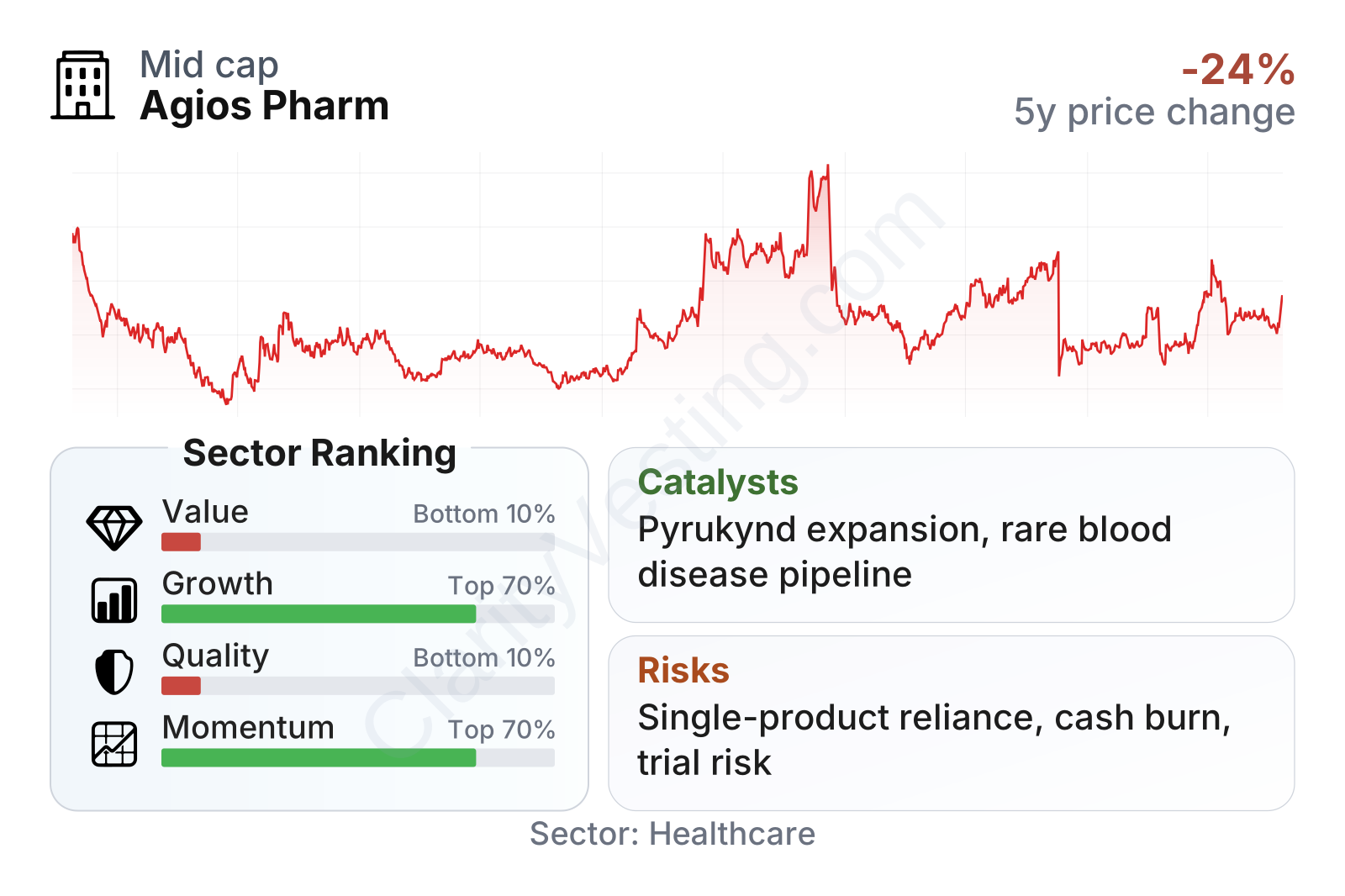
Agios is a small-cap biotech with a market value around $2 billion and a relatively low beta near 0.6, which suggests the shares have historically moved less than many stocks overall, even though biotech-specific swings can still be sharp. The broader factor picture is mixed: growth metrics stand above much of the sector because revenue is climbing quickly from a low base, but value and quality measures rank poorly because the company remains unprofitable and free cash flow is deeply negative. Momentum has been middling, reflecting a stock that has recovered from lows but has also seen large swings tied to development and regulatory expectations.
The share-price history also shows how event-driven the name is. The stock traded much higher in 2021, fell sharply during the following period, then rebounded in waves as commercial progress and pipeline developments shifted expectations. That kind of path is common for biotech companies where a few major milestones can have an outsized effect on valuation.
Growth
Agios operates in a part of healthcare that remains structurally attractive for long-term growth: rare diseases and genetically defined blood disorders. These markets are often small at launch but can support premium pricing, long treatment duration, and strong physician focus when a therapy addresses a serious unmet need. In that sense, the sector backdrop is favorable. The harder question is whether Agios can turn a narrow initial approval into a broader commercial franchise.
The company’s current strategy is logical. Pyrukynd already gives Agios a marketed asset, clinical experience, and a specialist prescriber base. The real growth opportunity comes from label expansion into larger populations than pyruvate kinase deficiency alone. That matters because the approved market is rare and limited, while disorders such as thalassemia and sickle cell disease are much larger. If the same core mechanism can support multiple indications, Agios could move from a niche rare-disease launch into a broader hematology platform.
Revenue growth has been very strong on a percentage basis, including a recent year-over-year pace well above the sector median. That said, readers should interpret this carefully: very high growth rates are easier to produce when the starting point is small. The more important signal is that product revenue has been moving upward consistently enough to show real commercial adoption rather than a one-time bump.
Beyond the marketed drug, Agios has highlighted pipeline programs in rare hematologic diseases, including PK activators and other genetically targeted approaches. For a company of this size, a single successful late-stage readout or regulatory expansion can materially change the revenue outlook. That makes upcoming clinical and regulatory milestones the clearest catalysts.
Recent company updates have continued to point toward progress in broadening Pyrukynd’s opportunity and advancing next-stage development work. In practical terms, the most significant opportunity is not the current approved use by itself, but the possibility that Agios can convert one validated mechanism into several indications over time.
Cash generation is the main weak point in the growth profile. Free cash flow remains significantly negative, which means expansion is still being financed by the balance sheet rather than by self-sustaining operations. For now, the growth case rests more on future clinical execution than on present financial operating leverage.
Risks
This article is for informational purposes only and does not constitute financial advice. Some content is AI-generated. See Disclaimer


