Stock Analysis · Affirm Holdings Inc (AFRM)
Overview
Affirm Holdings is a consumer finance company best known for its “buy now, pay later” offering. It lets shoppers split purchases into installments, while merchants use Affirm as a checkout tool that can help raise conversion, increase average order size, and attract customers who prefer transparent payment plans. Over time, the company has expanded beyond classic pay-in-4 loans into longer-term monthly installments, a consumer app, a merchant marketplace, debit-linked products, and interest-bearing consumer accounts.
Affirm’s business model sits between payments, lending, and commerce enablement. It earns money when consumers use its financing at partner merchants and when its platform helps originate and service loans. A key point for long-term analysis is that Affirm is not simply a payments button: it is also an underwriting, funding, and servicing platform, which means growth can be strong but credit discipline and funding access matter a lot.
Based on recent company reporting, Affirm’s main revenue sources are generally the following:
- Merchant network revenue: approximately 50% to 55% of total revenue in recent periods. This mainly includes merchant fees paid to offer Affirm at checkout and interchange-related economics tied to card products.
- Interest income: approximately 35% to 40%. This comes from interest charged on certain consumer loans and interest earned from holding loans or related assets.
- Gain on sales of loans and servicing income: approximately 5% to 10%. This reflects economics from selling loans to funding partners or investors and fees tied to servicing those receivables.
- Virtual card network revenue and other revenue: usually a small single-digit portion separately when disclosed, tied to one-time card use, platform activity, and smaller ancillary items.
Affirm’s revenue mix can shift from quarter to quarter depending on loan sales, funding structure, consumer demand, and product mix, so exact percentages move over time. What matters most is that merchant fees and loan-related income remain the core engines, while newer products broaden the ecosystem.
The business has also become meaningfully larger and more efficient. Over the last several fiscal years, revenue expanded from roughly $1.3 billion to nearly $4.0 billion, gross profit rose sharply, and the company moved from large operating losses to solid operating profitability. That improvement is one of the most important changes in the current investment case.
The financial flow shows a clear turning point: revenue and gross profit have scaled much faster than operating costs in the last two fiscal years, allowing Affirm to move from heavy losses to positive operating income and net income. That said, financing costs remain material, which is normal for a lending-linked platform and important to monitor if rates or credit conditions change.
Key Figures
| Metric | Value | Sector ⓘ |
|---|---|---|
| Date | Oct 03, 2026 | |
| Context | ||
| Sector | Financial Services | |
| Industry | Credit Services | |
| Market Cap ⓘ | $23.36B | |
| Beta ⓘ | 3.61 | |
Value (Cheapness) | ||
| P/E Ratio ⓘ | 12.54 | 12.60 |
| P/B Ratio ⓘ | 4.49 | 1.23 |
| FCF Yield ⓘ | 4.25% | 10.16% |
| Dividend Yield ⓘ | N/A | 2.96% |
| EBIT / EV ⓘ | 3.11% | 7.77% |
| PEG ⓘ | 8.26 | |
Growth (Business expansion) | ||
| Revenue Growth ⓘ | 33.00% | 9.50% |
| RPS Growth (5Y CAGR) ⓘ | 23.99% | 12.10% |
| EPS Growth (5Y CAGR) ⓘ | N/A | -9.45% |
| BVPS Growth (5Y CAGR) ⓘ | 14.04% | 5.01% |
| Margin Growth (5Y Trend) ⓘ | N/A | -4.07% |
| FCF Growth (5Y CAGR) ⓘ | N/A | 4.96% |
| DPS Growth (5Y CAGR) ⓘ | -54.10% | 8.79% |
Quality (Business durability) | ||
| ROIC (Latest) ⓘ | 25.95% | 9.60% |
| ROE (Latest) ⓘ | 43.95% | 13.84% |
| ROA (Latest) ⓘ | 14.15% | 1.53% |
| ROIC (5Y Median) ⓘ | -1.55% | 7.86% |
| ROE (5Y Median) ⓘ | -19.66% | 12.20% |
| ROA (5Y Median) ⓘ | -5.86% | 1.29% |
| Net Debt / EBIT (Latest) ⓘ | 7.81 | 0.91 |
| Net Debt / EBIT (5Y Median) ⓘ | N/A | 0.74 |
| Net Debt / EBITDA (Latest) ⓘ | 5.91 | 0.97 |
| Operating Margin (Latest) ⓘ | 22.62% | 22.12% |
| Operating Margin (5Y Median) ⓘ | -7.37% | 24.39% |
| Debt to Equity (Latest) ⓘ | 179.13% | 60.37% |
| Profit Margin (Latest) ⓘ | 45.29% | 26.62% |
| Free Cash Flow (Latest) ⓘ | $993.09M | |
Momentum (Price trend) | ||
| 3Y Return ⓘ | +244.40% | +89.23% |
| 12M Return (excl. last month) ⓘ | -20.94% | +17.35% |
| 6M Return ⓘ | +54.66% | +10.00% |
| Price vs. 200-Day MA ⓘ | +5.50% | +3.73% |
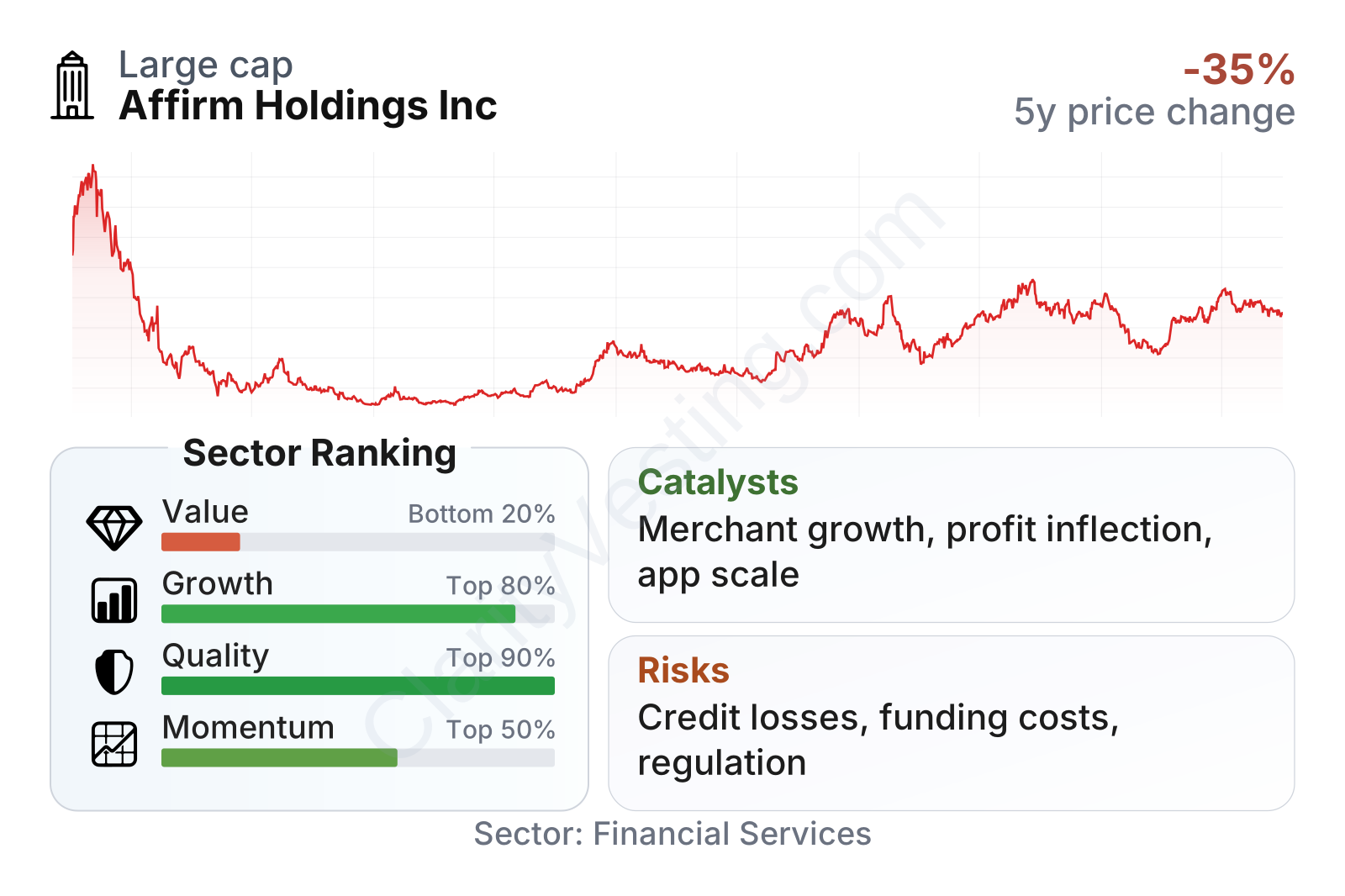
Affirm currently combines strong growth and much better recent profitability with a valuation that no longer looks cheap on balance-sheet-based measures. Relative to its sector, the company stands out positively on growth and quality, while value metrics are weaker. The share price history also shows that this is a high-volatility stock: the rebound from the 2022 collapse has been powerful, but swings have remained large, which fits the company’s high beta and the market’s changing view on fintech, rates, and credit risk.
In scale terms, Affirm is now a large listed fintech rather than an early-stage niche platform. Free cash flow has turned meaningful, recent returns on capital are strong, and momentum over several years has recovered well. At the same time, traditional valuation yardsticks are less forgiving now than they were when the stock traded near distressed levels.
Growth
Affirm operates in a part of finance that still has room to grow. Digital checkout financing continues to benefit from e-commerce, mobile shopping, demand for flexible payments, and merchant interest in tools that can improve conversion. The broader installment-payment category is becoming more mainstream in both online and physical retail, and that supports the long-term sector backdrop.
Affirm’s strategy for future expansion is logical. The company is trying to deepen its role across the full shopping and payment journey: merchant checkout, repeat consumer usage through its app, card-linked transactions, and a broader funding model to support more originations. This matters because a platform with repeat users, a wide merchant base, and multiple funding channels can become more durable than a single-product lender.
A major catalyst has been operating leverage. Revenue growth of about 33% year over year is well above the sector median, and recent profitability has improved much faster than earlier years suggested. That shift can be seen in earnings per share, which moved from deep losses in fiscal 2022 and 2023 to positive territory in fiscal 2025 and then a much stronger level in fiscal 2026.
The earnings trend suggests that Affirm is no longer being evaluated only on volume growth. The market is increasingly watching whether higher transaction scale can translate into durable profits after funding costs, credit provisions, and operating expenses. Recent results indicate much better discipline on that front.
Another constructive sign is balance-sheet value per share. After being mostly flat for several years, it rose sharply in the latest fiscal year, reflecting a combination of improved profitability and stronger underlying equity buildup.
There are also business-specific catalysts. Affirm has continued to add merchants, deepen integrations with commerce platforms, and expand product usage beyond one-off installment loans. Large distribution relationships, especially with major retail and platform partners, remain important because they can drive both transaction volume and brand visibility at relatively efficient customer acquisition economics.
Recent company updates have also highlighted continued momentum in gross merchandise volume, revenue less transaction costs, and the company’s ability to grow while tightening underwriting. If that balance holds, Affirm’s addressable market could keep widening without relying only on aggressive credit expansion.
Risks
This article is for informational purposes only and does not constitute financial advice. Some content is AI-generated. See Disclaimer