Stock Analysis · Alphamin Resources Corp (AFMJF)
Overview
Alphamin Resources Corp is a tin mining company. Its core asset is the Bisie mine in the eastern Democratic Republic of the Congo, where it produces tin concentrate through its operating subsidiary. In practical terms, the business is quite simple: Alphamin digs ore, processes it into concentrate, and sells that material into the global tin market.
The company is much more focused than a diversified miner. That concentration gives it strong exposure to one metal rather than spreading its business across copper, iron ore, gold, or coal. Tin is used heavily in solder, which is essential for electronics, circuit boards, semiconductors, and many industrial applications. That means Alphamin is tied closely to the health of electronics supply chains and to broader demand for digital hardware.
Revenue is overwhelmingly driven by tin sales. Based on the company’s public disclosures and the structure of its operations, the main sources of revenue are approximately:
- Tin concentrate sales: about 95% to 100% — the company’s main commercial output from the Bisie operation.
- By-product and other revenue: 0% to 5% — may include small amounts related to associated metals, trading adjustments, or other operating items, but these are not a major part of the business model.
This narrow revenue mix is important for long-term analysis. When tin prices are strong and the mine operates smoothly, Alphamin can generate very high margins and cash flow. When production is interrupted or tin prices weaken, there is very little diversification to soften the effect.
Over the last several years, the business has shown a sharp recovery after a weaker 2023 period. Revenue moved from roughly $353 million in 2021 to about $391 million in 2022, slipped to around $289 million in 2023, then rebounded strongly to about $528 million in 2024 and roughly $632 million in 2025. Operating income and net income followed a similar path, showing that earnings are highly responsive to both volume and tin pricing.
The overall picture is that Alphamin is a relatively small but highly profitable mining company built around one standout asset. The structure is easy to understand, but it also leaves the company heavily exposed to the fortunes of one mine, one country, and one primary commodity.
Key Figures
| Metric | Value | Sector ⓘ |
|---|---|---|
| Date | Oct 17, 2026 | |
| Context | ||
| Sector | Basic Materials | |
| Industry | Other Industrial Metals & Mining | |
| Market Cap ⓘ | $1.31B | |
| Beta ⓘ | 0.97 | |
Value (Cheapness) | ||
| P/E Ratio ⓘ | 6.00 | 16.90 |
| P/B Ratio ⓘ | 3.97 | 1.65 |
| FCF Yield ⓘ | 24.19% | 5.76% |
| Dividend Yield ⓘ | 12.04% | 2.13% |
| EBIT / EV ⓘ | 47.02% | 6.30% |
| PEG ⓘ | N/A | |
Growth (Business expansion) | ||
| Revenue Growth ⓘ | 75.30% | 11.10% |
| RPS Growth (5Y CAGR) ⓘ | 15.60% | 4.49% |
| EPS Growth (5Y CAGR) ⓘ | -70.55% | -13.47% |
| BVPS Growth (5Y CAGR) ⓘ | 3.41% | 5.51% |
| Margin Growth (5Y Trend) ⓘ | 5.29% | -1.54% |
| FCF Growth (5Y CAGR) ⓘ | 12.60% | 0.37% |
| DPS Growth (5Y CAGR) ⓘ | 20.50% | 6.08% |
Quality (Business durability) | ||
| ROIC (Latest) ⓘ | 80.37% | 9.26% |
| ROA (Latest) ⓘ | 43.05% | 4.91% |
| ROIC (5Y Median) ⓘ | 32.60% | 7.70% |
| ROA (5Y Median) ⓘ | 18.41% | 3.86% |
| Net Debt / EBIT (Latest) ⓘ | -0.16 | 1.40 |
| Net Debt / EBIT (5Y Median) ⓘ | 0.15 | 1.70 |
| Net Debt / EBITDA (Latest) ⓘ | -0.14 | 0.95 |
| Net Debt / Assets ⓘ | -13.22% | 13.69% |
| EBITDA / Interest ⓘ | 68.18 | 12.34 |
| Operating Margin (Latest) ⓘ | 49.42% | 13.20% |
| Operating Margin (5Y Median) ⓘ | 39.95% | 11.80% |
| Debt to Equity (Latest) ⓘ | 10.15% | 40.56% |
| Profit Margin (Latest) ⓘ | 25.94% | 6.43% |
| Free Cash Flow (Latest) ⓘ | $317.74M | |
Momentum (Price trend) | ||
| 3Y Return ⓘ | +102.04% | +68.89% |
| 12M Return (excl. last month) ⓘ | +62.13% | +30.21% |
| 6M Return ⓘ | +9.88% | -4.16% |
| Price vs. 200-Day MA ⓘ | +6.72% | -1.27% |
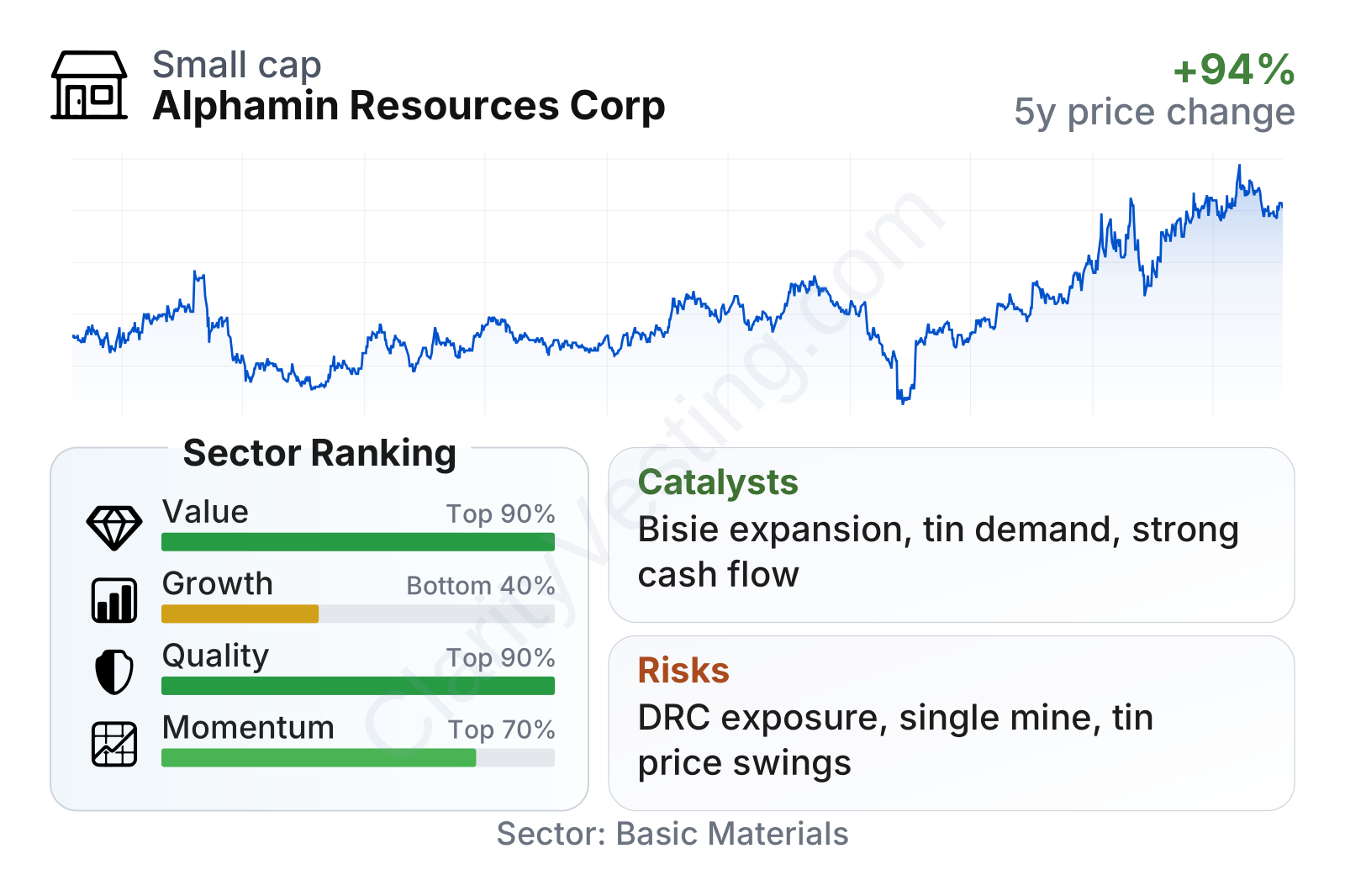
Recent market performance has been strong, with the share price well above levels seen a few years ago, although the path has not been smooth. The latest metrics point to a business that screens very well on value and quality compared with much of the broader materials sector. Profitability is unusually high, leverage is low, and cash generation has been strong. Growth indicators are more mixed because mining results can swing sharply from year to year, especially when production volumes and commodity prices move at the same time.
The company is also not especially large by mining industry standards, which can make results more volatile but can also make operating improvements show up quickly in earnings and cash flow. A beta near 1 suggests the stock has not behaved like an extreme outlier versus the broader market, but the underlying business is still much more cyclical than an average industrial company.
Growth
Alphamin operates in a niche that has long-term relevance. Tin does not get the same attention as copper or lithium, but it plays a critical role in electronics because solder remains one of the metal’s biggest end uses. As devices become more connected and semiconductor content keeps rising across cars, industrial systems, consumer electronics, and infrastructure, tin demand has a solid structural base. That does not guarantee steady annual growth, but it does support the idea that tin remains strategically useful in the global economy.
The company’s strategy also has a clear logic. Instead of trying to build a broad portfolio of mines, Alphamin has focused on maximizing a high-grade asset that has already demonstrated strong economics. A key part of the long-term thesis is operational expansion and optimization at Bisie, including the use of additional processing capacity and the development of nearby ore zones. In mining, high-grade ore matters because it can support lower unit costs and stronger margins, especially during weaker commodity price periods.
Revenue growth has been volatile rather than smooth, which is normal for a single-asset miner. After the setback in 2023, growth accelerated sharply through 2024 and remained strong into 2025 and 2026. That rebound matters because it suggests the earlier weakness was not a permanent deterioration in the asset’s economics. It also shows how quickly Alphamin’s income statement can improve when production and pricing align.
Cash generation tells a similar story. Free cash flow has swung from very strong positive levels to a temporary negative period and back again. For a miner, this can reflect investment spending, working capital movements, or changes in sales timing as much as it reflects underlying mine quality. What stands out is that Alphamin has recently returned to very strong cash generation, which gives it flexibility for dividends, balance-sheet protection, and project spending.
One notable catalyst is the simple fact that global tin supply is not easy to expand quickly. Tin is a smaller market than many major mined commodities, and that can make supply disruptions matter more. If Alphamin continues to deliver stable production from Bisie while the market remains relatively tight, the company could keep producing outsized margins. Another supportive factor is its position as one of the world’s more meaningful listed pure-play tin producers, which gives it a degree of scarcity value in public markets.
Recent company communications have also highlighted continued operational progress and strong financial results, which reinforce the idea that the business currently has momentum. For long-term analysis, the important point is not one quarter alone, but the combination of rising output potential, strong unit economics, and a commodity with durable industrial demand.
Risks
This article is for informational purposes only and does not constitute financial advice. Some content is AI-generated. See Disclaimer


