Stock Analysis · Grupo Aeroméxico S.A.B. de C.V (AERO)
Overview
Grupo Aeroméxico is Mexico’s flagship airline group. It provides passenger air transportation in Mexico and on international routes, with a network centered on Mexico City and other key hubs. The company operates under the Aeroméxico and Aeroméxico Connect brands and is also active in loyalty and travel-related services through its ecosystem around air travel. For a long-term view, the business is best understood as a mix of demand for leisure trips, corporate travel, cross-border traffic between Mexico and the United States, and connecting passengers moving through its hub network.
The largest source of revenue is passenger transportation. Based on the company’s business model and segment disclosures typically used by airline groups, revenue is primarily generated from ticket sales, while a smaller but still meaningful portion comes from cargo and ancillary or loyalty-related activities. A practical breakdown is:
- Passenger revenue: approximately 85% to 90% of total revenue. This includes domestic and international ticket sales, premium cabin sales, and fare classes purchased by leisure and business travelers.
- Cargo revenue: approximately 5% to 10% of total revenue. This covers freight carried in the belly space of passenger aircraft and dedicated logistics-related services.
- Other revenue: approximately 3% to 7% of total revenue. This includes loyalty-related income, ancillary fees, and other service revenues tied to the travel experience.
Aeroméxico’s economics depend heavily on keeping aircraft filled at profitable fares while managing major costs such as fuel, labor, aircraft rent or financing, maintenance, airport charges, and interest expense. Over the last few years, the company moved from deep pandemic-era losses to a much healthier operating profile, with revenue climbing from about $3.8 billion in 2022 to about $5.4 billion in 2025. Profitability also improved materially, although 2025 was weaker than 2024, showing that the recovery phase has largely passed and the company is now operating in a more normal, competitive environment.
The revenue base is far larger than it was during the recovery period, and operating income remains clearly positive. At the same time, the business still shows how sensitive airlines are to cost swings: interest expense stayed elevated and net income pulled back in 2025 even though sales remained strong.
Key Figures
| Metric | Value | Sector ⓘ |
|---|---|---|
| Date | Oct 23, 2026 | |
| Context | ||
| Sector | Industrials | |
| Industry | Airlines | |
| Market Cap ⓘ | $2.22B | |
| Beta ⓘ | N/A | |
Value (Cheapness) | ||
| P/E Ratio ⓘ | 1.52 | 22.29 |
| P/B Ratio ⓘ | N/A | 1.98 |
| FCF Yield ⓘ | 22.81% | 6.26% |
| Dividend Yield ⓘ | N/A | 1.92% |
| EBIT / EV ⓘ | 12.72% | 4.83% |
| PEG ⓘ | N/A | |
Growth (Business expansion) | ||
| Revenue Growth ⓘ | 13.60% | 9.30% |
| RPS Growth (5Y CAGR) ⓘ | -95.42% | 7.76% |
| EPS Growth (5Y CAGR) ⓘ | N/A | -13.17% |
| BVPS Growth (5Y CAGR) ⓘ | -97.47% | 6.13% |
| Margin Growth (5Y Trend) ⓘ | 55.44% | 0.74% |
| FCF Growth (5Y CAGR) ⓘ | N/A | 10.79% |
| DPS Growth (5Y CAGR) ⓘ | N/A | 9.41% |
Quality (Business durability) | ||
| ROIC (Latest) ⓘ | 16.18% | 10.75% |
| ROA (Latest) ⓘ | 2.19% | 5.41% |
| ROIC (5Y Median) ⓘ | N/A | 9.37% |
| ROA (5Y Median) ⓘ | 4.70% | 4.95% |
| Net Debt / EBIT (Latest) ⓘ | 4.56 | 2.04 |
| Net Debt / EBIT (5Y Median) ⓘ | 3.91 | 2.27 |
| Net Debt / EBITDA (Latest) ⓘ | 2.14 | 1.39 |
| Net Debt / Assets ⓘ | 41.89% | 19.27% |
| EBITDA / Interest ⓘ | 2.86 | 9.58 |
| Operating Margin (Latest) ⓘ | 11.55% | 10.49% |
| Operating Margin (5Y Median) ⓘ | 11.85% | 10.30% |
| Debt to Equity (Latest) ⓘ | -682.86% | 64.82% |
| Profit Margin (Latest) ⓘ | 2.70% | 6.67% |
| Free Cash Flow (Latest) ⓘ | $506.12M | |
Momentum (Price trend) | ||
| 3Y Return ⓘ | N/A | +67.77% |
| 12M Return (excl. last month) ⓘ | N/A | +12.05% |
| 6M Return ⓘ | -2.87% | 0.00% |
| Price vs. 200-Day MA ⓘ | -7.32% | +0.67% |
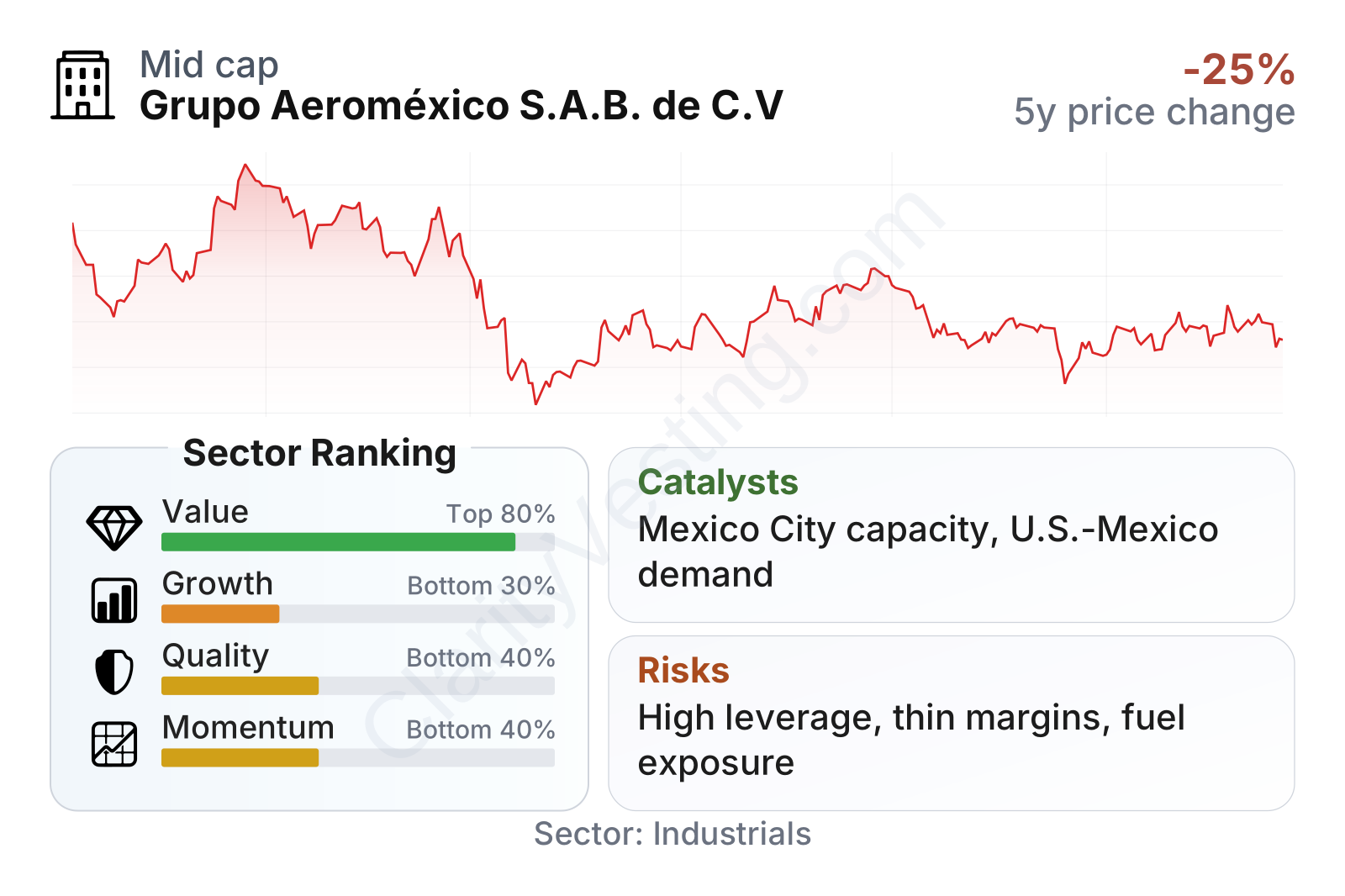
The overall picture is unusual. On valuation and cash generation, Aeroméxico screens as very cheap versus much of the sector, with a low earnings multiple, high free cash flow yield, and EBIT-to-enterprise-value well above the industry median. However, these attractive signals sit beside weaker rankings in growth, quality, and momentum. Recent revenue growth is still solid, margins are above the sector median at the operating level, and returns on invested capital are respectable, but leverage remains heavy and the stock has recently traded below its longer-term trend.
The company is also mid-sized rather than dominant on a global scale, which matters in aviation because airline economics can change quickly when demand, fuel prices, or exchange rates move. That makes the strong free cash flow especially important: it gives Aeroméxico more room to support fleet plans and debt service than a simple earnings number would suggest.
Growth
The airline sector is growing over the long run, especially in regions with rising middle-class travel demand and strong tourism flows. Mexico benefits from all three structural drivers that matter most for Aeroméxico: domestic mobility, inbound tourism, and especially cross-border travel with the United States. That last market is particularly important because it combines leisure, business, and visiting-friends-and-relatives traffic, which tends to be more resilient than purely discretionary travel.
Aeroméxico’s strategy broadly makes sense for future growth. The company has focused on strengthening its network, improving fleet efficiency, and leaning on its partnership model to broaden reach beyond what its own aircraft can serve directly. A more modern fleet can help fuel efficiency, reliability, and customer appeal, while international connectivity supports higher-yield traffic. In airlines, these network and fleet choices matter more than flashy expansion targets because they shape unit costs and pricing power over time.
One of the clearest growth catalysts is the reopening and normalization of capacity at Mexico City after past operational constraints affected the market. Aeroméxico’s position at the country’s main business hub gives it a strong chance to benefit if slot availability, operational conditions, and premium demand improve further. Another important catalyst is the durability of U.S.-Mexico demand, one of North America’s most strategically valuable air corridors.
Recent company communications and public updates have also pointed to continued fleet and network execution rather than a turnaround narrative. That matters because long-term value in airlines usually comes from disciplined operations, not just a one-time recovery bounce. The current setup appears more about converting a stronger network and travel demand backdrop into steadier earnings and cash flow.
Risks
This article is for informational purposes only and does not constitute financial advice. Some content is AI-generated. See Disclaimer


