Stock Analysis · AerCap Holdings NV (AER)
Overview
AerCap Holdings NV is one of the world’s largest aircraft leasing companies. In simple terms, it buys commercial aircraft, engines, and helicopters, then rents them to airlines and other aviation customers under multi-year contracts. This business model allows airlines to expand or renew their fleets without paying the full purchase price upfront, while AerCap earns recurring lease income and can also make money by selling assets over time.
The company’s business became even more important after the aviation industry shifted toward more flexible fleet management. Many airlines prefer leasing rather than owning because it reduces upfront capital needs and helps them react faster to changes in travel demand, fuel efficiency requirements, and aircraft delivery delays.
AerCap’s revenue mix is mainly tied to its leasing platform, with asset sales and services adding a smaller but still meaningful contribution. Based on recent annual reporting, the main sources of revenue can be summarized as follows:
- Lease rental income from aircraft: the largest source, representing the clear majority of revenue, driven by long-term leases to airlines worldwide.
- Net gain on sale of assets: a meaningful secondary source, coming from selling aircraft, engines, or other equipment above their carrying value.
- Lease rental income from engines: a smaller but important source tied to spare engines and engine leasing arrangements.
- Maintenance rights and other revenue: includes compensation related to maintenance arrangements, end-of-lease settlements, and other fleet management activities.
- Helicopter leasing and related income: the smallest major segment, linked to offshore energy, search and rescue, and transport uses.
AerCap is a large-scale, asset-heavy business. That matters because its economics depend not just on demand for air travel, but also on aircraft values, financing costs, and the company’s ability to keep its fleet placed with customers at attractive lease rates.
The long-term pattern is favorable: revenue has expanded from roughly $4.6 billion in 2021 to more than $8.1 billion in 2025, while operating income and net income recovered strongly after the disruption seen in 2022. Interest expense remains a major cost, which is normal for a leasing company, so future profitability still depends heavily on financing discipline.
Key Figures
| Metric | Value | Sector ⓘ |
|---|---|---|
| Date | Oct 24, 2026 | |
| Context | ||
| Sector | Industrials | |
| Industry | Rental & Leasing Services | |
| Market Cap ⓘ | $22.70B | |
| Beta ⓘ | 0.98 | |
Value (Cheapness) | ||
| P/E Ratio ⓘ | 7.08 | 22.29 |
| P/B Ratio ⓘ | 1.27 | 1.98 |
| FCF Yield ⓘ | -1.35% | 6.26% |
| Dividend Yield ⓘ | 1.11% | 1.92% |
| EBIT / EV ⓘ | 8.73% | 4.83% |
| PEG ⓘ | 0.80 | |
Growth (Business expansion) | ||
| Revenue Growth ⓘ | 14.90% | 9.30% |
| RPS Growth (5Y CAGR) ⓘ | 10.85% | 7.76% |
| EPS Growth (5Y CAGR) ⓘ | 4.25% | -13.17% |
| BVPS Growth (5Y CAGR) ⓘ | -1.65% | 6.13% |
| Margin Growth (5Y Trend) ⓘ | 21.82% | 0.74% |
| FCF Growth (5Y CAGR) ⓘ | N/A | 10.79% |
| DPS Growth (5Y CAGR) ⓘ | 126.27% | 9.41% |
Quality (Business durability) | ||
| ROIC (Latest) ⓘ | 7.81% | 10.75% |
| ROA (Latest) ⓘ | 4.74% | 5.41% |
| ROIC (5Y Median) ⓘ | 6.19% | 9.37% |
| ROA (5Y Median) ⓘ | 2.94% | 4.95% |
| Net Debt / EBIT (Latest) ⓘ | 7.35 | 2.04 |
| Net Debt / EBIT (5Y Median) ⓘ | 9.84 | 2.27 |
| Net Debt / EBITDA (Latest) ⓘ | 5.01 | 1.39 |
| Net Debt / Assets ⓘ | 57.56% | 19.27% |
| EBITDA / Interest ⓘ | 4.31 | 9.58 |
| Operating Margin (Latest) ⓘ | 67.18% | 10.49% |
| Operating Margin (5Y Median) ⓘ | 56.12% | 10.30% |
| Debt to Equity (Latest) ⓘ | 232.35% | 64.82% |
| Profit Margin (Latest) ⓘ | 37.85% | 6.67% |
| Free Cash Flow (Latest) ⓘ | -$307.27M | |
Momentum (Price trend) | ||
| 3Y Return ⓘ | +160.92% | +67.77% |
| 12M Return (excl. last month) ⓘ | +20.17% | +12.05% |
| 6M Return ⓘ | +5.72% | 0.00% |
| Price vs. 200-Day MA ⓘ | +2.84% | +0.67% |
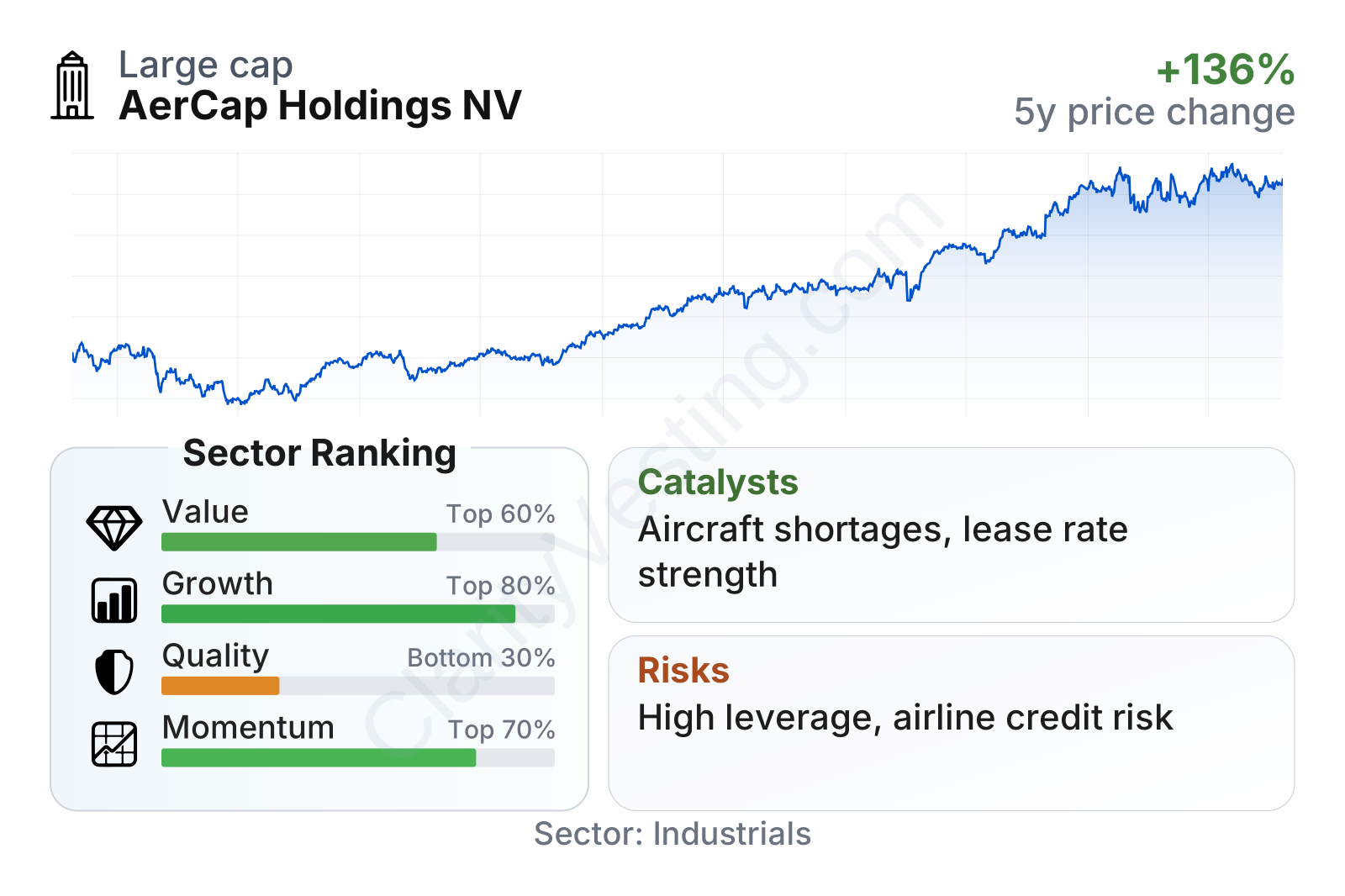
AerCap stands out for strong growth and better-than-average market performance, while quality measures look weaker mainly because leverage is much higher than the broader industrial sector. Valuation ratios are notably below sector norms, with earnings and book-based multiples looking modest for a business of this scale. Profitability is strong, but free cash flow can swing sharply because aircraft leasing requires large and uneven capital spending.
The share price trend over the last several years has been strong, with a large recovery from 2022 lows and continued gains into 2026. That suggests the market has increasingly recognized improved earnings power, tighter aircraft supply, and the company’s stronger post-pandemic position.
Growth
AerCap operates in a sector that still benefits from long-term expansion in global air travel, especially in emerging markets and in regions where airlines prefer leased fleets. Leasing is also supported by the rising cost of new aircraft and by ongoing delivery bottlenecks at major manufacturers. When aircraft are hard to get, established lessors with available fleet and customer relationships often gain pricing power.
The company’s strategy makes sense in this setting. AerCap combines scale, global airline relationships, portfolio diversity, and access to capital markets. That matters because airlines increasingly want flexibility across aircraft types and lease durations, while lessors with large fleets can move assets across geographies more efficiently than smaller rivals.
Growth has become steadier after the extreme swings around 2022. More recently, year-over-year revenue growth has remained positive and moved back into a healthier range by mid-2026, outperforming the broader sector. Over a five-year view, revenue per share and earnings per share also show a favorable trend, pointing to real expansion rather than just a short-term rebound.
Free cash flow is less smooth than earnings because AerCap regularly buys, sells, and finances aircraft. That can produce negative periods even when the underlying business is healthy. The more important point is that cash generation has shown the ability to recover after heavy investment periods, which fits the company’s capital-intensive model.
One of the strongest catalysts is the current imbalance between aircraft supply and airline demand. Manufacturers continue to face production constraints, while many airlines need newer, more fuel-efficient planes. This tends to support lease rates, aircraft utilization, and resale values. AerCap is well positioned to benefit because of its large installed fleet and broad customer base.
Another important growth support is portfolio management. AerCap does not simply collect rent; it also sells assets, rotates capital, and can redeploy funds into aircraft types with better returns. If fleet values remain firm and travel demand stays resilient, this approach can support both earnings growth and capital returns over time.
Risks
This article is for informational purposes only and does not constitute financial advice. Some content is AI-generated. See Disclaimer