Stock Analysis · Aeroports de Paris SA (AEOXF)
Overview
Aeroports de Paris SA, also known as Groupe ADP, owns and operates the main airport system serving Paris, including Paris-Charles de Gaulle, Paris-Orly, and Paris-Le Bourget. Beyond running terminals, runways, and passenger services, the group also earns money from retail, real estate, engineering, and international airport activities. This makes it more than a simple airport operator: it is an infrastructure business with several revenue streams linked to air traffic, passenger spending, and long-term assets.
The company’s revenue mix is fairly diversified, although aviation activity remains the backbone. Based on recent annual disclosures, the main sources of revenue can be summarized approximately as follows:
- Aviation and airport fees: about 30% to 35% — passenger charges, aircraft landing and parking fees, security-related services, and other regulated airport income.
- Retail and services: about 20% to 25% — duty-free and specialty retail, food and beverage, advertising, lounges, parking, and other passenger-facing services.
- International and airport development activities: about 20% to 25% — stakes in airports outside France, engineering, and airport management contracts.
- Real estate: about 10% to 15% — rental income from offices, logistics, hotels, and airport-area property development.
- Other activities: about 5% to 10% — smaller operational and support businesses.
This structure matters for long-term analysis. Airport fees are relatively stable once traffic is established, while retail and parking can grow faster when passenger volumes and spending per traveler rise. Real estate adds a slower but often steadier layer of cash generation, and international assets can broaden exposure beyond Paris.
The broader financial picture shows a sharp recovery from the pandemic years, with revenue now well above 2021 levels. However, operating profit has not translated into equally strong net profit because financing costs remain heavy.
Key Figures
| Metric | Value | Sector ⓘ |
|---|---|---|
| Date | Oct 24, 2026 | |
| Context | ||
| Sector | Industrials | |
| Industry | Airports & Air Services | |
| Market Cap ⓘ | $11.49B | |
| Beta ⓘ | 0.92 | |
Value (Cheapness) | ||
| P/E Ratio ⓘ | 16.52 | 22.29 |
| P/B Ratio ⓘ | 3.50 | 1.98 |
| FCF Yield ⓘ | 4.94% | 6.26% |
| Dividend Yield ⓘ | 2.58% | 1.92% |
| EBIT / EV ⓘ | N/A | 4.83% |
| PEG ⓘ | 0.83 | |
Growth (Business expansion) | ||
| Revenue Growth ⓘ | 1.60% | 9.30% |
| RPS Growth (5Y CAGR) ⓘ | 24.71% | 7.76% |
| EPS Growth (5Y CAGR) ⓘ | N/A | -13.17% |
| BVPS Growth (5Y CAGR) ⓘ | -1.63% | 6.13% |
| Margin Growth (5Y Trend) ⓘ | 15.96% | 0.74% |
| FCF Growth (5Y CAGR) ⓘ | 10.23% | 10.79% |
| DPS Growth (5Y CAGR) ⓘ | 122.97% | 9.41% |
Quality (Business durability) | ||
| ROIC (Latest) ⓘ | 4.94% | 10.75% |
| ROA (Latest) ⓘ | 3.32% | 5.41% |
| ROIC (5Y Median) ⓘ | 4.10% | 9.37% |
| ROA (5Y Median) ⓘ | 1.88% | 4.95% |
| Net Debt / EBIT (Latest) ⓘ | 5.61 | 2.04 |
| Net Debt / EBIT (5Y Median) ⓘ | 7.69 | 2.27 |
| Net Debt / EBITDA (Latest) ⓘ | 2.40 | 1.39 |
| Net Debt / Assets ⓘ | 39.35% | 19.27% |
| EBITDA / Interest ⓘ | 3.14 | 9.58 |
| Operating Margin (Latest) ⓘ | 11.31% | 10.49% |
| Operating Margin (5Y Median) ⓘ | 18.32% | 10.30% |
| Debt to Equity (Latest) ⓘ | 252.92% | 64.82% |
| Profit Margin (Latest) ⓘ | 8.84% | 6.67% |
| Free Cash Flow (Latest) ⓘ | $568.01M | |
Momentum (Price trend) | ||
| 3Y Return ⓘ | +19.38% | +67.77% |
| 12M Return (excl. last month) ⓘ | +2.11% | +12.05% |
| 6M Return ⓘ | -5.99% | 0.00% |
| Price vs. 200-Day MA ⓘ | -7.75% | +0.67% |
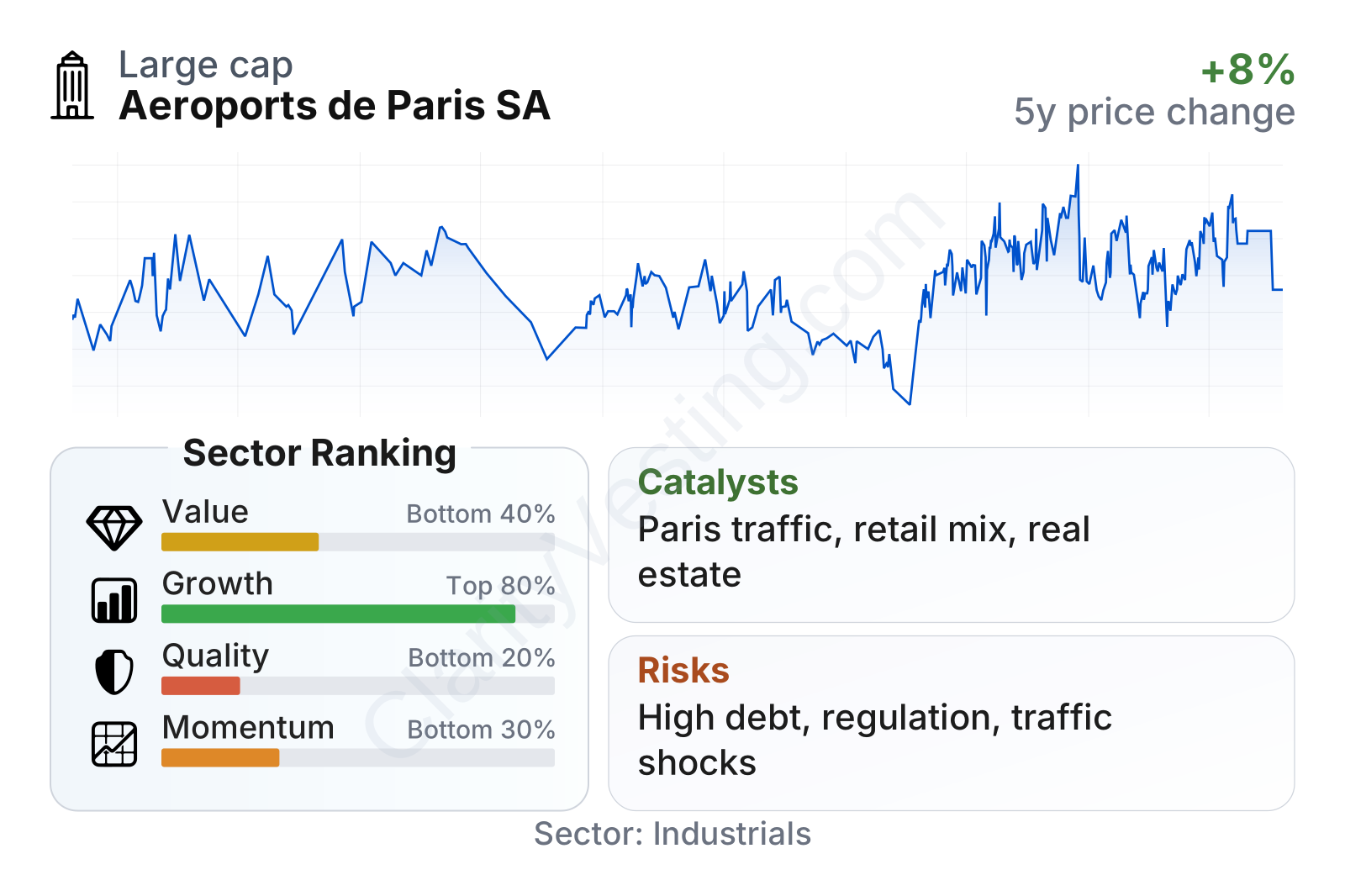
Aeroports de Paris is a large infrastructure operator with relatively low share-price volatility compared with many industrial businesses. The company’s growth profile ranks better than much of its sector over a multi-year period, helped by the rebound in aviation and improved operating margins. At the same time, quality measures are weaker than sector norms because returns on capital remain modest and leverage is high. The value picture is mixed: the earnings multiple is below the sector median, but the balance sheet and cash flow metrics do not make the shares look obviously cheap.
Growth
The airport industry is tied to long-term growth in air travel, tourism, and international mobility. Over long periods, major hub airports usually benefit from rising passenger demand, airline network concentration, and inflation-linked pricing mechanisms. Paris is one of Europe’s largest air travel markets, and that gives Aeroports de Paris a structural advantage: its core assets are difficult to replicate and sit in a globally important destination for tourism, business, and connecting traffic.
The company’s strategy is coherent for long-term expansion because it is not relying on only one driver. It can grow through higher passenger traffic, better commercial monetization inside terminals, tariff adjustments on regulated activities, and development of airport-adjacent real estate. Its international exposure also offers another layer of growth, although that part can be less predictable than domestic airport operations.
Recent years show the difference between short-term and long-term growth. Year-over-year revenue growth has slowed to a low single-digit pace, which is weaker than the sector median, suggesting that the easy post-pandemic rebound phase is largely over. Still, the five-year picture is stronger, with revenue per share growth well ahead of many peers and a marked improvement in operating margin compared with earlier years. In other words, the business has already completed most of its traffic recovery and is now entering a more normal, slower-growth phase.
A notable catalyst is the continued normalization of international travel, especially long-haul and premium passenger flows, which typically support stronger retail spending. Another important factor is Paris’s role as a major European hub, where capacity constraints can help protect pricing power. The group’s real estate pipeline and commercial development around airport land can also support growth without requiring passenger numbers to rise at the same pace.
Recent company communications have also highlighted traffic resilience and continued investment in airport modernization, service quality, and environmental transition. These projects can support future revenue, although the payoff often comes gradually rather than immediately.
Risks
This article is for informational purposes only and does not constitute financial advice. Some content is AI-generated. See Disclaimer