Stock Analysis · Adyen N.V (ADYYF)
Overview
Adyen N.V. is a global payments technology company. In simple terms, it helps businesses accept and manage payments across online checkout, mobile apps, and physical stores. Its platform combines payment processing, gateway services, risk management, data tools, issuing, and embedded financial products in one system. The company mainly serves medium-sized and large merchants, including global brands that want one payments setup across many countries and sales channels.
Its business model is centered on processing payment volume for merchants and earning fees on those transactions, while also selling additional services around that activity. Based on company disclosures, the revenue mix is not broken out in a very detailed public percentage split by product every year, but the main sources can be described as follows:
- Settlement fees and acquiring/processing revenue — the largest source, representing the clear majority of net revenue. This includes fees earned when Adyen routes, authorizes, settles, and processes card and local payment transactions for merchants.
- Point-of-sale and omnichannel services — an important and growing part of the business. This covers in-store payment terminals and unified commerce tools linking store and digital payments.
- Digital and online payments services — online checkout, mobile app payments, marketplace support, and cross-border acceptance for e-commerce merchants.
- Value-added services — a smaller source that includes risk management, fraud screening, tokenization, analytics, issuing, payout tools, and some embedded finance features such as business accounts and capital products.
Geographically, Adyen is broadly international, with Europe still important but with meaningful exposure to North America, Asia-Pacific, and Latin America. That matters because large merchants increasingly want one provider that can support local payment methods and compliance rules across many markets.
One notable financial feature is how scalable the business has been. Revenue has grown strongly over the last several years, while profitability has remained unusually high for a payments platform. At the same time, cost of revenue has stayed relatively contained versus total revenue, showing the benefits of a unified platform rather than a patchwork of acquired systems.
The multi-year income flow shows a business that has expanded revenue and operating profit significantly since 2021, with net income also moving higher. The broad pattern suggests strong operating leverage, even though the company has continued investing in staff, product capabilities, and international expansion.
Key Figures
| Metric | Value | Sector ⓘ |
|---|---|---|
| Date | Nov 21, 2026 | |
| Context | ||
| Sector | Technology | |
| Industry | Software - Infrastructure | |
| Market Cap ⓘ | $30.78B | |
| Beta ⓘ | 1.91 | |
Value (Cheapness) | ||
| P/E Ratio ⓘ | 23.49 | 26.18 |
| FCF Yield ⓘ | 15.21% | 3.74% |
| Dividend Yield ⓘ | N/A | 1.32% |
| EBIT / EV ⓘ | 18.02% | 3.92% |
| PEG ⓘ | 0.92 | |
Growth (Business expansion) | ||
| Revenue Growth ⓘ | 18.90% | 17.95% |
| RPS Growth (5Y CAGR) ⓘ | 26.85% | 8.44% |
| EPS Growth (5Y CAGR) ⓘ | 26.49% | -6.06% |
| Margin Growth (5Y Trend) ⓘ | -6.94% | 0.56% |
| FCF Growth (5Y CAGR) ⓘ | -15.43% | 9.84% |
| DPS Growth (5Y CAGR) ⓘ | N/A | 7.96% |
Quality (Business durability) | ||
| ROIC (Latest) ⓘ | 42.85% | 10.05% |
| ROIC (5Y Median) ⓘ | 25.19% | 8.19% |
| Net Debt / EBIT (Latest) ⓘ | -4.21 | 0.61 |
| Net Debt / EBIT (5Y Median) ⓘ | -7.68 | 0.48 |
| Net Debt / EBITDA (Latest) ⓘ | -3.85 | 0.33 |
| Net Debt / Assets ⓘ | -81.39% | 4.20% |
| EBITDA / Interest ⓘ | 79.47 | 13.53 |
| Operating Margin (Latest) ⓘ | 53.76% | 10.59% |
| Operating Margin (5Y Median) ⓘ | 56.32% | 8.53% |
| Debt to Equity (Latest) ⓘ | 6.93% | 34.34% |
| Profit Margin (Latest) ⓘ | 43.56% | 7.54% |
| Free Cash Flow (Latest) ⓘ | $4.68B | |
Momentum (Price trend) | ||
| 3Y Return ⓘ | -21.78% | +26.20% |
| 12M Return (excl. last month) ⓘ | -39.40% | +11.65% |
| 6M Return ⓘ | -13.43% | -4.21% |
| Price vs. 200-Day MA ⓘ | -15.78% | -4.34% |
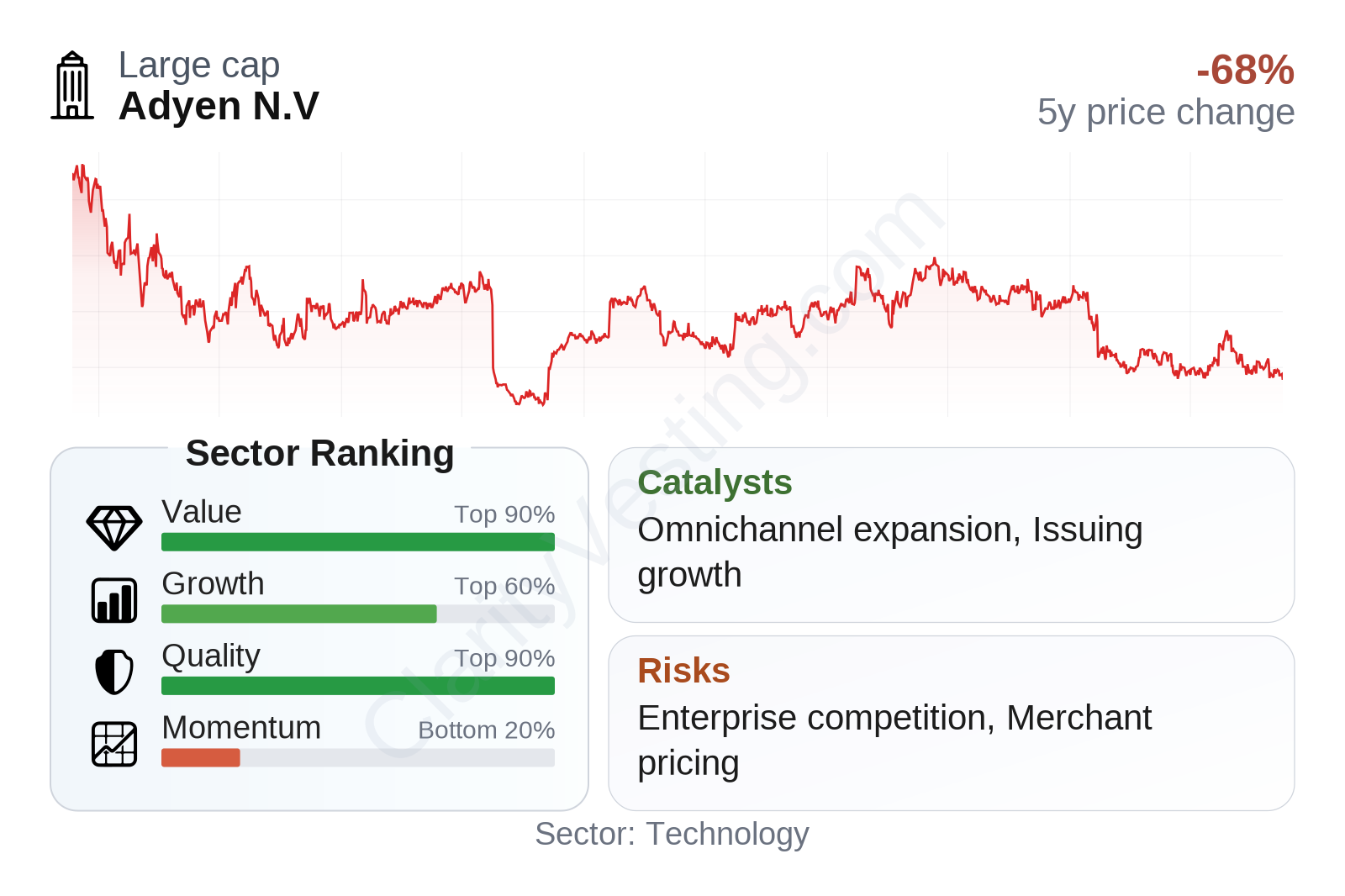
Adyen stands out for quality more than for short-term market momentum. Profitability metrics are well above the software sector median, with operating margin around the mid-50% range and profit margin above 40%, which is unusually strong. The balance sheet is also conservative, with low leverage and net cash rather than heavy debt. Growth has remained solid, with revenue still rising faster than the sector median and long-term per-share growth well ahead of many peers. The weaker area is recent share-price performance, which has lagged the broader sector and shows that market sentiment has been more cautious than the business fundamentals alone would suggest.
Growth
Adyen operates in digital payments, a sector that continues to benefit from long-term structural expansion. Cash usage keeps declining in many markets, online commerce remains large, and physical stores are adopting more software-driven payment systems. Businesses also want fewer vendors and better visibility across channels, which supports demand for integrated platforms like Adyen’s.
Its strategy is straightforward and credible: build one in-house platform, serve larger merchants that process high transaction volumes, expand across geographies, and add more services around the payment relationship. That approach can strengthen customer retention because once a merchant uses Adyen for online payments, store payments, fraud tools, issuing, and financial services, switching becomes more disruptive.
Another growth driver is enterprise consolidation. Large merchants often want a smaller number of payment partners that can support card networks, local payment methods, fraud prevention, regulatory requirements, and settlement in multiple countries. Adyen’s value proposition fits that trend well. It is also increasing its presence in unified commerce, where the same merchant wants one system for e-commerce and in-store transactions.
Recent growth remains healthy rather than explosive. Year-over-year revenue growth is around the high-teens range, which is still above the sector median. Over a longer period, revenue per share and earnings per share have compounded at strong rates, indicating that the business has been creating real scale rather than only adding volume without profits.
A meaningful catalyst is the company’s continued push into financial products beyond pure payment acceptance. Issuing, embedded finance, and banking-like services for merchants can deepen relationships and increase revenue per customer. Adyen has also continued announcing merchant wins and expanded partnerships in areas such as platform businesses, marketplaces, and omnichannel retail. Those developments matter because large enterprise clients can contribute sizable payment volume once fully ramped.
There is also a favorable industry backdrop from cross-border commerce and the ongoing modernization of in-store payments. Many merchants still run separate systems for online and physical stores, leaving room for vendors that can unify both. Adyen has been positioning itself directly for that gap.
Risks
This article is for informational purposes only and does not constitute financial advice. Some content is AI-generated. See Disclaimer