Stock Analysis · ADT Inc (ADT)
Overview
ADT Inc is a U.S. provider of security, smart home, and life-safety services. The company installs and monitors burglar alarms, video systems, access control, fire detection, and connected home devices for residential customers and small business clients. Its model is built around recurring monthly service revenue, which makes the business more subscription-like than a typical equipment seller.
For long-term analysis, the most important point is that ADT is not mainly a one-time hardware business. The core economics come from ongoing monitoring and related services, while equipment sales and installations support customer acquisition and retention.
Based on company reporting, ADT’s revenue mix is centered on recurring service and monitoring fees, with a smaller contribution from installation, product, and other revenues. The breakdown can be summarized approximately as follows:
- Monitoring and related services: about 75% to 80% of revenue. This includes monthly alarm monitoring, interactive smart security services, and other recurring customer payments.
- Installation, product, and other revenue: about 20% to 25% of revenue. This includes system installation, equipment, upgrades, and related items tied to new customer additions or service enhancements.
This structure helps explain why ADT can produce strong cash generation even when top-line growth is modest. Over the past several years, profitability has improved meaningfully, with operating income and net income recovering from earlier pressure. Interest expense still absorbs a large share of earnings, but the overall business mix remains favorable because gross profit is substantial relative to hardware-heavy peers.
The financial flow shows a business with sizable recurring gross profit and much better earnings conversion than a few years ago. Revenue has stabilized after a major reset in 2023, while interest expense remains one of the biggest claims on profit.
Key Figures
| Metric | Value | Sector ⓘ |
|---|---|---|
| Date | Oct 24, 2026 | |
| Context | ||
| Sector | Industrials | |
| Industry | Security & Protection Services | |
| Market Cap ⓘ | $4.96B | |
| Beta ⓘ | 1.06 | |
Value (Cheapness) | ||
| P/E Ratio ⓘ | 9.30 | 22.29 |
| P/B Ratio ⓘ | 1.55 | 1.98 |
| FCF Yield ⓘ | 37.93% | 6.26% |
| Dividend Yield ⓘ | 3.28% | 1.92% |
| EBIT / EV ⓘ | 10.25% | 4.83% |
| PEG ⓘ | N/A | |
Growth (Business expansion) | ||
| Revenue Growth ⓘ | 2.00% | 9.30% |
| RPS Growth (5Y CAGR) ⓘ | -2.86% | 7.76% |
| EPS Growth (5Y CAGR) ⓘ | 16.28% | -13.17% |
| BVPS Growth (5Y CAGR) ⓘ | 1.74% | 6.13% |
| Margin Growth (5Y Trend) ⓘ | 20.40% | 0.74% |
| FCF Growth (5Y CAGR) ⓘ | 13.65% | 10.79% |
| DPS Growth (5Y CAGR) ⓘ | 10.39% | 9.41% |
Quality (Business durability) | ||
| ROIC (Latest) ⓘ | 8.01% | 10.75% |
| ROA (Latest) ⓘ | 3.90% | 5.41% |
| ROIC (5Y Median) ⓘ | 7.92% | 9.37% |
| ROA (5Y Median) ⓘ | 1.73% | 4.95% |
| Net Debt / EBIT (Latest) ⓘ | 6.09 | 2.04 |
| Net Debt / EBIT (5Y Median) ⓘ | 6.69 | 2.27 |
| Net Debt / EBITDA (Latest) ⓘ | 2.84 | 1.39 |
| Net Debt / Assets ⓘ | 48.82% | 19.27% |
| EBITDA / Interest ⓘ | 6.70 | 9.58 |
| Operating Margin (Latest) ⓘ | 24.44% | 10.49% |
| Operating Margin (5Y Median) ⓘ | 24.26% | 10.30% |
| Debt to Equity (Latest) ⓘ | 221.11% | 64.82% |
| Profit Margin (Latest) ⓘ | 11.86% | 6.67% |
| Free Cash Flow (Latest) ⓘ | $1.88B | |
Momentum (Price trend) | ||
| 3Y Return ⓘ | +18.85% | +67.77% |
| 12M Return (excl. last month) ⓘ | -20.30% | +12.05% |
| 6M Return ⓘ | -3.76% | 0.00% |
| Price vs. 200-Day MA ⓘ | -2.91% | +0.67% |
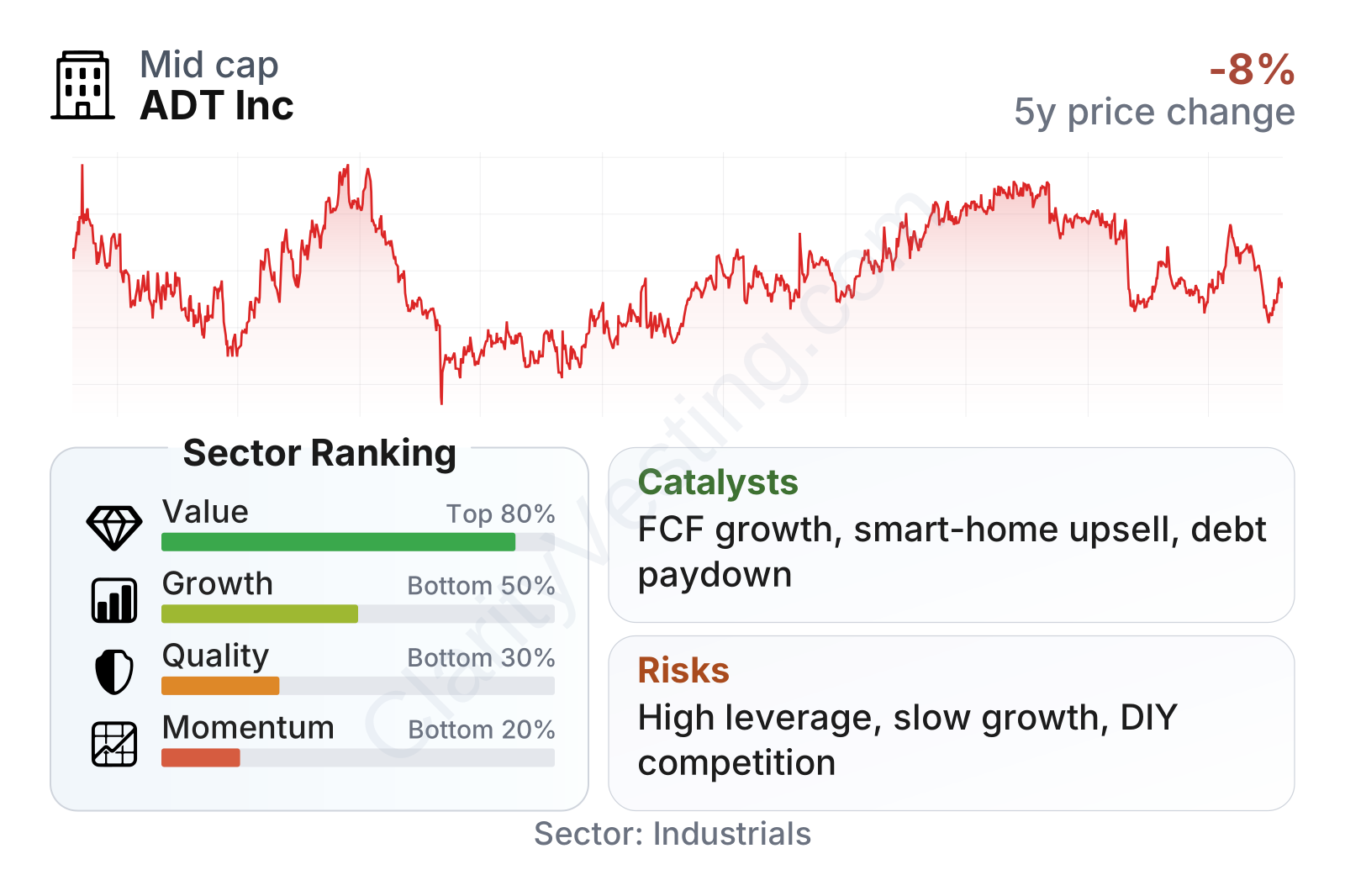
ADT is a mid-sized company with a share price that has been volatile over the last several years. The recent metric profile is unusual: valuation measures look inexpensive versus the broader sector, cash generation is strong, and margins are healthy, but growth, balance-sheet strength, and stock momentum are weaker. In other words, the market appears to be rewarding ADT for cash flow and current earnings while still discounting the company for leverage and modest expansion.
Growth
The security and smart home sector has long-term support from several durable trends: rising demand for connected devices, growing consumer awareness of home safety, increased use of mobile app control, and more commercial demand for integrated access and surveillance systems. ADT is exposed to these trends, although its position is more mature than that of a fast-scaling technology company.
Its strategy makes sense if the goal is steady, durable expansion rather than rapid disruption. The company benefits from a large installed base, recurring billing relationships, and ongoing demand for upgrades such as video, automation, and integrated monitoring. Partnerships with major technology and telecom groups in recent years have also aimed to improve customer acquisition and product relevance, especially in professionally monitored smart home offerings.
Revenue growth has slowed sharply from the unusually strong levels seen earlier in the cycle. After a difficult 2023, ADT returned to positive growth, but the most recent year-over-year pace is still only around 1% to 2%, well below the sector median. That suggests the business is currently more of a cash compounder than a strong top-line grower.
Where ADT looks much stronger is free cash flow. Trailing free cash flow has climbed significantly over the last few years and now sits in a very high range relative to the company’s market value. That matters because recurring service businesses often create value through cash generation, debt reduction, and shareholder distributions rather than through rapid sales growth alone.
A notable catalyst is the company’s continued emphasis on operational efficiency and customer monetization. If ADT can keep lifting revenue per user, expand attach rates for video and automation services, and maintain disciplined subscriber retention, even low single-digit sales growth could still translate into improving earnings and cash flow. Recent company updates have also highlighted ongoing progress in business simplification and capital returns, which strengthens the case for a more efficient earnings model.
Risks
This article is for informational purposes only and does not constitute financial advice. Some content is AI-generated. See Disclaimer


