Stock Analysis · Adaptive Biotechnologies Corp (ADPT)
Overview
Adaptive Biotechnologies is a healthcare company focused on reading and interpreting the immune system. Its core technology sequences T-cell and B-cell receptors, which are the molecular fingerprints that show how the body responds to disease. In practical terms, the company uses this capability in two main ways: diagnostic testing for blood cancers and immune medicine discovery partnerships.
The business is built around immune profiling rather than a traditional drug portfolio. Its best-known commercial product is clonoSEQ, a test used to detect measurable residual disease, or very small amounts of cancer that remain after treatment in certain blood cancers. Adaptive also works with pharmaceutical partners to discover and develop immune-driven therapies and tools, using its platform to map immune responses at scale.
Based on the company’s latest annual reporting and recent quarterly disclosures, revenue is mainly split between diagnostics and research-related collaboration work. The mix can move meaningfully from year to year depending on milestone activity, but the broad picture is:
- Minimal Residual Disease / diagnostics: approximately 55% to 65% of revenue in recent periods. This primarily includes clonoSEQ testing volume, related clinical use, and diagnostic services tied to hematologic cancers.
- Immune medicine and collaborations: approximately 35% to 45% of revenue in recent periods. This includes research services, platform access, and partnership-related payments, especially from pharmaceutical collaborations.
That mix matters because the diagnostic side is generally more recurring and scalable if testing adoption keeps rising, while collaboration revenue can be lumpier but sometimes produces larger jumps when milestones are recognized.
Over the last several years, the company’s revenue base has become more meaningful while operating losses have narrowed sharply. Gross profit expanded strongly in 2025 as sales improved without a similar rise in cost of revenue, suggesting better operating leverage. Research and development remains a major spending item, which is consistent with a company still investing in platform expansion and future applications.
The broader financial flow shows a business that is still loss-making, but one where revenue and gross profit improved materially in 2025 while operating expenses grew far more slowly. That is an important change from earlier years, when losses were much heavier relative to sales.
Key Figures
| Metric | Value | Sector ⓘ |
|---|---|---|
| Date | Oct 03, 2026 | |
| Context | ||
| Sector | Healthcare | |
| Industry | Diagnostics & Research | |
| Market Cap ⓘ | $4.61B | |
| Beta ⓘ | 2.10 | |
Value (Cheapness) | ||
| P/E Ratio ⓘ | N/A | 24.06 |
| P/B Ratio ⓘ | 31.93 | 3.08 |
| FCF Yield ⓘ | -0.52% | 3.07% |
| Dividend Yield ⓘ | N/A | 2.05% |
| EBIT / EV ⓘ | -0.71% | 0.63% |
| PEG ⓘ | N/A | |
Growth (Business expansion) | ||
| Revenue Growth ⓘ | 21.50% | 7.50% |
| RPS Growth (5Y CAGR) ⓘ | 13.51% | 8.70% |
| EPS Growth (5Y CAGR) ⓘ | -38.36% | -18.20% |
| BVPS Growth (5Y CAGR) ⓘ | -24.46% | 3.95% |
| Margin Growth (5Y Trend) ⓘ | N/A | -0.58% |
| FCF Growth (5Y CAGR) ⓘ | -33.78% | 0.88% |
| DPS Growth (5Y CAGR) ⓘ | N/A | 6.80% |
Quality (Business durability) | ||
| ROIC (Latest) ⓘ | -8.96% | 3.29% |
| ROA (Latest) ⓘ | -11.29% | 3.02% |
| ROIC (5Y Median) ⓘ | -28.64% | 4.75% |
| ROA (5Y Median) ⓘ | -22.49% | 1.93% |
| Net Debt / EBIT (Latest) ⓘ | N/A | 1.33 |
| Net Debt / EBIT (5Y Median) ⓘ | N/A | 1.83 |
| Net Debt / EBITDA (Latest) ⓘ | N/A | 0.99 |
| Net Debt / Assets ⓘ | 37.56% | 5.33% |
| EBITDA / Interest ⓘ | N/A | 9.63 |
| Operating Margin (Latest) ⓘ | -10.42% | 9.25% |
| Operating Margin (5Y Median) ⓘ | -105.84% | 7.80% |
| Debt to Equity (Latest) ⓘ | 287.23% | 28.99% |
| Profit Margin (Latest) ⓘ | -20.73% | 3.60% |
| Free Cash Flow (Latest) ⓘ | -$24.03M | |
Momentum (Price trend) | ||
| 3Y Return ⓘ | +427.36% | +37.48% |
| 12M Return (excl. last month) ⓘ | +84.67% | +20.85% |
| 6M Return ⓘ | +89.67% | +9.73% |
| Price vs. 200-Day MA ⓘ | +47.19% | +4.69% |
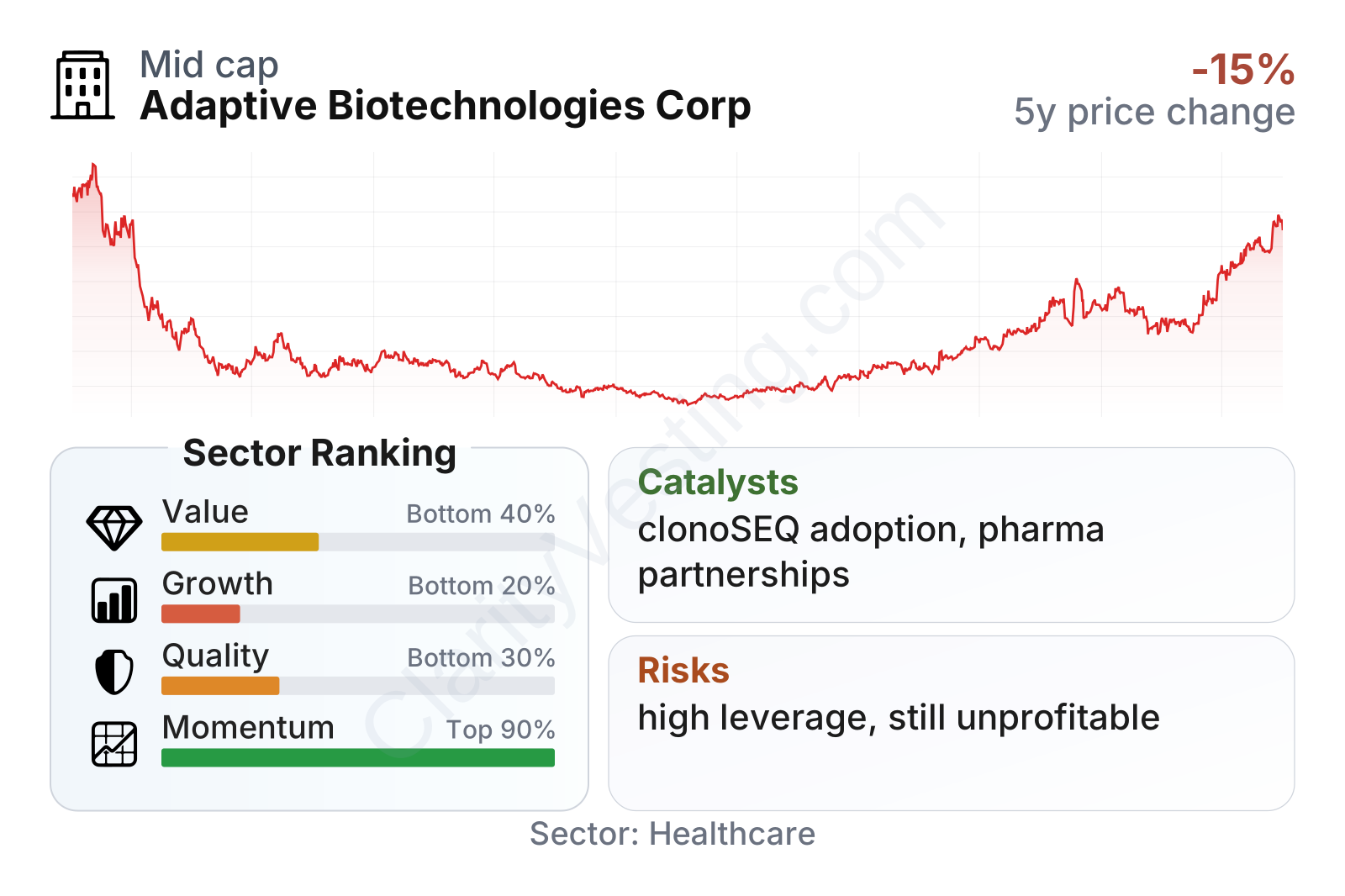
Adaptive is now a mid-sized healthcare company by market value, but the share price has been highly volatile. After a deep decline from 2021 into 2024, the stock rebounded strongly through 2025 and into 2026. The metrics table presents a mixed picture: price momentum is exceptionally strong versus the healthcare sector, but value, quality, and growth rankings remain weaker because the company is still not consistently profitable and carries elevated balance-sheet pressure.
Revenue growth is better than the sector median, and five-year revenue per share growth is also ahead of many peers. However, returns on capital, returns on assets, margins, and free cash flow remain below sector norms. This is the profile of a company the market is increasingly willing to price on future commercial potential rather than current earnings strength.
Growth
Adaptive operates in a sector with long-term structural tailwinds. Precision medicine, cancer monitoring, and immune-system data are all areas of sustained interest across healthcare. In blood cancers especially, measurable residual disease testing has become increasingly important because doctors want more sensitive tools to track treatment response and relapse risk. That creates a favorable backdrop for clonoSEQ if adoption continues to broaden across care settings, clinical guidelines, and reimbursement channels.
The company’s strategy also makes sense in a long-term framework. It is trying to build value from both a commercial diagnostics franchise and an immune mapping platform that can be used by partners. That combination can be attractive because diagnostics can generate recurring test revenue, while platform collaborations can open additional uses of the underlying technology without requiring Adaptive to fund every program on its own.
Revenue growth has not been perfectly smooth, but the recent pattern is much better than the company’s earlier volatility. Year-over-year growth accelerated meaningfully through 2025, including a very strong spike in the second half of that year, and remained positive in the first half of 2026. The latest annual growth pace is above the sector median, which supports the view that commercial traction is improving even if quarterly comparisons can still move around.
Cash generation is also moving in the right direction. Free cash flow remains negative, but the deficit has narrowed dramatically over the last several years, from very large outflows to a much smaller trailing twelve-month burn by early 2026. That does not make the business self-funding yet, but it does suggest that scaling revenue and expense discipline are beginning to matter.
One of the clearest catalysts is continued expansion of clonoSEQ testing volume and physician adoption. Another is the company’s collaboration network, especially its work with major pharmaceutical partners in immune medicine. Adaptive has also highlighted progress in integrating immune profiling into broader clinical and research workflows, which could enlarge the addressable market over time. Recent company updates have pointed to ongoing commercial execution in MRD testing and continued development activity with partners, reinforcing the idea that the platform is gaining practical relevance rather than remaining only a research concept.
Risks
This article is for informational purposes only and does not constitute financial advice. Some content is AI-generated. See Disclaimer