Stock Analysis · Adaro Energy (ADOOY)
Overview
Adaro Energy, now widely known through its Indonesian operating group as Alamtri Resources Indonesia, is a diversified natural resources and infrastructure company built around coal mining, energy logistics, and selected non-coal investments. The business started as a major thermal coal producer in Indonesia and remains most exposed to coal today, but management has been broadening the portfolio into mining services, logistics, land assets, and energy-related infrastructure.
For long-term readers, the key point is simple: this is still primarily a coal-driven company, even though it has been reshaping itself and separating parts of its operations through corporate actions in recent years. Its earnings and cash generation continue to depend heavily on coal prices, production volumes, and export demand from Asia.
The company’s revenue mix is still dominated by coal mining and trading, with other activities adding support around the core franchise. Based on recent company reporting and segment disclosures, the main sources of revenue can be summarized as follows:
- Coal mining and trading: approximately 75% to 85% of revenue. This includes thermal coal sales from Adaro’s mining operations and associated trading activities.
- Mining services and contracting: approximately 8% to 15%. This covers overburden removal, mine operations support, and related services provided to mining assets.
- Logistics, shipping, and other infrastructure-related services: approximately 3% to 8%. This includes coal transport, barging, terminals, and supporting supply-chain activities.
- Land, investments, and other businesses: typically a small single-digit percentage. This can include industrial land, supporting businesses, and newer energy-related initiatives depending on the reporting period.
The broader business model matters because Adaro is not only extracting coal; it also controls parts of the chain that move coal from pit to customer. That vertical integration can protect margins better than a pure producer when operating conditions are favorable.
The long-term operating picture shows how cyclical the company is. Revenue and operating income surged in 2022 during the coal boom, then normalized afterward. Even after that cooling period, margins have remained strong by sector standards, showing that the asset base is still capable of producing solid profits when prices are lower than peak levels.
Key Figures
| Metric | Value | Sector ⓘ |
|---|---|---|
| Date | Oct 17, 2026 | |
| Context | ||
| Sector | Energy | |
| Industry | Thermal Coal | |
| Market Cap ⓘ | $4.01B | |
| Beta ⓘ | -0.11 | |
Value (Cheapness) | ||
| P/E Ratio ⓘ | 6.90 | 15.44 |
| P/B Ratio ⓘ | 0.96 | 1.73 |
| FCF Yield ⓘ | -5.44% | 8.20% |
| Dividend Yield ⓘ | 10.95% | 3.59% |
| EBIT / EV ⓘ | 15.23% | 7.46% |
| PEG ⓘ | N/A | |
Growth (Business expansion) | ||
| Revenue Growth ⓘ | 11.00% | 26.90% |
| RPS Growth (5Y CAGR) ⓘ | -15.54% | 6.90% |
| EPS Growth (5Y CAGR) ⓘ | -43.45% | -15.73% |
| BVPS Growth (5Y CAGR) ⓘ | 1.06% | 6.07% |
| Margin Growth (5Y Trend) ⓘ | -11.05% | 0.58% |
| FCF Growth (5Y CAGR) ⓘ | N/A | 1.86% |
| DPS Growth (5Y CAGR) ⓘ | 38.63% | 16.79% |
Quality (Business durability) | ||
| ROIC (Latest) ⓘ | N/A | 11.40% |
| ROA (Latest) ⓘ | 8.05% | 6.06% |
| ROIC (5Y Median) ⓘ | 20.23% | 10.30% |
| ROA (5Y Median) ⓘ | 15.45% | 5.42% |
| Net Debt / EBIT (Latest) ⓘ | 1.38 | 1.64 |
| Net Debt / EBIT (5Y Median) ⓘ | -0.55 | 1.83 |
| Net Debt / EBITDA (Latest) ⓘ | 1.01 | 1.08 |
| Net Debt / Assets ⓘ | 12.27% | 17.29% |
| EBITDA / Interest ⓘ | 24.73 | 9.64 |
| Operating Margin (Latest) ⓘ | 34.56% | 16.27% |
| Operating Margin (5Y Median) ⓘ | 39.31% | 20.39% |
| Debt to Equity (Latest) ⓘ | 42.08% | 54.76% |
| Profit Margin (Latest) ⓘ | 28.89% | 8.82% |
| Free Cash Flow (Latest) ⓘ | -$218.38M | |
Momentum (Price trend) | ||
| 3Y Return ⓘ | +162.05% | +67.38% |
| 12M Return (excl. last month) ⓘ | +62.18% | +49.19% |
| 6M Return ⓘ | +1.14% | +7.07% |
| Price vs. 200-Day MA ⓘ | +7.17% | +9.56% |
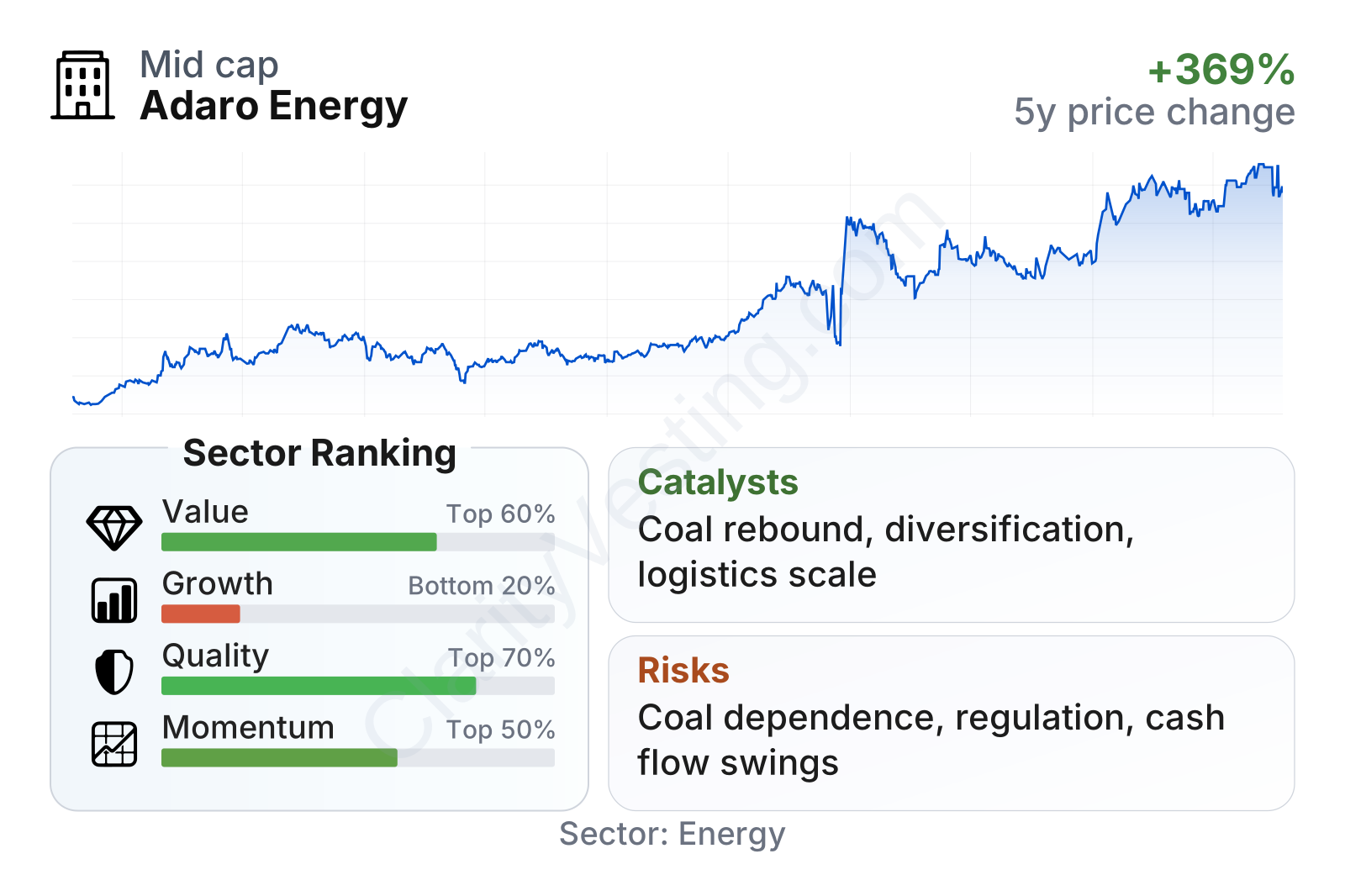
Adaro stands out on profitability and balance-sheet discipline more than on growth. Valuation multiples are below sector medians, while dividend yield remains unusually high. At the same time, recent free cash flow has turned negative and growth metrics rank near the bottom of the sector, which suggests the market is discounting weaker expansion and the cyclical nature of coal earnings.
The share price trend over the past several years has been strong overall, although not smooth. That pattern fits a company whose valuation often moves with commodity conditions: strong rallies when coal markets tighten, followed by resets when prices cool or when the market questions the durability of cash generation.
Growth
Adaro operates in a sector with two very different timelines. In the near to medium term, coal still has a large role in many Asian power systems, especially in Indonesia, India, and parts of Southeast Asia where affordability and energy security remain major priorities. In the longer term, however, thermal coal faces structural pressure from decarbonization policies, renewable power growth, and tighter financing conditions. That means the sector is not a straightforward growth market, but it can still generate substantial cash for efficient low-cost producers.
Adaro’s strategy makes sense only if viewed through that lens. The company is using its existing coal platform to generate earnings while expanding into adjacent businesses and selected non-coal areas. That is a rational approach for a mature resource company: harvest strong assets, keep costs competitive, and reinvest carefully into activities that may remain relevant if coal demand gradually weakens.
Recent top-line growth has been unstable. After the exceptional jump during the 2022 commodity upcycle, revenue contracted sharply through 2023 and 2025 before turning positive again in 2026. That rebound is encouraging, but the longer pattern still looks cyclical rather than steadily expanding.
Cash generation tells a similarly mixed story. Free cash flow was very strong during the period of elevated coal prices, then weakened materially and recently turned negative on a trailing basis. For a capital-intensive resource company, that is an important signal: the business can produce large amounts of cash in favorable conditions, but those levels are not stable enough to assume as a baseline.
One meaningful catalyst is Indonesia’s continued importance in seaborne coal markets. Adaro remains one of the country’s established export producers, and that scale supports customer relationships, logistics efficiency, and operating continuity. Another potential growth driver is the company’s portfolio reshaping, including efforts to develop infrastructure and other energy-related businesses beyond its historical coal center of gravity. If those newer activities gain enough size, they could gradually reduce dependence on one commodity cycle.
Recent company updates have also pointed to continued work on diversification and capital allocation across its broader resource and infrastructure platform. That does not change the current coal-heavy profile, but it supports the idea that management is preparing the business for a different demand mix over time.
Risks
This article is for informational purposes only and does not constitute financial advice. Some content is AI-generated. See Disclaimer


