Stock Analysis · Archer-Daniels-Midland Company (ADM)
Overview
Archer-Daniels-Midland Company is one of the largest agricultural supply chain and food ingredient businesses in the world. It buys crops such as corn, oilseeds, wheat, and other agricultural raw materials, transports and stores them, processes them into ingredients and products, and sells those outputs to food manufacturers, animal feed customers, energy markets, and industrial users. In simple terms, ADM sits in the middle of the global food system: it connects farms to factories and end markets.
Its revenue base is broad, but the largest contribution still comes from commodity processing and merchandising activities. Based on the company’s segment reporting in recent annual filings, the business can be viewed approximately as follows:
- Ag Services & Oilseeds: about 70% to 75% of revenue. This includes grain origination, transportation, storage, trading, and processing of soybeans and other oilseeds into meal and vegetable oils.
- Carbohydrate Solutions: about 15% to 20% of revenue. This includes corn processing, sweeteners, starches, syrups, alcohol, and products linked to food, industrial, and energy uses.
- Nutrition: about 8% to 12% of revenue. This includes flavors, colors, emulsifiers, probiotics, specialty ingredients, and animal nutrition solutions. It is smaller by sales than the commodity businesses, but strategically important because margins are typically better.
- Other Business: a low-single-digit share of revenue. This generally includes smaller activities and corporate-related items.
One important point for long-term analysis is that ADM’s sales are very large, but profitability is naturally thinner than many branded consumer businesses because a major part of the company handles high-volume agricultural commodities. That means small changes in margins, crop spreads, and processing economics can have an outsized effect on earnings.
The business mix shows this clearly: revenue has remained very large, but the share absorbed by raw material costs is also substantial. After exceptionally strong results in 2022 and still solid performance in 2023, operating income and net income fell materially in 2024 and 2025 as processing margins and trade conditions normalized.
Key Figures
| Metric | Value | Sector ⓘ |
|---|---|---|
| Date | Oct 24, 2026 | |
| Context | ||
| Sector | Consumer Defensive | |
| Industry | Farm Products | |
| Market Cap ⓘ | $38.80B | |
| Beta ⓘ | 0.63 | |
Value (Cheapness) | ||
| P/E Ratio ⓘ | 22.62 | 18.68 |
| P/B Ratio ⓘ | 1.68 | 1.24 |
| FCF Yield ⓘ | 4.32% | 12.11% |
| Dividend Yield ⓘ | 2.49% | 2.67% |
| EBIT / EV ⓘ | 5.55% | 6.40% |
| PEG ⓘ | 1.02 | |
Growth (Business expansion) | ||
| Revenue Growth ⓘ | 7.20% | 4.10% |
| RPS Growth (5Y CAGR) ⓘ | 2.44% | 6.22% |
| EPS Growth (5Y CAGR) ⓘ | -25.89% | -13.59% |
| BVPS Growth (5Y CAGR) ⓘ | 3.98% | 3.27% |
| Margin Growth (5Y Trend) ⓘ | -1.87% | -0.13% |
| FCF Growth (5Y CAGR) ⓘ | -6.18% | 4.10% |
| DPS Growth (5Y CAGR) ⓘ | 8.46% | 6.83% |
Quality (Business durability) | ||
| ROIC (Latest) ⓘ | 7.18% | 12.34% |
| ROA (Latest) ⓘ | 3.36% | 6.30% |
| ROIC (5Y Median) ⓘ | 12.09% | 10.53% |
| ROA (5Y Median) ⓘ | 5.12% | 5.44% |
| Net Debt / EBIT (Latest) ⓘ | -0.09 | 1.98 |
| Net Debt / EBIT (5Y Median) ⓘ | 2.69 | 2.35 |
| Net Debt / EBITDA (Latest) ⓘ | -0.06 | 1.38 |
| Net Debt / Assets ⓘ | -0.44% | 21.70% |
| EBITDA / Interest ⓘ | 6.49 | 9.49 |
| Operating Margin (Latest) ⓘ | 3.23% | 8.88% |
| Operating Margin (5Y Median) ⓘ | 4.20% | 9.57% |
| Debt to Equity (Latest) ⓘ | 39.62% | 72.35% |
| Profit Margin (Latest) ⓘ | 2.16% | 5.40% |
| Free Cash Flow (Latest) ⓘ | $1.68B | |
Momentum (Price trend) | ||
| 3Y Return ⓘ | +22.10% | +24.53% |
| 12M Return (excl. last month) ⓘ | +42.20% | +1.93% |
| 6M Return ⓘ | +19.21% | +1.61% |
| Price vs. 200-Day MA ⓘ | +7.02% | +2.99% |
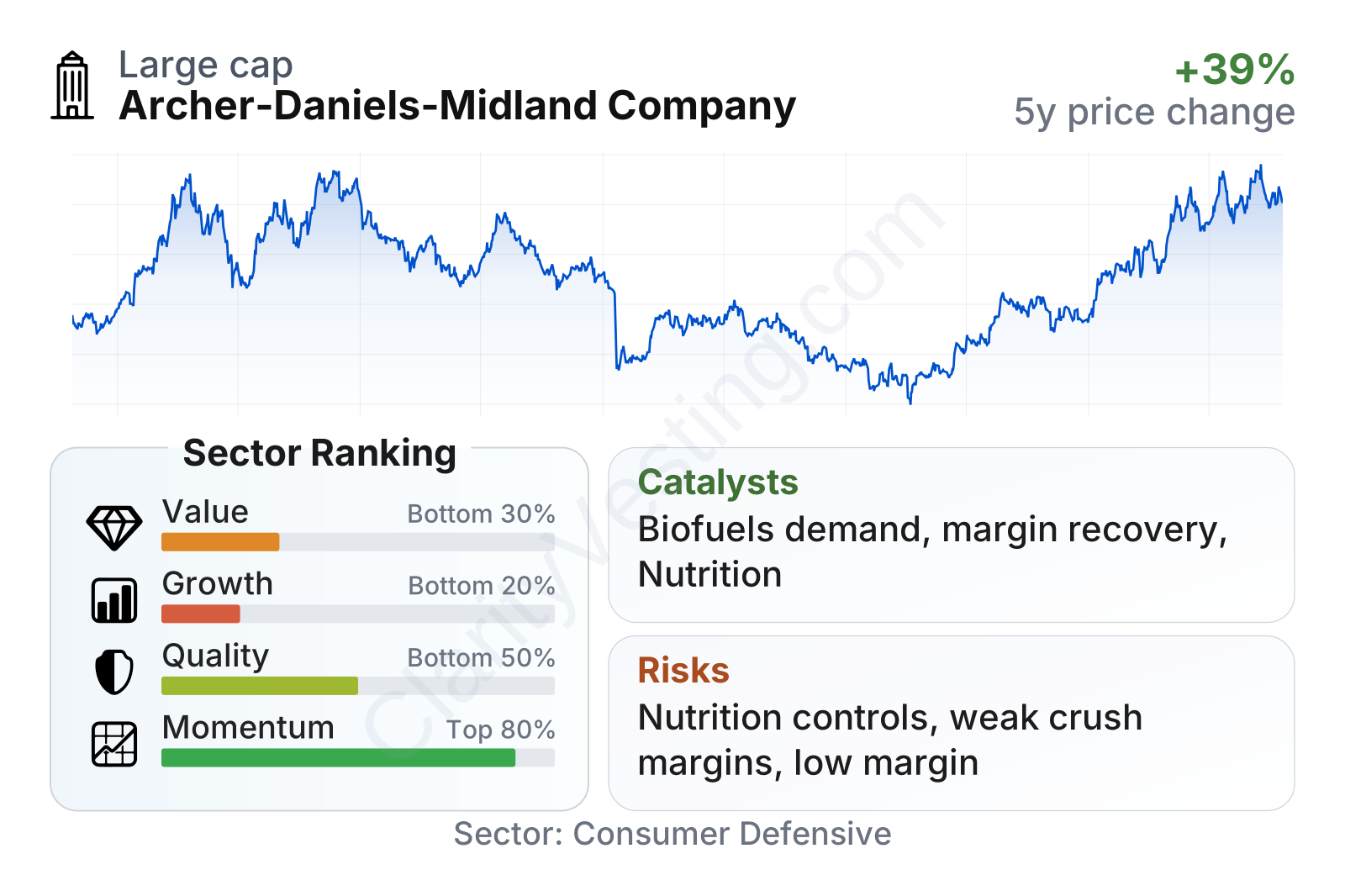
ADM is a large-cap company with a relatively low beta of about 0.61, meaning its share price has historically moved less than the broader market. The factor profile is mixed. Valuation metrics sit in the weaker part of the sector, with the stock trading above the sector median on earnings and book value while offering a lower free cash flow yield. Growth and quality rankings are also below many sector peers, mainly because earnings, margins, and cash generation have been inconsistent over the last several years. The stronger area is momentum: recent price performance has been well ahead of the sector median, helped by a rebound from depressed levels.
Growth
ADM operates in a sector with durable long-term demand. Global population growth, rising protein consumption, food processing needs, animal feed demand, and biofuel-related crop usage all support the broader agricultural value chain. This is not a fast-growing industry in the way software or biotechnology can be, but it is essential, global, and difficult to replace. That gives the sector staying power even when yearly results are volatile.
The company’s strategy for future growth makes sense on paper because it aims to reduce dependence on pure commodity cycles. Management has spent years building the Nutrition segment and other value-added ingredient businesses, where pricing is usually less exposed to raw grain swings and customer relationships can be stickier. At the same time, ADM retains the scale advantages of its grain handling and processing network, which remains the company’s economic foundation.
Recent revenue trends suggest the downturn may be easing, but not fully resolved. Year-over-year revenue growth was deeply negative through much of 2023 and 2024, stayed mixed in 2025, and turned positive again in early 2026. That points to stabilization rather than a clean return to the unusually strong conditions seen in 2022.
Cash generation has also been uneven. Free cash flow has swung sharply from very strong levels to weak periods and then back again, which is common in agribusiness because working capital needs can move significantly with commodity prices, inventories, and trade flows. The encouraging part is that recent free cash flow recovered strongly after a soft 2025 period, showing that the business can still produce meaningful cash when operating conditions improve.
Several catalysts could matter over the next few years. Biofuels remain one of the clearest structural opportunities, especially demand tied to vegetable oils and feedstocks used in renewable diesel and similar fuel pathways. A second catalyst is margin recovery in oilseed processing and grain merchandising after a weak stretch. A third is any successful rebuilding of confidence in the Nutrition segment, which remains strategically important because long-term value creation depends in part on ADM becoming more than a low-margin commodity processor.
Recent company disclosures and investor communications also point to continued portfolio discipline, cost actions, and operational streamlining. Those steps do not change the industry cycle, but they can improve resilience if margins remain below peak levels.
Risks
This article is for informational purposes only and does not constitute financial advice. Some content is AI-generated. See Disclaimer


