Stock Analysis · ADI Global Distribution Inc (ADIG)
Overview
ADI Global Distribution Inc is a specialty distributor focused on security, audiovisual, and low-voltage products used in commercial buildings, homes, and institutional sites. In simple terms, the company sits between manufacturers and professional installers or integrators. It helps customers source products such as video surveillance systems, access control equipment, intrusion alarms, fire and life-safety devices, networking gear, smart home products, and related infrastructure.
The business model is mostly based on product distribution rather than manufacturing. That means ADI earns revenue by purchasing equipment from suppliers and reselling it through its branch network, digital channels, and value-added services. This kind of model can benefit from scale, purchasing relationships, logistics efficiency, and a broad catalog, but it also tends to operate with thinner margins than software or branded hardware companies.
Based on the company’s public disclosures and business description, revenue appears to be concentrated in a few major categories:
- Security products: the largest revenue source, likely representing a majority of sales. This includes video surveillance, access control, intrusion, and related professional security systems.
- Low-voltage and smart building products: an important secondary source, including wiring, networking, connected devices, and infrastructure used by installers and integrators.
- Audiovisual and adjacent categories: a smaller but relevant contributor, covering products used in commercial AV, conferencing, and connected environments.
- Services and other revenue: a relatively small portion, including support activities tied to distribution, project assistance, and digital ordering tools.
Geographically, the company’s operations are centered on distribution markets where professional installers need broad product availability, technical support, and reliable fulfillment. That makes ADI less dependent on one product cycle than a pure hardware maker, but more exposed to construction activity, renovation demand, and customers’ capital spending.
The operating flow shows a classic distribution profile: large revenue volume, high cost of goods sold, and modest profit conversion. Revenue has climbed from about $3.6 billion in 2023 to about $4.8 billion in 2025, while gross profit also expanded. However, selling and administrative costs have risen materially, and net income has turned negative despite positive operating income in 2025. That suggests the top line is growing, but the translation into bottom-line earnings remains uneven.
The financial flow highlights a business with improving gross profit dollars but tight profitability after operating costs, interest expense, and other charges. In other words, ADI has scale, but not much margin for execution mistakes.
Key Figures
| Metric | Value | Sector ⓘ |
|---|---|---|
| Date | Oct 03, 2026 | |
| Context | ||
| Sector | Technology | |
| Industry | Computer Hardware | |
| Market Cap ⓘ | $1.44B | |
| Beta ⓘ | N/A | |
Value (Cheapness) | ||
| P/E Ratio ⓘ | 33.93 | 29.95 |
| FCF Yield ⓘ | N/A | 4.22% |
| Dividend Yield ⓘ | N/A | 1.30% |
| EBIT / EV ⓘ | N/A | 2.83% |
| PEG ⓘ | N/A | |
Growth (Business expansion) | ||
| Revenue Growth ⓘ | 0.70% | 15.80% |
| RPS Growth (5Y CAGR) ⓘ | N/A | 8.55% |
| EPS Growth (5Y CAGR) ⓘ | N/A | -11.72% |
| Margin Growth (5Y Trend) ⓘ | -0.38% | 0.39% |
| FCF Growth (5Y CAGR) ⓘ | N/A | 9.72% |
| DPS Growth (5Y CAGR) ⓘ | N/A | 7.73% |
Quality (Business durability) | ||
| ROIC (Latest) ⓘ | N/A | 9.36% |
| ROIC (5Y Median) ⓘ | N/A | 8.32% |
| Net Debt / EBIT (Latest) ⓘ | N/A | 0.50 |
| Net Debt / EBIT (5Y Median) ⓘ | N/A | 0.46 |
| Net Debt / EBITDA (Latest) ⓘ | N/A | 0.28 |
| Net Debt / Assets ⓘ | 15.39% | 3.44% |
| EBITDA / Interest ⓘ | N/A | 12.67 |
| Operating Margin (Latest) ⓘ | N/A | 9.81% |
| Operating Margin (5Y Median) ⓘ | 3.74% | 8.50% |
| Debt to Equity (Latest) ⓘ | 50.71% | 33.33% |
| Profit Margin (Latest) ⓘ | 0.86% | 7.15% |
| Free Cash Flow (Latest) ⓘ | N/A | |
Momentum (Price trend) | ||
| 3Y Return ⓘ | N/A | +49.46% |
| 12M Return (excl. last month) ⓘ | N/A | +16.51% |
| 6M Return ⓘ | N/A | +24.29% |
| Price vs. 200-Day MA ⓘ | N/A | +4.74% |
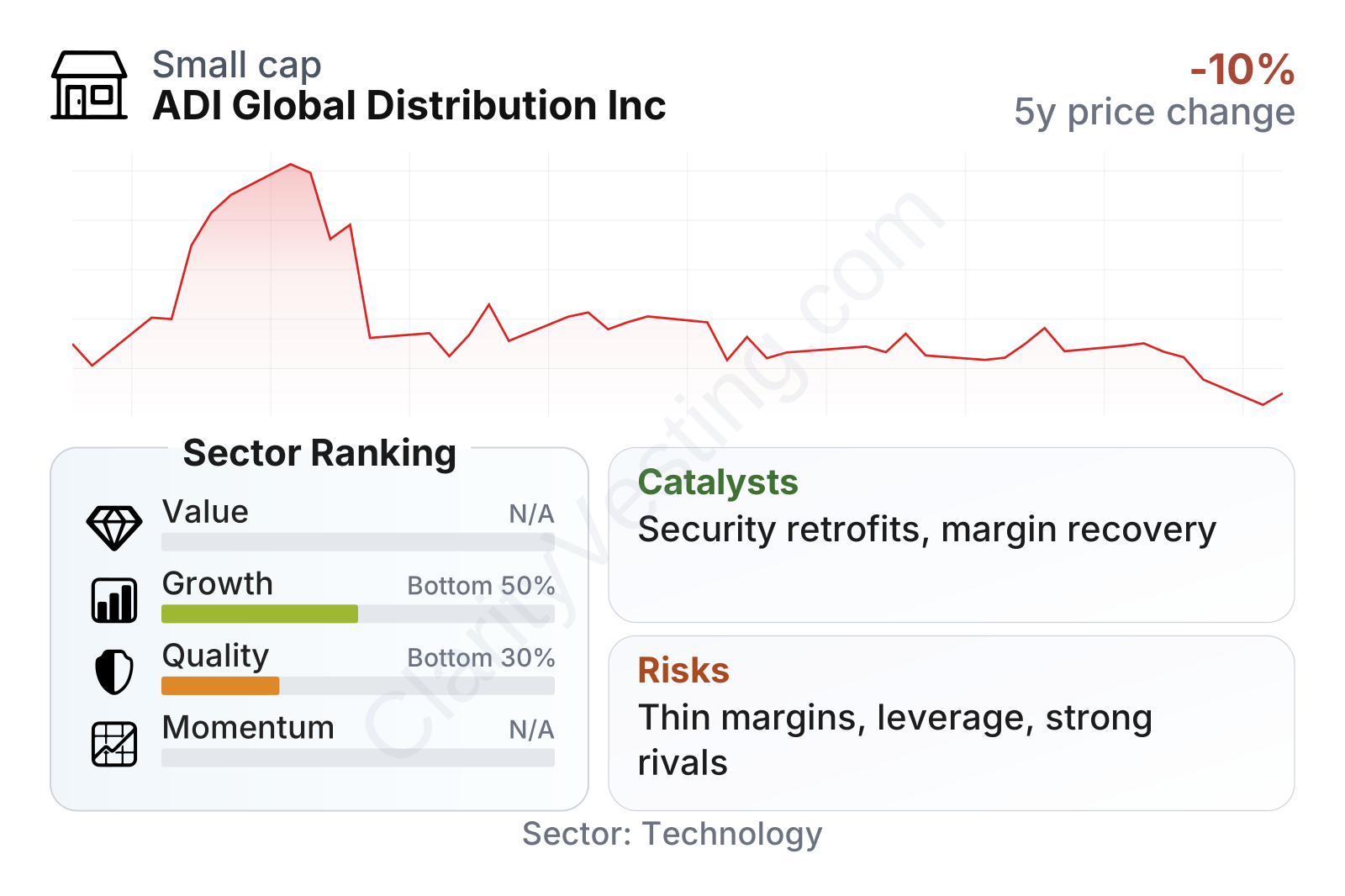
At a high level, ADI sits in the small-cap range, with valuation metrics that do not look cheap relative to its present growth and profitability profile. The earnings multiple is somewhat above the sector median, while growth metrics rank in the lower half of the sector. Quality indicators also trail many peers, mainly because margins are thin, leverage is somewhat elevated for the group, and recent profitability has been weak.
Revenue growth is positive but modest at roughly 1% year over year, well below the sector median of about 16%. Profit margin is below 1%, versus roughly 7% for the sector median, which is a major gap. Debt-to-equity stands near 51%, above the sector median of around 33%, and net debt as a share of assets is also noticeably higher than typical peers. The stock’s valuation therefore appears to rest more on operational improvement potential than on current financial strength.
Growth
ADI operates in markets that still have structural support: physical security, access control, connected buildings, and professionally installed low-voltage systems remain relevant as buildings become more automated and security requirements become more demanding. Demand can be helped by commercial retrofits, modernization of legacy systems, migration to more connected devices, and tighter compliance requirements in areas such as fire and life safety.
The company’s strategy makes sense if viewed through the lens of distribution economics. A broad catalog, established supplier relationships, local branch presence, and digital ordering capabilities can make ADI useful to installers that prefer one-stop sourcing. That can create repeat purchasing behavior and reduce customer switching, especially for projects that require dependable inventory and technical coordination.
A practical growth catalyst is mix improvement. If ADI can sell a larger share of higher-value categories such as integrated security, access control, smart building systems, and specialized AV solutions, gross profit can rise faster than revenue. Another important catalyst is cost discipline. The business already generates meaningful gross profit dollars, so better control of operating expenses could have an outsized effect on earnings.
Scale can also help over time. Distribution businesses often become more efficient as volume grows through the same infrastructure. ADI’s recent revenue expansion shows that demand and channel reach are real, even if earnings have lagged. If management can stabilize expenses and keep working capital under control, the gap between sales growth and bottom-line performance could narrow.
There is also a broader industry tailwind from the continuing convergence of security, networking, and building automation. Installers increasingly need products that work together across surveillance, access, connectivity, and control. A distributor that can aggregate these categories and support professional buyers may remain relevant even when end-market spending is uneven.
Risks
This article is for informational purposes only and does not constitute financial advice. Some content is AI-generated. See Disclaimer