Stock Analysis · Agree Realty Corporation (ADC)
Overview
Agree Realty Corporation is a retail real estate investment trust, or REIT. In simple terms, it owns commercial properties and collects rent from tenants. Its focus is mainly on single-tenant net lease properties, where the tenant usually pays property taxes, insurance, and maintenance costs in addition to rent. That structure can make cash flow more predictable than in many other forms of real estate.
The company’s portfolio is spread across the United States and is centered on large national retailers. Based on recent company reporting, revenue comes overwhelmingly from rental income generated by its owned properties, with a smaller contribution from ground leases and development-related activity. The business model is straightforward: acquire or develop properties leased to retailers with strong operating profiles, sign long leases, collect rent, and recycle capital into new properties.
Its revenue sources can be summarized as follows:
- Rental income from retail properties: approximately 90% to 95% of total revenue. This includes base rent from freestanding stores leased to national and regional tenants.
- Ground lease income: approximately 5% to 10% of total revenue. In these arrangements, Agree Realty often owns the land while the tenant controls and operates the building, which can reduce property-level risk.
- Other real estate revenue: a small share of revenue. This may include development, tenant reimbursement items, and gains or miscellaneous property-related income depending on the reporting period.
Tenant mix is an important part of the investment case. Agree Realty has emphasized necessity-based and value-oriented categories such as home improvement, auto service, grocery, farm and rural supply, convenience, and discount retail. That matters because these formats have generally held up better than weaker discretionary retail categories during economic slowdowns.
Over the last several years, revenue, gross profit, operating income, and net income have all moved higher. At the same time, interest expense has also risen as the company expanded and financing costs increased, which is typical for a growing REIT in a higher-rate environment.
Key Figures
| Metric | Value | Sector ⓘ |
|---|---|---|
| Date | Oct 31, 2026 | |
| Context | ||
| Sector | Real Estate | |
| Industry | REIT - Retail | |
| Market Cap ⓘ | $8.26B | |
| Beta ⓘ | 0.42 | |
Value (Cheapness) | ||
| P/E Ratio ⓘ | 34.13 | 18.09 |
| P/B Ratio ⓘ | 1.21 | 0.87 |
| FCF Yield ⓘ | 6.34% | 7.20% |
| Dividend Yield ⓘ | 4.74% | 4.74% |
| EBIT / EV ⓘ | 2.96% | 3.79% |
| PEG ⓘ | 0.13 | |
Growth (Business expansion) | ||
| Revenue Growth ⓘ | 16.70% | 5.65% |
| RPS Growth (5Y CAGR) ⓘ | 6.33% | 6.02% |
| EPS Growth (5Y CAGR) ⓘ | 12.80% | -7.60% |
| BVPS Growth (5Y CAGR) ⓘ | 3.96% | 0.46% |
| Margin Growth (5Y Trend) ⓘ | -4.25% | -0.69% |
| FCF Growth (5Y CAGR) ⓘ | 19.61% | 5.40% |
| DPS Growth (5Y CAGR) ⓘ | 1.78% | 5.11% |
Quality (Business durability) | ||
| ROIC (Latest) ⓘ | 3.70% | 5.24% |
| ROE (Latest) ⓘ | 3.62% | 7.59% |
| ROA (Latest) ⓘ | 2.33% | 3.05% |
| ROIC (5Y Median) ⓘ | 3.81% | 4.22% |
| ROE (5Y Median) ⓘ | 3.39% | 6.04% |
| ROA (5Y Median) ⓘ | 2.35% | 2.45% |
| Net Debt / EBIT (Latest) ⓘ | 9.91 | 7.33 |
| Net Debt / EBIT (5Y Median) ⓘ | 9.57 | 8.34 |
| Net Debt / EBITDA (Latest) ⓘ | 5.63 | 5.15 |
| Net Debt / Assets ⓘ | 33.42% | 37.10% |
| EBITDA / Interest ⓘ | 4.27 | 4.18 |
| Operating Margin (Latest) ⓘ | 45.59% | 33.44% |
| Operating Margin (5Y Median) ⓘ | 49.11% | 37.79% |
| Debt to Equity (Latest) ⓘ | 53.87% | 88.65% |
| Profit Margin (Latest) ⓘ | 29.75% | 20.06% |
| Free Cash Flow (Latest) ⓘ | $523.96M | |
Momentum (Price trend) | ||
| 3Y Return ⓘ | +40.20% | +38.89% |
| 12M Return (excl. last month) ⓘ | +0.07% | +2.55% |
| 6M Return ⓘ | -9.51% | -1.76% |
| Price vs. 200-Day MA ⓘ | -7.89% | -0.99% |
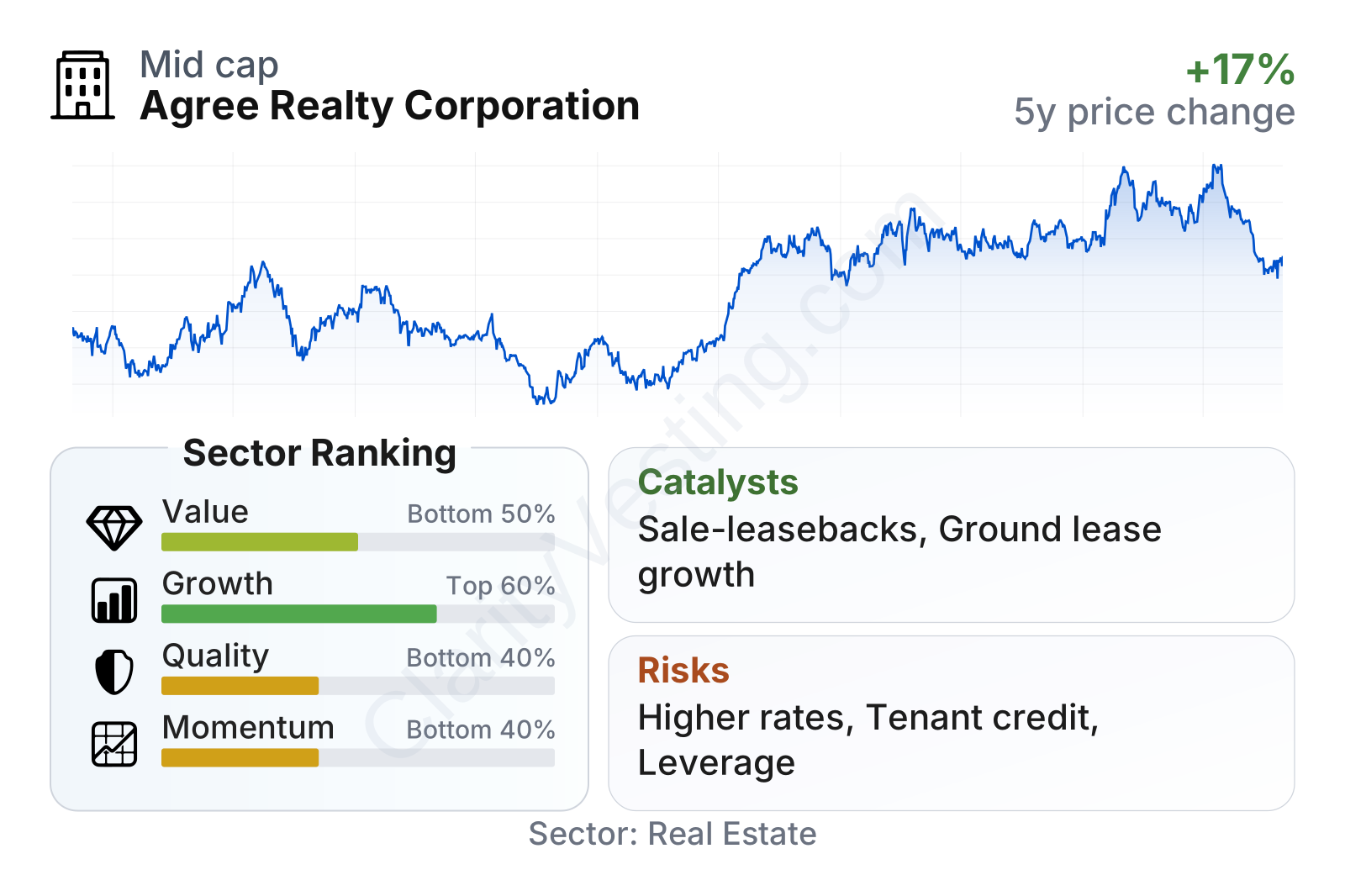
Agree Realty is a mid-sized listed REIT with a market value around the multi-billion-dollar range and a relatively low beta, which suggests its share price has historically been less volatile than the broader equity market. The metrics table points to a mixed profile. Growth looks better than much of the sector, supported by strong recent revenue expansion and solid multi-year progress in revenue per share, earnings, and free cash flow. Profitability is respectable in margin terms, but returns on assets and equity sit below many sector peers, showing that the business is efficient at collecting rent but not exceptional at generating accounting returns from its asset base. Valuation appears richer than the sector median on earnings and book value measures, while recent share-price momentum has been weaker than many peers despite solid longer-term performance.
Growth
Agree Realty operates in a part of commercial real estate that still has a clear role despite the long shift toward e-commerce. Net lease retail remains relevant because many of its tenants depend on physical locations for convenience, fulfillment, service, or nondiscretionary spending. Categories such as auto parts, convenience stores, home improvement, dollar stores, grocery-adjacent retail, and rural supply tend to be more resilient than apparel or mall-based retail. That does not make the sector immune to downturns, but it does give Agree Realty a more durable backdrop than many other retail landlords.
The company’s strategy is also easy to understand and largely coherent for future expansion. It has focused on acquiring properties leased to large retailers, increasing exposure to ground leases, and maintaining broad geographic diversification. Ground leases are particularly notable because they often carry lower building-related risk and can improve the quality of cash flow. The company has also used forward funding and development partnerships as another way to source properties beyond simple acquisitions.
Revenue per share has shown a steady upward path over the last five years. That is an important detail for a REIT because growth funded by new share issuance only creates long-term value when revenue and cash flow per share also rise. In Agree Realty’s case, the trend suggests that portfolio expansion has generally translated into per-share progress rather than just a larger asset base.
Dividend per share has also edged higher over time, although the growth rate has been moderate rather than rapid. That fits the profile of a REIT balancing expansion, cost of capital, and payout stability. The current yield is close to the sector median, so the distinguishing feature is not an unusually high payout, but the combination of regular income with consistent operating growth.
A meaningful catalyst for future growth is the continuing supply of sale-leaseback and acquisition opportunities among retailers that prefer to free up capital from owned real estate. Agree Realty can benefit when strong operators choose to monetize store properties and sign long leases. Another catalyst is that its focus on investment-grade or larger national tenants can make it a preferred counterparty in these transactions.
Recent company updates have continued to highlight active acquisition volume, portfolio expansion, and ongoing access to capital markets. For a REIT, that combination matters because growth depends not only on finding properties, but also on financing them at returns that remain attractive after debt and equity costs. If interest rates stabilize or fall, that could improve acquisition economics and support external growth.
Risks
This article is for informational purposes only and does not constitute financial advice. Some content is AI-generated. See Disclaimer