Stock Analysis · Enact Holdings Inc (ACT)
Overview
Enact Holdings Inc is a private mortgage insurance company in the United States. In simple terms, it helps lenders make home loans to borrowers who put down a small down payment. If a borrower defaults, Enact covers part of the lender’s loss. This makes homeownership more accessible for borrowers and reduces credit risk for banks, mortgage lenders, and other loan originators.
The business is concentrated in one main activity rather than spread across many unrelated segments. That focus makes the company easier to understand than many diversified financial groups, but it also means results depend heavily on the health of the U.S. housing and mortgage markets.
Its revenue mainly comes from insurance-related income tied to mortgage credit risk. Based on company filings, the main sources are:
- Net premiums earned: approximately 55% to 65% of total revenue in recent years. This is the recurring income Enact collects for insuring mortgage loans.
- Net investment income: approximately 25% to 35%. Like other insurers, Enact invests the premiums it holds before claims are paid, mainly in fixed-income securities.
- Other insurance-related and fee income: generally less than 10%. This can include items such as ceded reinsurance impacts, policy cancellations, and other smaller operating items.
That mix matters because it gives Enact two earnings engines: underwriting performance and investment income. It also means profit can be influenced both by mortgage credit conditions and by interest rates.
Over the last several years, revenue has stayed broadly around the same level with a modest upward trend, while net income has remained strong. The standout feature is profitability: operating income and net income have held up well even when revenue did not rise sharply, showing a business with disciplined costs and favorable credit performance.
Key Figures
| Metric | Value | Sector ⓘ |
|---|---|---|
| Date | Oct 03, 2026 | |
| Context | ||
| Sector | Financial Services | |
| Industry | Insurance - Specialty | |
| Market Cap ⓘ | $5.95B | |
| Beta ⓘ | 0.46 | |
Value (Cheapness) | ||
| P/E Ratio ⓘ | 9.13 | 12.60 |
| P/B Ratio ⓘ | 1.15 | 1.23 |
| FCF Yield ⓘ | 12.12% | 10.16% |
| Dividend Yield ⓘ | 1.87% | 2.96% |
| EBIT / EV ⓘ | 13.36% | 7.77% |
| PEG ⓘ | N/A | |
Growth (Business expansion) | ||
| Revenue Growth ⓘ | 4.10% | 9.50% |
| RPS Growth (5Y CAGR) ⓘ | 4.62% | 12.10% |
| EPS Growth (5Y CAGR) ⓘ | -13.96% | -9.45% |
| BVPS Growth (5Y CAGR) ⓘ | 9.22% | 5.01% |
| Margin Growth (5Y Trend) ⓘ | 12.14% | -4.07% |
| FCF Growth (5Y CAGR) ⓘ | N/A | 4.96% |
| DPS Growth (5Y CAGR) ⓘ | -9.93% | 8.79% |
Quality (Business durability) | ||
| ROIC (Latest) ⓘ | 11.85% | 9.60% |
| ROE (Latest) ⓘ | 12.76% | 13.84% |
| ROA (Latest) ⓘ | 9.88% | 1.53% |
| ROIC (5Y Median) ⓘ | 13.02% | 7.86% |
| ROE (5Y Median) ⓘ | 14.29% | 12.20% |
| ROA (5Y Median) ⓘ | 10.78% | 1.29% |
| Net Debt / EBIT (Latest) ⓘ | 0.32 | 0.91 |
| Net Debt / EBIT (5Y Median) ⓘ | 0.18 | 0.74 |
| Net Debt / EBITDA (Latest) ⓘ | 0.32 | 0.97 |
| Operating Margin (Latest) ⓘ | 73.18% | 22.12% |
| Operating Margin (5Y Median) ⓘ | 73.86% | 24.39% |
| Debt to Equity (Latest) ⓘ | 13.80% | 60.37% |
| Profit Margin (Latest) ⓘ | 54.51% | 26.62% |
| Free Cash Flow (Latest) ⓘ | $720.83M | |
Momentum (Price trend) | ||
| 3Y Return ⓘ | +77.10% | +89.23% |
| 12M Return (excl. last month) ⓘ | +31.36% | +17.35% |
| 6M Return ⓘ | +9.97% | +10.00% |
| Price vs. 200-Day MA ⓘ | +1.98% | +3.73% |
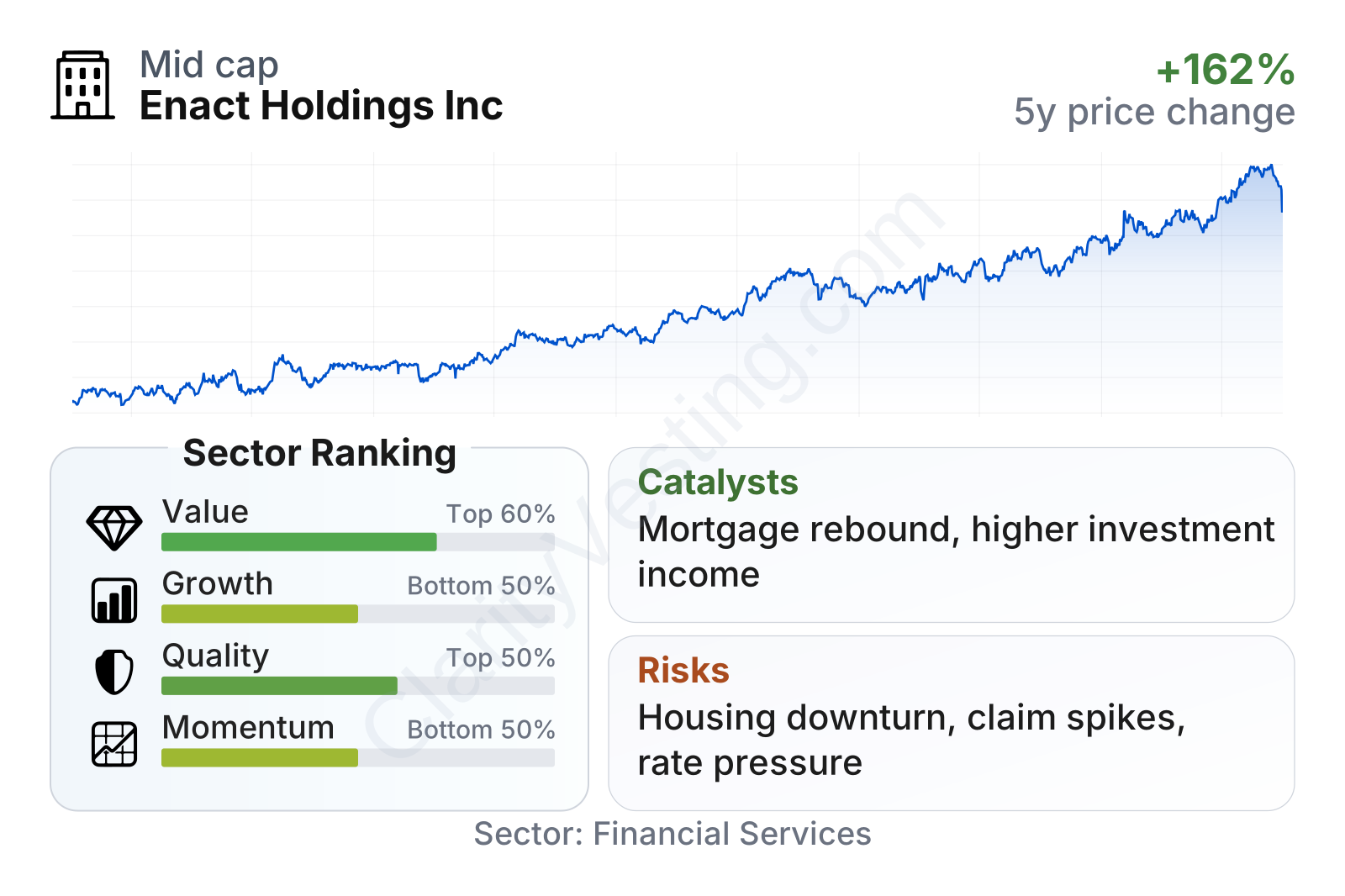
Enact stands out more for profitability and balance-sheet discipline than for fast top-line growth. Relative to much of the financial sector, valuation measures are not stretched, quality indicators are solid, and leverage looks conservative. Growth metrics are more mixed, which fits a mature insurance business rather than a rapidly expanding platform.
The share price has trended upward strongly since late 2021, with gains accelerating over the last 12 to 24 months. Even after that move, earnings and cash generation metrics still suggest the market is not pricing the company like a high-growth financial stock.
Growth
Enact operates in a market that is mature but still structurally relevant. Private mortgage insurance remains an important part of the U.S. housing finance system because many homebuyers, especially first-time buyers, do not make a 20% down payment. Over the long run, that creates a steady need for mortgage credit enhancement. This is not a sector driven by rapid disruption, but it can benefit from housing turnover, household formation, and any improvement in mortgage origination volumes.
The company’s strategy is sensible for this type of business. Management has emphasized disciplined underwriting, risk-sharing through reinsurance, and strong capital returns while maintaining a solid capital base. For a mortgage insurer, that combination is important: growth is less about chasing volume at any cost and more about writing profitable insurance through the cycle.
Earnings per share rose meaningfully from 2021 through 2025, then remained positive in 2026 on a trailing basis. The broader pattern is one of resilient profitability rather than explosive growth. That matters because long-term value in insurance often comes from consistency, not from rapid revenue expansion.
Book value per share has increased steadily over the last several years, which is an important signal for an insurer. It indicates that retained earnings have continued to build shareholder equity even while the company has returned capital. That trend suggests the business has been compounding value internally at a healthy pace.
A practical catalyst for future growth would be a recovery in mortgage activity if interest rates ease or housing affordability improves. Another potential tailwind is the ongoing role of private mortgage insurance as lenders manage capital and credit risk. Enact can also benefit from higher investment income when it reinvests its portfolio at better yields, although that effect can level off over time.
Recent company updates have also highlighted continued use of share repurchases and dividends alongside solid capital levels. That does not create operating growth by itself, but it can support per-share metrics when underwriting results remain stable.
Risks
This article is for informational purposes only and does not constitute financial advice. Some content is AI-generated. See Disclaimer