Stock Analysis · The A2 Milk Company Ltd (ACOPY)
Overview
The A2 Milk Company Ltd sells dairy and infant nutrition products centered on milk that contains only the A2 beta-casein protein. The company’s core idea is product differentiation: it markets its milk, infant formula, and related dairy items as an alternative to conventional cow’s milk products that contain both A1 and A2 proteins. Its business is consumer staples in nature, but with a brand-led premium positioning rather than a commodity dairy model.
The company operates mainly through infant nutrition and liquid milk, with infant formula remaining the economic engine. Based on recent annual reporting, revenue is concentrated in a few categories and markets, especially China and English-speaking developed markets.
- Infant milk formula: approximately 75% to 80% of revenue. This includes products sold in China, Australia and New Zealand, and other export channels, and remains the largest profit driver.
- Liquid milk: approximately 15% to 20% of revenue. This is mainly fresh milk sold under the a2 brand in markets such as Australia, New Zealand, and the United States.
- Other nutrition and dairy products: approximately 5% to 10% of revenue. This includes products such as milk powder, UHT milk, and selected adjacent dairy offerings.
Geographically, China is the most important market because infant formula demand there has historically supported the company’s premium brand. Australia and New Zealand are also major contributors, while the United States is still more of a development market than a mature earnings base.
Operationally, recent years show a favorable pattern: revenue has continued to rise, gross profit has expanded, and operating income has improved faster than sales. That suggests pricing, mix, and scale have been helping margins even as selling costs have also increased.
The business mix remains attractive because a large share of sales comes from premium infant nutrition rather than low-margin bulk dairy, although that concentration also makes category and market execution especially important.
Key Figures
| Metric | Value | Sector ⓘ |
|---|---|---|
| Date | Oct 17, 2026 | |
| Context | ||
| Sector | Consumer Defensive | |
| Industry | Packaged Foods | |
| Market Cap ⓘ | $3.31B | |
| Beta ⓘ | 0.29 | |
Value (Cheapness) | ||
| P/E Ratio ⓘ | 26.76 | 17.88 |
| P/B Ratio ⓘ | 3.11 | 1.29 |
| FCF Yield ⓘ | 7.79% | 12.39% |
| Dividend Yield ⓘ | 2.66% | 2.85% |
| EBIT / EV ⓘ | N/A | 6.43% |
| PEG ⓘ | 1.73 | |
Growth (Business expansion) | ||
| Revenue Growth ⓘ | 6.50% | 4.10% |
| RPS Growth (5Y CAGR) ⓘ | 8.62% | 6.18% |
| EPS Growth (5Y CAGR) ⓘ | N/A | -13.59% |
| BVPS Growth (5Y CAGR) ⓘ | -1.89% | 3.20% |
| Margin Growth (5Y Trend) ⓘ | 2.76% | -0.15% |
| FCF Growth (5Y CAGR) ⓘ | -25.99% | 4.10% |
| DPS Growth (5Y CAGR) ⓘ | N/A | 6.79% |
Quality (Business durability) | ||
| ROIC (Latest) ⓘ | N/A | 12.34% |
| ROA (Latest) ⓘ | 22.02% | 6.30% |
| ROIC (5Y Median) ⓘ | 12.04% | 10.49% |
| ROA (5Y Median) ⓘ | 9.35% | 5.44% |
| Net Debt / EBIT (Latest) ⓘ | -1.13 | 1.96 |
| Net Debt / EBIT (5Y Median) ⓘ | -2.16 | 2.35 |
| Net Debt / EBITDA (Latest) ⓘ | -1.03 | 1.38 |
| Net Debt / Assets ⓘ | -33.66% | 21.51% |
| EBITDA / Interest ⓘ | N/A | 9.46 |
| Operating Margin (Latest) ⓘ | 14.90% | 8.87% |
| Operating Margin (5Y Median) ⓘ | 12.65% | 9.53% |
| Debt to Equity (Latest) ⓘ | 2.27% | 72.35% |
| Profit Margin (Latest) ⓘ | 5.76% | 5.40% |
| Free Cash Flow (Latest) ⓘ | $258.10M | |
Momentum (Price trend) | ||
| 3Y Return ⓘ | +85.68% | +20.92% |
| 12M Return (excl. last month) ⓘ | -15.00% | +2.13% |
| 6M Return ⓘ | -16.64% | +1.26% |
| Price vs. 200-Day MA ⓘ | -10.04% | +1.39% |
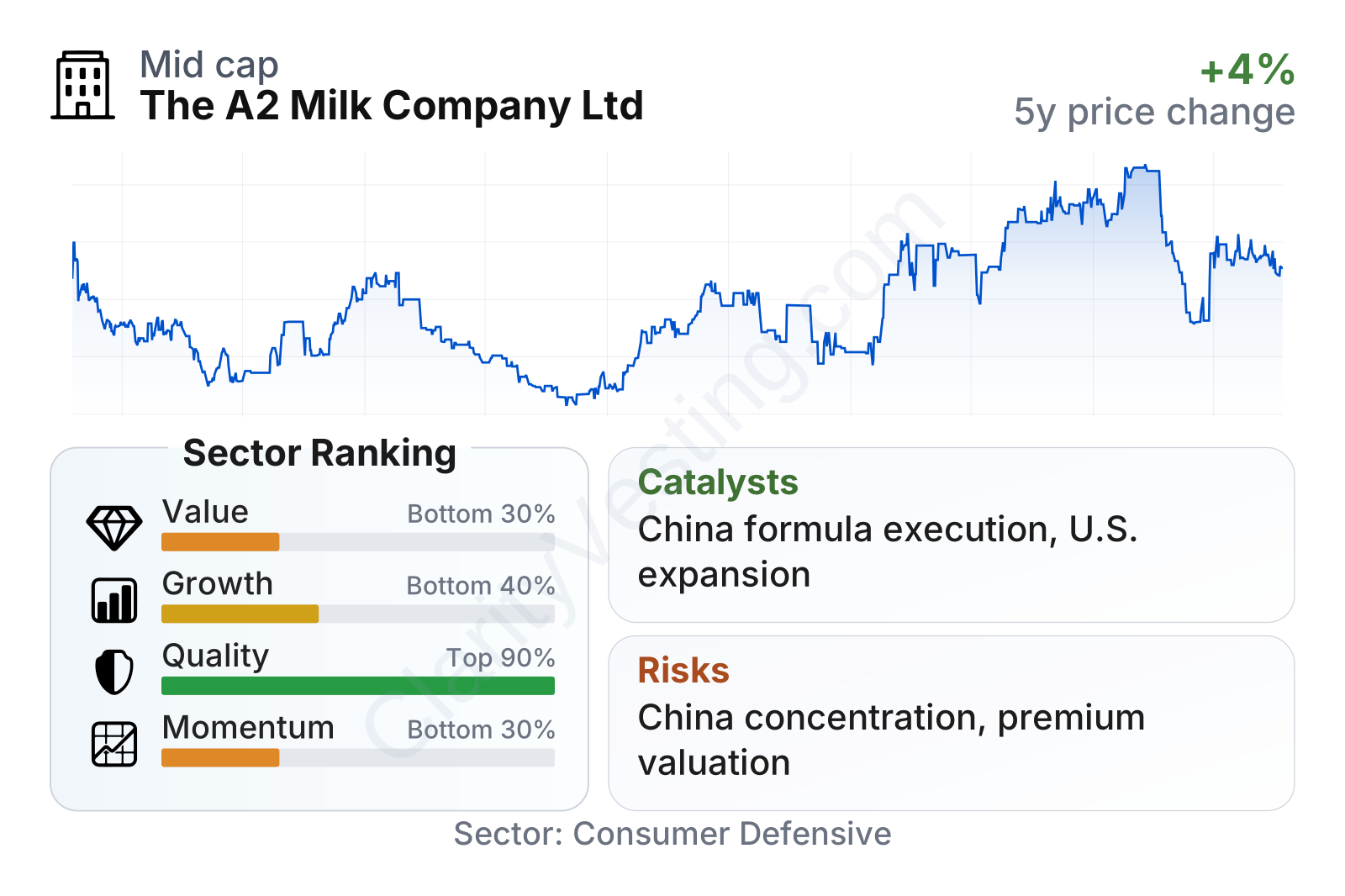
The company stands out more for business quality than for conventional cheapness. Profitability is strong for a packaged foods company, with operating margin around the mid-teens versus a sector median closer to the high single digits, and returns on assets are well above typical peers. The balance sheet is unusually conservative, with very low debt-to-equity and net cash rather than net debt.
Growth is more mixed. Recent revenue growth is ahead of the sector median, and the longer-term revenue-per-share trend is solid, but free cash flow has been less consistent over five years and book value per share has edged down over that span. Market behavior has also cooled recently: despite a strong three-year share price gain, the shorter-term trend has weakened, with the stock below its 200-day average and negative over the last six to twelve months.
On valuation, the shares trade at higher earnings and book multiples than the sector median while offering a lower free-cash-flow yield than many peers. That points to a market that is assigning a premium to the brand, margins, and balance sheet strength.
Growth
The company operates in parts of the food and nutrition market that can still grow faster than standard packaged foods. Premium infant nutrition, specialized dairy, and products linked to digestive tolerance or perceived wellness tend to benefit from brand trust, repeat purchasing, and pricing power. Even in mature grocery markets, differentiated milk and premium formula can gain share if the consumer proposition remains clear.
A2 Milk’s strategy is logical for long-term expansion because it is not trying to compete purely on volume or lowest price. Instead, it is building around a branded nutritional niche where product identity matters. That is especially relevant in infant formula, where trust, quality control, and regulatory compliance can create barriers to entry. The company has also been working to strengthen its direct presence in China after earlier channel disruptions in that market, while maintaining its positions in Australia and New Zealand and continuing to build the U.S. business.
A notable positive is that revenue and operating income have both moved higher in recent annual results. Sales rose from roughly NZ$1.44 billion in fiscal 2022 to about NZ$1.97 billion in fiscal 2026, while operating income climbed from about NZ$177 million to nearly NZ$297 million over the same period. Gross profit has also steadily increased. This combination suggests that growth has not come at the expense of profitability.
Recent company updates have also highlighted ongoing progress in China label registration and channel development, both of which matter because access and shelf presence in Chinese infant formula are major commercial levers. In addition, the company has been broadening its product lineup, including innovation around toddler and adult nutrition, which could gradually reduce reliance on a single life-stage category.
The U.S. remains a longer-duration opportunity rather than a near-term earnings catalyst. If the brand gains broader retail traction there, it could become meaningful because the milk market is large, but execution risk is still high and consumer education remains necessary.
Risks
This article is for informational purposes only and does not constitute financial advice. Some content is AI-generated. See Disclaimer


